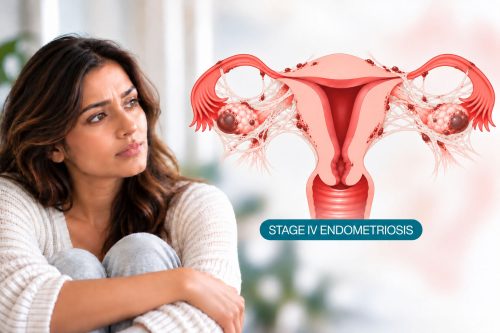


For patients with endometriosis who hope to become pregnant in the future, surgery involves an important balance: treating the disease while preserving healthy reproductive anatomy whenever possible.
One consideration is the formation of postoperative adhesions. These are bands of scar-like tissue that can develop as tissues heal after surgery. In the pelvis, adhesions may cause normally separate structures, such as the ovaries, fallopian tubes, uterus, bowel, or pelvic sidewall, to become attached to one another.
When fertility is a priority, reducing adhesions around the ovaries and fallopian tubes may be particularly important.
Why Can Adhesions Matter for Fertility?
Normal pelvic anatomy plays an important role in natural conception.
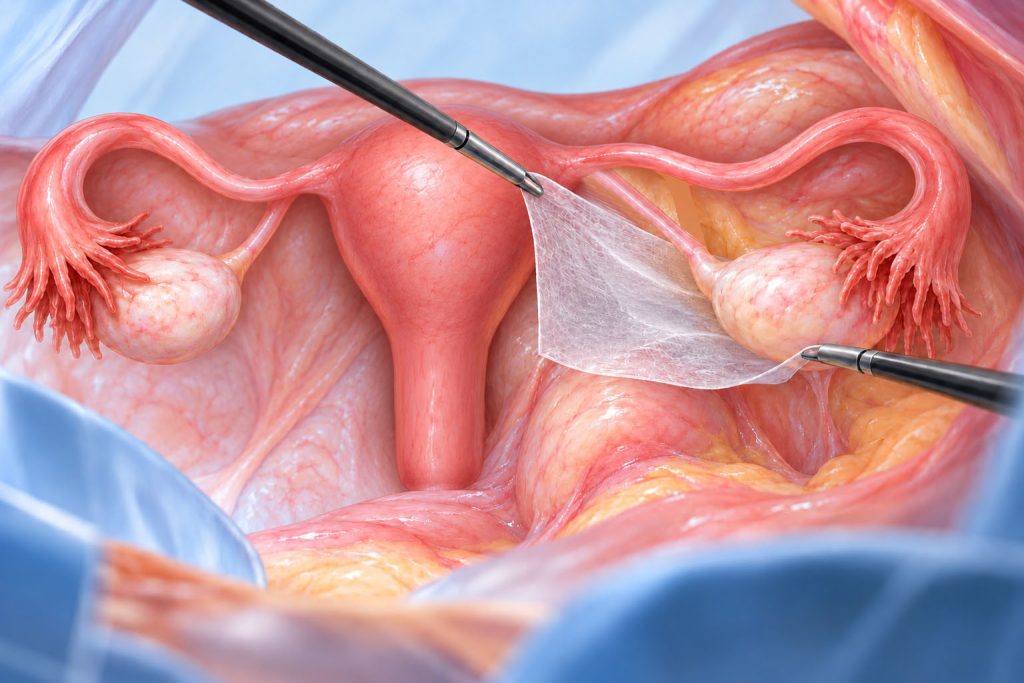
After an egg is released from an ovary, the nearby fallopian tube must be able to pick it up. Significant adhesions can distort this relationship by pulling, tethering, or fixing the ovary and fallopian tube in abnormal positions.
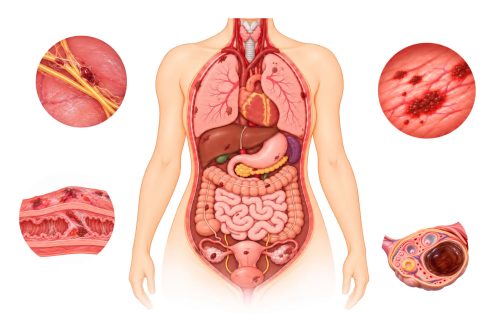
Endometriosis itself can cause inflammation, fibrosis, and adhesions. In more advanced cases, the ovaries, uterus, bowel, and other structures may already be attached to one another before surgery.
Surgery can separate these adhesions and restore anatomy when possible. However, surgery also creates healing surfaces, which means new adhesions can potentially develop afterward.
What Is an Adhesion Barrier?
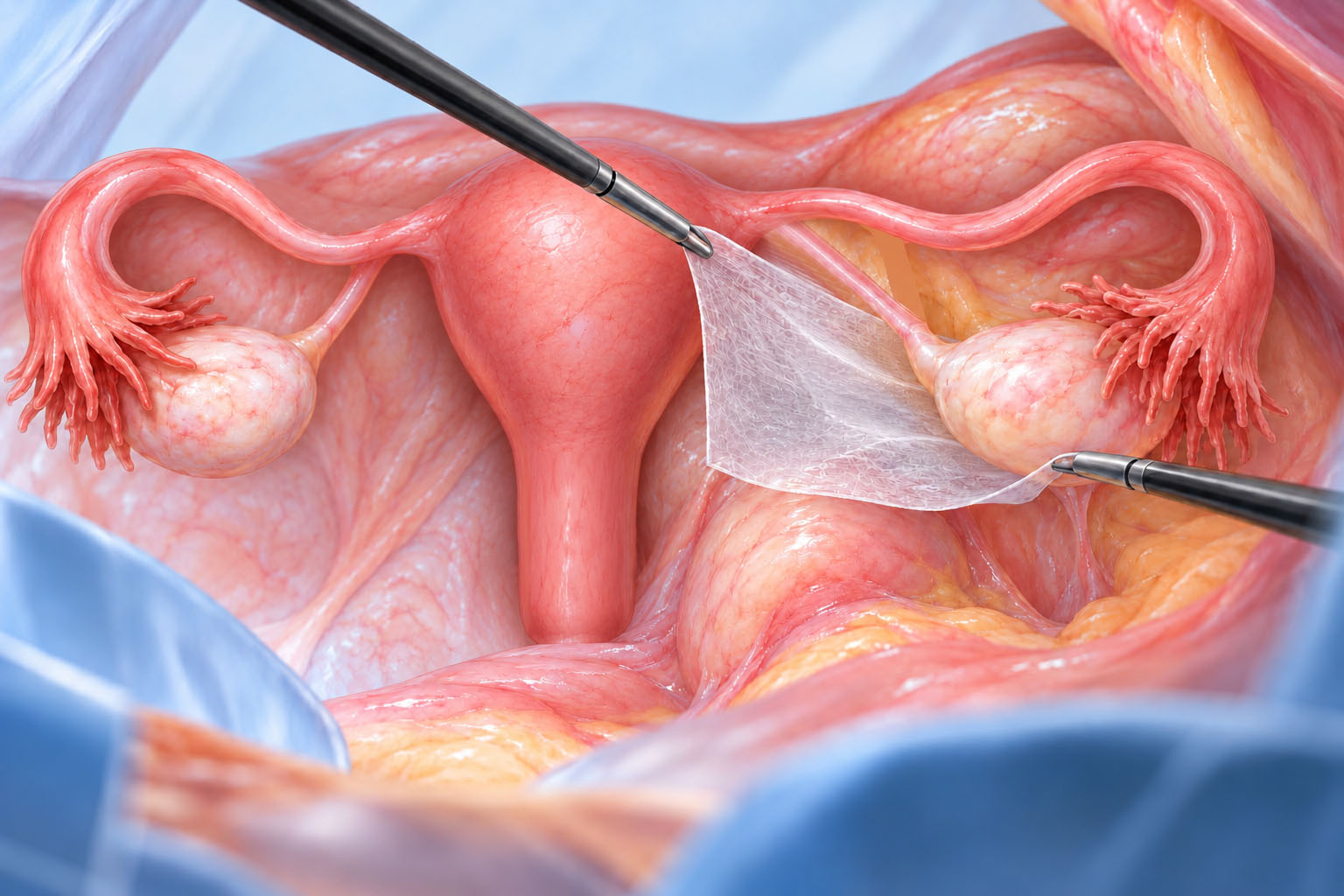
An adhesion barrier is a material used during surgery to temporarily separate selected tissue surfaces while they heal.
The principle is straightforward: keeping two injured surfaces apart during the early healing period may reduce the likelihood that they will form an adhesion between them.
Several types of adhesion-reduction products may be used in gynecologic surgery.
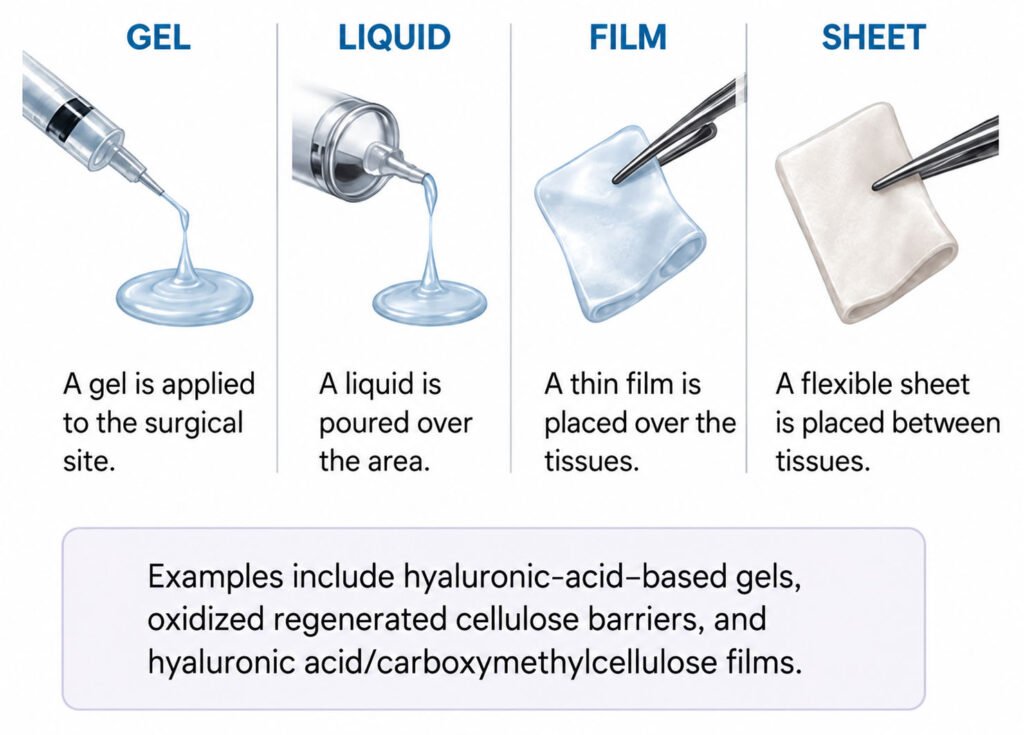
Films or Membranes
Thin sheets can be positioned between healing tissue surfaces. Some are designed to gradually be absorbed by the body.
Gels
Certain gels can be applied to surgical areas to create a temporary physical layer between tissues.
Fluid-Based Barriers
Fluid-based products have also been used in pelvic surgery with the goal of reducing contact between healing surfaces.
Which product is appropriate, if any, depends on the operation, surgical findings, product indications, and the surgeon’s judgment.
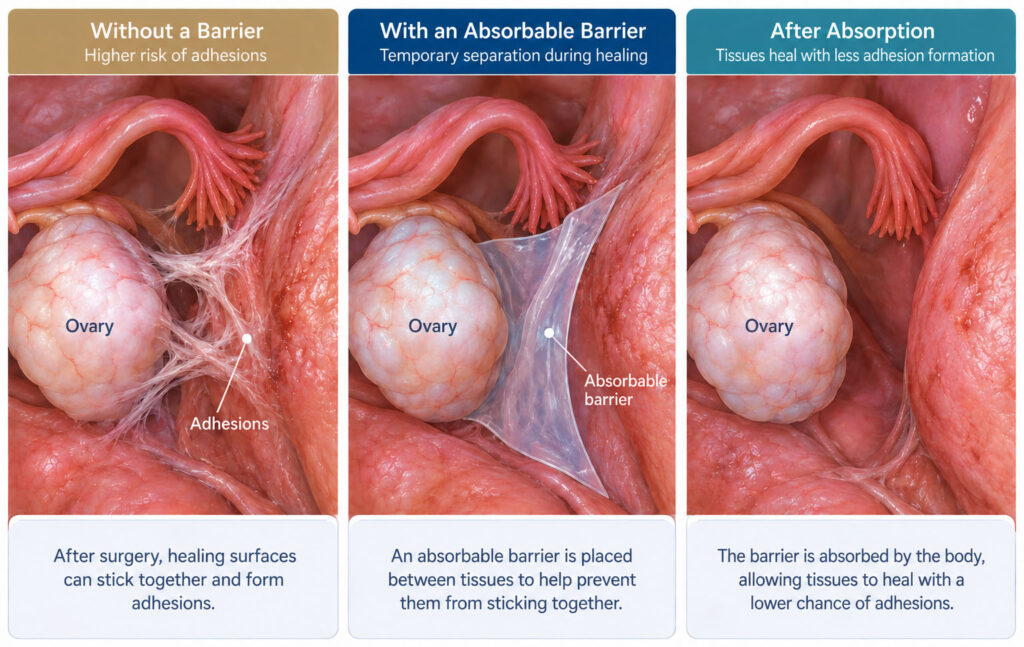
Where Are Adhesion Barriers Placed?
Adhesion barriers are generally intended to separate injured surfaces from other tissues, rather than simply coating every pelvic organ.
For example, if an ovary has been surgically separated from nearby tissue, a barrier may sometimes be placed between the healing surfaces to reduce direct contact during recovery.
Placement therefore varies according to the patient’s anatomy and the areas treated during surgery. Adhesion barriers are not necessarily designed as one large covering for the uterus, ovaries, and fallopian tubes.
Can Adhesion Barriers Help Preserve Fertility?
Research suggests that adhesion barriers can reduce postoperative adhesion formation after endometriosis surgery. In one randomized controlled trial involving 32 women undergoing laparoscopic surgery for severe endometriosis, 75% of women treated with an oxidized regenerated cellulose adhesion barrier were adhesion-free at second-look laparoscopy, compared with 12.5% of women who underwent surgery without the barrier (Mais et al., 1995).
However, fewer adhesions do not necessarily translate into higher pregnancy or live-birth rates. A Cochrane review of 19 randomized controlled trials involving 1,316 women found some evidence that certain barriers may reduce adhesion formation after gynecologic surgery, but none of the included studies reported live-birth outcomes, and evidence regarding clinical pregnancy was very limited (Ahmad et al., 2020).
For this reason, an adhesion barrier should not be viewed as a guarantee of fertility preservation. Instead, reducing postoperative adhesions may be one part of a broader fertility-conscious approach to endometriosis surgery, particularly when an operation involves the ovaries, fallopian tubes, or surrounding pelvic tissues.
Fertility-Conscious Surgery Involves More Than a Barrier
An adhesion barrier is only one potential tool.
Careful surgical technique remains central to reducing tissue injury and preserving reproductive anatomy. Depending on the operation, this may include gentle tissue handling, careful control of bleeding, minimizing unnecessary tissue trauma, and thoughtful use of surgical energy.
This can be particularly important when treating ovarian endometriomas. Surgery involving the ovary requires careful consideration because healthy ovarian tissue and ovarian reserve may be important for future fertility.
For this reason, adhesion prevention should be considered as part of the overall surgical strategy rather than as a separate solution.
Questions to Ask Before Endometriosis Surgery
If you are considering surgery and hope to become pregnant in the future, you may want to ask your endometriosis specialist:
- Will the surgery involve my ovaries or fallopian tubes?
- Do I already have adhesions affecting my reproductive organs?
- How will healthy ovarian tissue be preserved?
- What techniques do you use to reduce postoperative adhesions?
- Would an adhesion barrier be appropriate in my case?
- Should my ovarian reserve be evaluated before surgery?
- Should I consult a fertility specialist before treatment?
These discussions may be particularly important for patients with ovarian endometriomas, extensive adhesions, previous ovarian surgery, or fertility difficulties.
Fertility-Focused Endometriosis Specialist
At New York Gynecology Surgery & Endometriosis (NYGSE), endometriosis treatment is individualized according to each patient’s symptoms, anatomy, extent of disease, previous treatment, and reproductive goals.
When future fertility is important, surgical planning may include preserving healthy ovarian tissue, restoring pelvic anatomy when possible, minimizing unnecessary tissue trauma, and considering strategies to reduce postoperative adhesions.
Adhesion barriers may have a role in selected cases, but they are only one part of this approach. Discussing your future fertility goals with your endometriosis specialist before surgery can help ensure that these goals are considered when developing your treatment plan.
References
Ahmad, G., Kim, K., Thompson, M., Agarwal, P., O’Flynn, H., Hindocha, A., & Watson, A. (2020). Barrier agents for adhesion prevention after gynaecological surgery. Cochrane Database of Systematic Reviews, 2020(3), CD000475. https://doi.org/10.1002/14651858.CD000475.pub4
American Society for Reproductive Medicine. (2019). Postoperative adhesions in gynecologic surgery: A committee opinion. Fertility and Sterility, 112(3), 458–463. https://pubmed.ncbi.nlm.nih.gov/31446904/
Keckstein, J., Becker, C. M., Canis, M., Feki, A., Grimbizis, G. F., Hummelshoj, L., Nisolle, M., Roman, H., Saridogan, E., Tanos, V., Tomassetti, C., Ulrich, U. A., Vermeulen, N., & De Wilde, R. L. (2020). Recommendations for the surgical treatment of endometriosis. Part 2: Deep endometriosis. Human Reproduction Open, 2020(1), hoaa002. https://doi.org/10.1093/hropen/hoaa002
Mais, V., Ajossa, S., Marongiu, D., Peiretti, R. F., Guerriero, S., & Melis, G. B. (1995). Reduction of adhesion reformation after laparoscopic endometriosis surgery: A randomized trial with an oxidized regenerated cellulose absorbable barrier. Obstetrics & Gynecology, 86(4), 512–515. https://doi.org/10.1016/0029-7844(95)00241-I