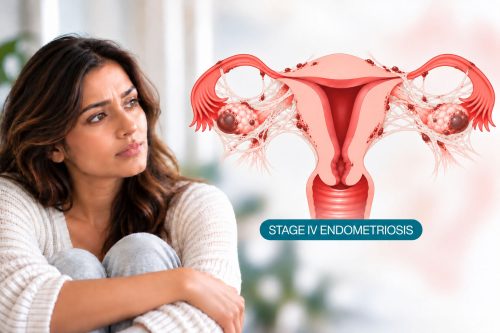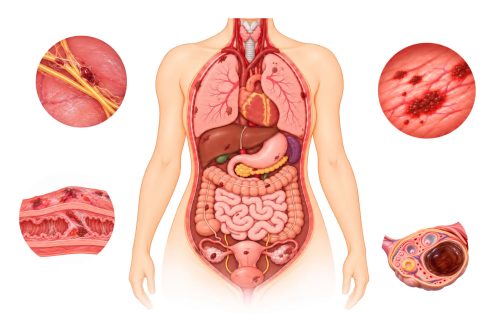


Finding out that you have an ovarian endometrioma, sometimes called a “chocolate cyst”, can raise several questions at once.
“Do I need surgery? Could the cyst affect my ovary? Could surgery affect my fertility? What if I want children, but not for another few years? Should I see an endometriosis specialist or a fertility specialist first?”
These questions are especially important for women in their 20s and 30s who are not currently trying to become pregnant but want to protect their fertility for the future.
There is no single answer that is right for every patient. The size and appearance of the endometrioma matter, but so do your symptoms, whether one or both ovaries are involved, your ovarian reserve, previous surgery, and your future pregnancy plans.
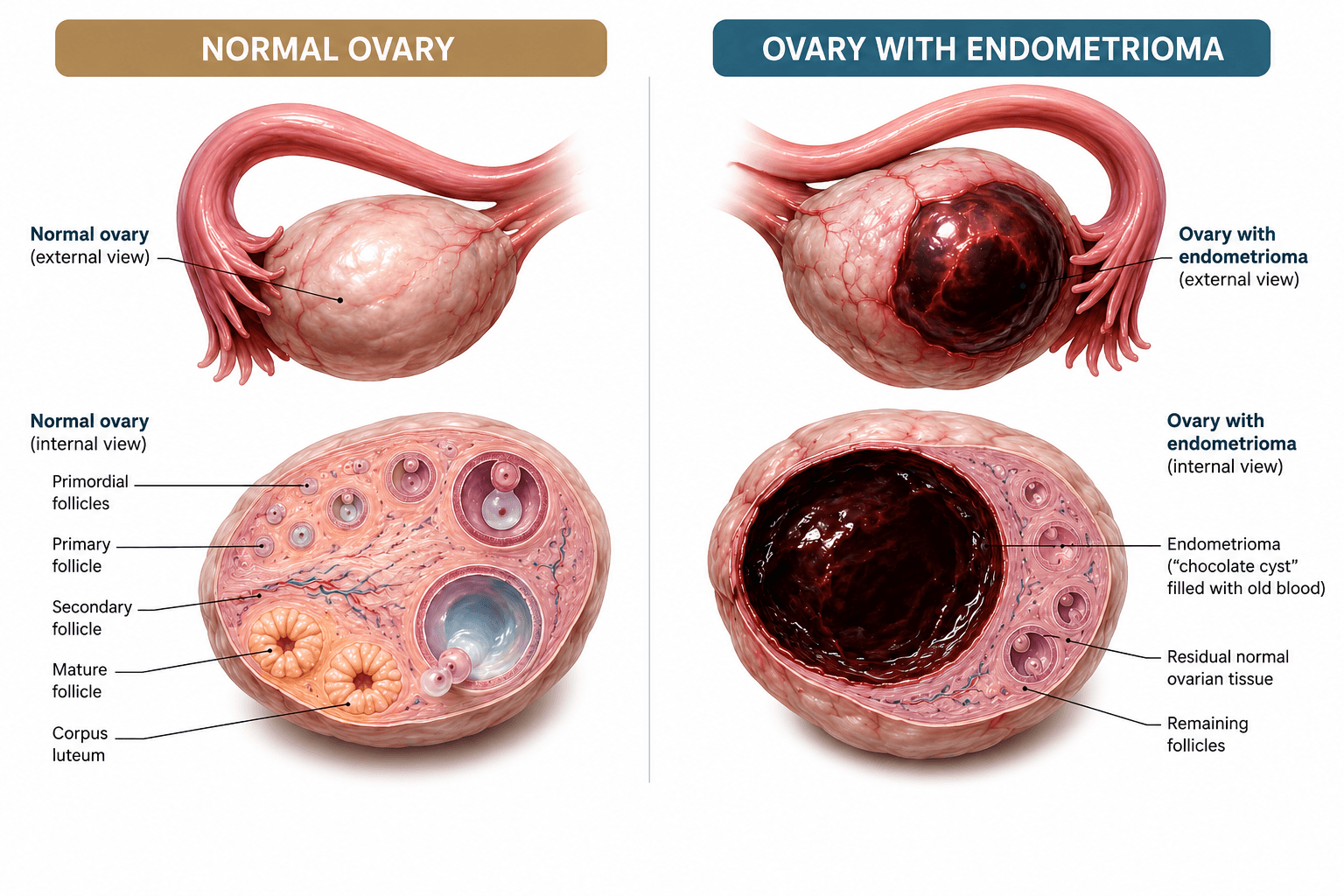
A simple ovarian cyst typically contains clear fluid, while an endometrioma is associated with endometriosis and contains thick, dark fluid.
What Is an Ovarian Endometrioma?
An ovarian endometrioma is a cyst that develops when endometriosis involves the ovary. It contains old blood, which is why these cysts are sometimes called “chocolate cysts”.
An endometrioma seen on imaging can provide important evidence of ovarian endometriosis. It may also prompt further evaluation for endometriosis elsewhere in the pelvis.
However, the presence or size of an endometrioma does not tell us everything about a patient’s disease.
Does a 5 or 6 cm Endometrioma Mean Stage III or IV Endometriosis?
Not necessarily.
Endometriosis has traditionally been classified from Stage I (minimal) through Stage IV (severe). Ovarian endometriomas can contribute to a higher surgical stage, particularly when they occur alongside adhesions or endometriosis elsewhere in the pelvis.
But the stage of endometriosis cannot be determined from the size of an ovarian cyst alone.
There is another important point: the stage of endometriosis does not necessarily correspond with the severity of a patient’s pain or predict her fertility.
Does an Endometrioma Need Surgery?
Not every ovarian endometrioma automatically requires surgery.
When deciding whether surgery is appropriate, an endometriosis specialist may consider the size and appearance of the cyst, whether it is growing, the patient’s symptoms, whether one or both ovaries are involved, previous ovarian surgery, fertility plans, ovarian reserve, and findings suggesting endometriosis elsewhere.
An ovarian mass can also be relevant to the risk of ovarian torsion, which occurs when an ovary twists around the tissues supporting it and compromises its blood supply.
Sudden, severe pelvic pain, particularly with nausea or vomiting, requires urgent medical evaluation.
For planned treatment, however, the question is not simply whether an endometrioma has reached a particular size. The potential benefits of surgery need to be weighed against the potential effects on the ovary.
Endometrioma Surgery and Ovarian Reserve
For women who hope to become pregnant in the future, this is an especially important part of the conversation.
Endometriosis and ovarian endometriomas themselves may affect reproductive health. At the same time, surgery on an ovary can affect ovarian reserve.
Removing an endometrioma requires separating the cyst from ovarian tissue. During that process, some healthy ovarian tissue or follicles can potentially be lost or damaged.
This does not mean surgery should be avoided when it is indicated. It means that preserving healthy ovarian tissue should be an important consideration when planning the procedure, particularly in a young patient who has not completed her family.
Why the Choice of Surgeon Matters
If surgery is recommended, the goal should extend beyond simply removing the cyst.
For a patient concerned about future fertility, surgical planning should consider how to appropriately treat the endometriosis while preserving as much healthy ovarian tissue as reasonably possible.
An experienced endometriosis surgeon can also evaluate whether imaging or symptoms suggest disease beyond the ovary and discuss how those findings could affect the surgical plan.
Before elective surgery, it is reasonable to understand why surgery is being recommended, what will happen to the ovary during the procedure, and how ovarian tissue will be preserved whenever possible.
Should You See a Fertility Specialist Before Surgery?
For some patients, a fertility consultation before ovarian surgery can be valuable, even when pregnancy is several years away.
That does not automatically mean you need IVF or should freeze your eggs.
A reproductive endocrinologist can assess factors related to ovarian reserve and discuss your reproductive goals. If fertility preservation is worth considering, options such as egg freezing can be discussed before an operation that could potentially affect ovarian tissue.
Whether fertility preservation makes sense depends on the individual. Age, ovarian reserve, whether one or both ovaries are affected, previous ovarian surgery, the urgency of treatment, desired family size, and other fertility factors can all influence the decision.
Endometriosis Specialist or Fertility Specialist: Which Should You See First?
It does not necessarily need to be one or the other.
For a young woman with a sizable ovarian endometrioma who hopes to have children in the future, coordinating the two perspectives before elective surgery can be particularly useful.
An endometriosis specialist can help answer:
Does the endometrioma need to be removed now? Is there evidence of endometriosis elsewhere? How can surgery be planned to preserve healthy ovarian tissue?
A fertility specialist can address:
What does my ovarian reserve look like? Should I consider fertility preservation before ovarian surgery?
If there is time to obtain both opinions, having these conversations before surgery can help patients make a more informed decision.
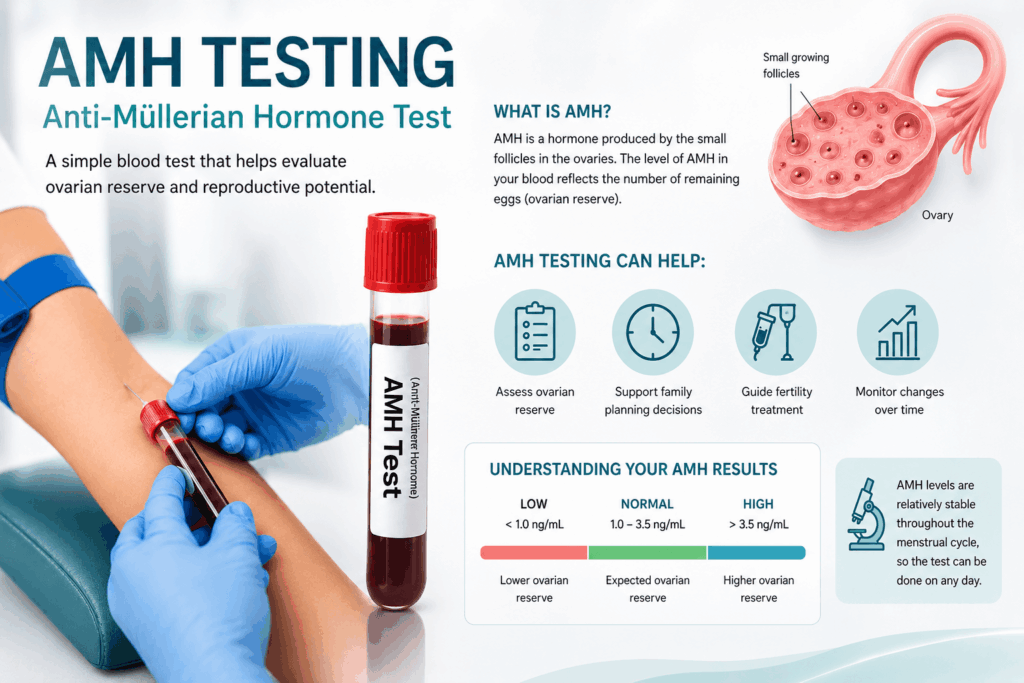
What About AMH Testing?
Patients researching endometriomas often encounter AMH, or anti-Müllerian hormone, as a measure of ovarian reserve.
AMH testing can provide useful information about the remaining pool of ovarian follicles and may be considered as part of fertility counseling before ovarian surgery.
But AMH has important limitations.
A low or high AMH level does not tell you whether you can or cannot become pregnant naturally. It is one piece of information that needs to be interpreted alongside age, antral follicle count, ovarian anatomy, whether one or both ovaries are involved, and other reproductive factors.
Questions to Ask Before Endometrioma Surgery
If surgery has been recommended, consider asking your doctor:
- Why are you recommending surgery now rather than monitoring the endometrioma?
- What does my imaging show besides the ovarian cyst?
- Is one ovary affected or are both involved?
- How will you preserve as much healthy ovarian tissue as possible?
- What is the possibility that part or all of the ovary could need to be removed?
- Should my ovarian reserve be evaluated before surgery?
- Should I speak with a fertility specialist before the procedure?
- Is fertility preservation worth considering in my situation?
- If endometriosis is found elsewhere during surgery, how will it be treated?
- What are the risks and benefits of waiting rather than having surgery now?
You do not necessarily need the same answer as another patient with an endometrioma. These questions help make the decision specific to your ovaries, symptoms, disease, and future plans.
Planning for Today Without Losing Sight of the Future
Being diagnosed with an ovarian endometrioma in your 20s does not mean you suddenly need to decide when to have children. It does mean that if ovarian surgery is being considered, future fertility deserves to be part of the conversation now.
At New York Gynecology Surgery & Endometriosis (NYGSE), evaluation of ovarian endometriosis considers the endometrioma itself as well as symptoms, surrounding disease, healthy ovarian tissue, previous treatment, and a patient’s reproductive goals.
The goal is not simply to decide whether a cyst should be removed. It is to develop an individualized plan that appropriately treats the endometriosis while giving careful consideration to ovarian health and future fertility.
References
Becker, C. M., Bokor, A., Heikinheimo, O., Horne, A., Jansen, F., Kiesel, L., King, K., Kvaskoff, M., Nap, A., Petersen, K., Saridogan, E., Tomassetti, C., van Hanegem, N., Vulliemoz, N., & Vermeulen, N. (2022).
ESHRE guideline: Endometriosis. Human Reproduction Open, 2022(2), hoac009. https://doi.org/10.1093/hropen/hoac009
Practice Committee of the American Society for Reproductive Medicine. (2012). Endometriosis and infertility: A committee opinion. Fertility and Sterility, 98(3), 591-598. https://doi.org/10.1016/j.fertnstert.2012.05.031
Practice Committee of the American Society for Reproductive Medicine. (2021). Fertility evaluation of infertile women: A committee opinion. Fertility and Sterility, 116(5), 1255-1265. https://doi.org/10.1016/j.fertnstert.2021.08.038
Raffi, F., Metwally, M., & Amer, S. (2012). The impact of excision of ovarian endometrioma on ovarian reserve: A systematic review and meta-analysis. The Journal of Clinical Endocrinology & Metabolism, 97(9), 3146-3154. https://doi.org/10.1210/jc.2012-1558
World Health Organization. (2025, October 15). Endometriosis. https://www.who.int/news-room/fact-sheets/detail/endometriosis