Endometriosis does not look the same in every patient. Some women experience severe period pain, while others have chronic pelvic pain, pain during sex, fertility problems, or bowel and urinary symptoms.
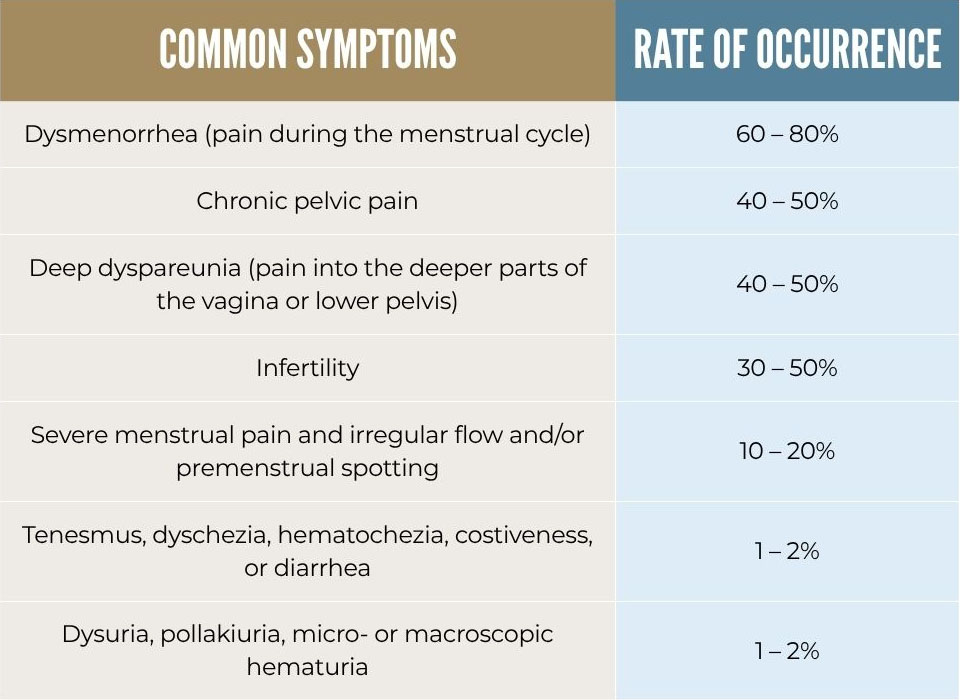
Even among women with endometriosis, some symptoms are reported much more frequently than others. Understanding these differences can help put symptoms into context, but percentages alone cannot determine whether someone has endometriosis.
Source: Bulletti et al. (2010).
Painful Periods: 60–80%
Dysmenorrhea, the medical term for painful menstruation, is among the most frequently reported symptoms of endometriosis, occurring in an estimated 60–80% of patients.
Menstrual cramps are common even without endometriosis. What deserves closer attention is pain that is severe, progressively worsens, does not respond adequately to usual measures, or repeatedly interferes with school, work, sleep, exercise, or everyday activities.
Pain may also begin before menstrual bleeding starts and continue during the period.
Chronic Pelvic Pain: 40–50%
An estimated 40–50% of patients experience chronic pelvic pain.
Unlike menstrual pain, chronic pelvic pain can occur at other times during the cycle. It may be persistent or intermittent and can vary considerably in location and intensity.
Pelvic pain can have many possible causes, so experiencing it does not necessarily mean you have endometriosis. The timing and pattern of the pain, along with other symptoms, can provide important clues.
Deep Pain During Sex: 40–50%
Deep dyspareunia, or pain felt deeper in the pelvis during sexual intercourse, is reported in approximately 40–50% of patients with endometriosis.
This is different from discomfort at the vaginal opening. Patients may describe deep pain during penetration or pelvic pain that continues afterward.
Endometriosis is only one possible cause of painful sex, but persistent or recurring deep pelvic pain during intercourse deserves medical evaluation.
Infertility: 30–50%
Infertility is reported in approximately 30–50% of women with endometriosis.
For some patients, difficulty becoming pregnant may actually be the reason endometriosis is first investigated, particularly when pain symptoms have been mild or absent.
Endometriosis can affect fertility in several ways, but having the condition does not mean pregnancy is impossible. Fertility outcomes vary considerably depending on age, disease characteristics, ovarian reserve, other fertility factors, and the individual patient.
Severe Menstrual Pain and irregular flow and/or premenstrual spotting: 10–20%
Approximately 10–20% of patients may experience severe menstrual pain accompanied by irregular menstrual flow and/or premenstrual spotting.
Abnormal bleeding can have many causes other than endometriosis. Changes in menstrual bleeding therefore need to be considered alongside pain, other symptoms, medical history, and appropriate evaluation.
Bowel Symptoms: 1–2%
The data reports tenesmus, dyschezia, hematochezia, constipation, or diarrhea in approximately 1–2% of patients.
In everyday language, these can include:
Tenesmus: a persistent feeling that you still need to have a bowel movement
Dyschezia: painful or difficult bowel movements
Hematochezia: visible blood passed from the rectum
Constipation or diarrhea
The timing of bowel symptoms may be clinically useful, particularly when they recur or worsen around menstruation.
Rectal bleeding should always be medically evaluated because endometriosis is only one of many possible causes.
Urinary Symptoms: 1–2%
Urinary manifestations listed in the data are also estimated at 1–2% and include dysuria, pollakiuria, and microscopic or macroscopic hematuria.
In simpler terms, these refer to painful urination, frequent urination, and blood in the urine that may be visible or detectable only through testing.
As with bowel symptoms, urinary complaints have many possible causes. Blood in the urine in particular should always be evaluated rather than assumed to be related to endometriosis.
Symptoms Do Not Tell Us the Whole Story
These percentages show how frequently certain symptoms are reported, but they should not be used as a diagnostic checklist.
A woman does not need to have painful periods, pelvic pain, infertility, and painful sex simultaneously to have endometriosis. Likewise, having one or more of these symptoms does not necessarily mean endometriosis is the cause.
Importantly, endometriosis can exist without noticeable symptoms. This is sometimes referred to as silent or asymptomatic endometriosis and may be discovered unexpectedly during an examination, imaging study, or surgery.
The number or severity of symptoms also does not necessarily reflect how extensive the disease may be.
When Should Symptoms Be Evaluated?
Consider talking with an endometriosis specialist when menstrual or pelvic pain repeatedly interferes with everyday life, pain during sex persists, bowel or urinary symptoms recur, or you are having difficulty becoming pregnant.
At New York Gynecology Surgery & Endometriosis (NYGSE), we look beyond any single symptom or percentage. Understanding the complete pattern of your symptoms, along with your medical history, examination, and imaging, can help determine whether endometriosis is likely. When surgery is appropriate, suspected endometriosis can be directly evaluated and tissue can be examined to confirm the diagnosis.
Allaire, C., Bedaiwy, M. A., & Yong, P. J. (2023). Diagnosis and management of endometriosis. CMAJ, 195(10), E363–E371. https://doi.org/10.1503/cmaj.220637
Bulletti, C., Coccia, M. E., Battistoni, S., & Borini, A. (2010). Endometriosis and infertility. Journal of Assisted Reproduction and Genetics, 27(8), 441–447. https://doi.org/10.1007/s10815-010-9436-1