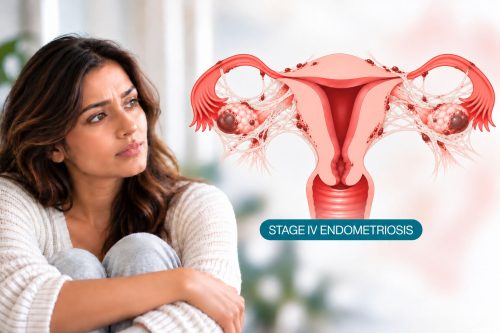


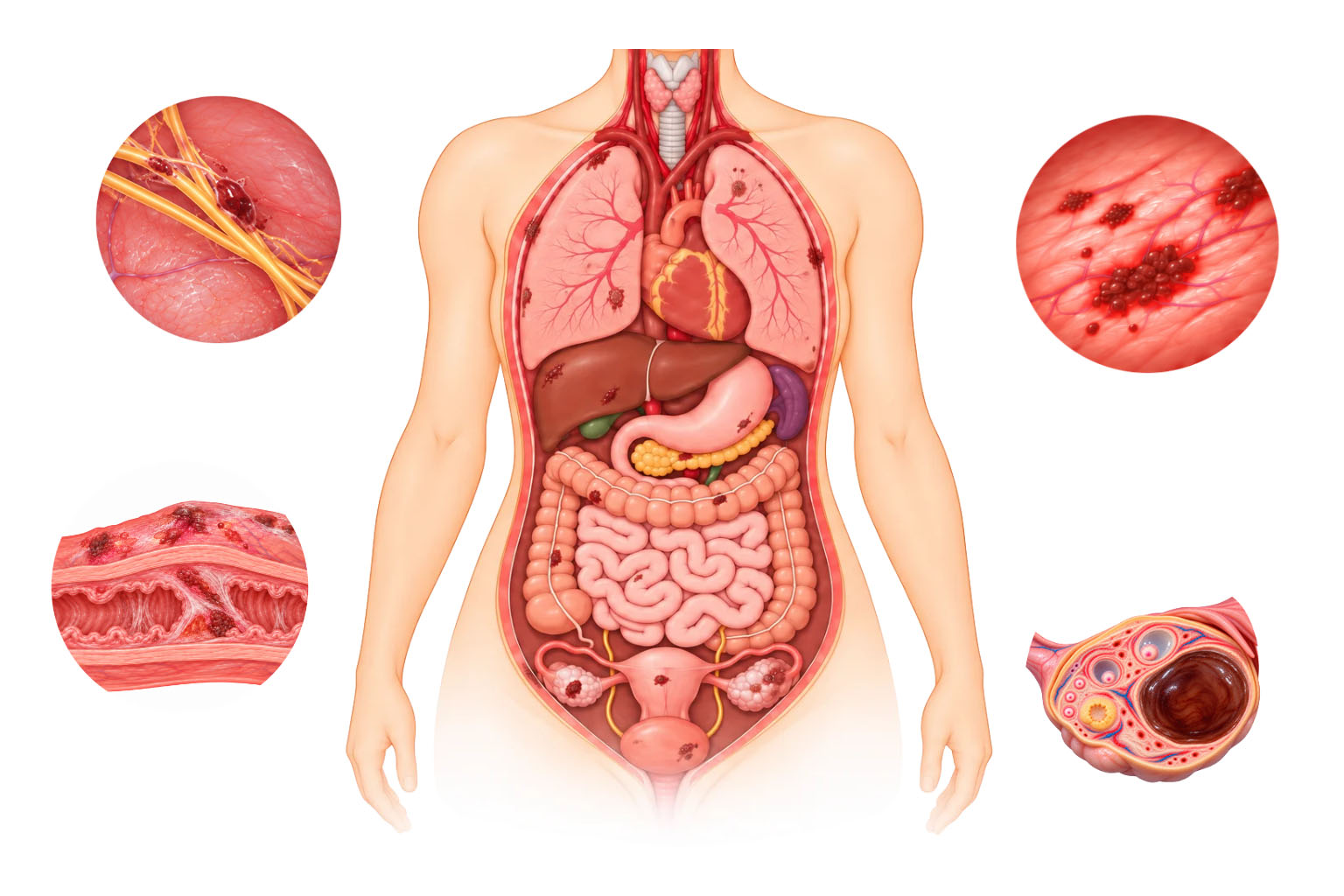
Endometriosis is often associated with the uterus, ovaries, and fallopian tubes. However, the disease is not limited to the reproductive organs.
Endometriosis occurs when tissue similar to the uterine lining grows outside the uterus. Although most lesions develop within the pelvis, they can also affect the bowel, bladder, ureters, and surrounding nerves. In rare cases, endometriosis may involve structures outside the pelvic cavity, including the diaphragm and chest.
The location and depth of these lesions can influence symptoms, interfere with normal organ function, and affect treatment decisions. [1]
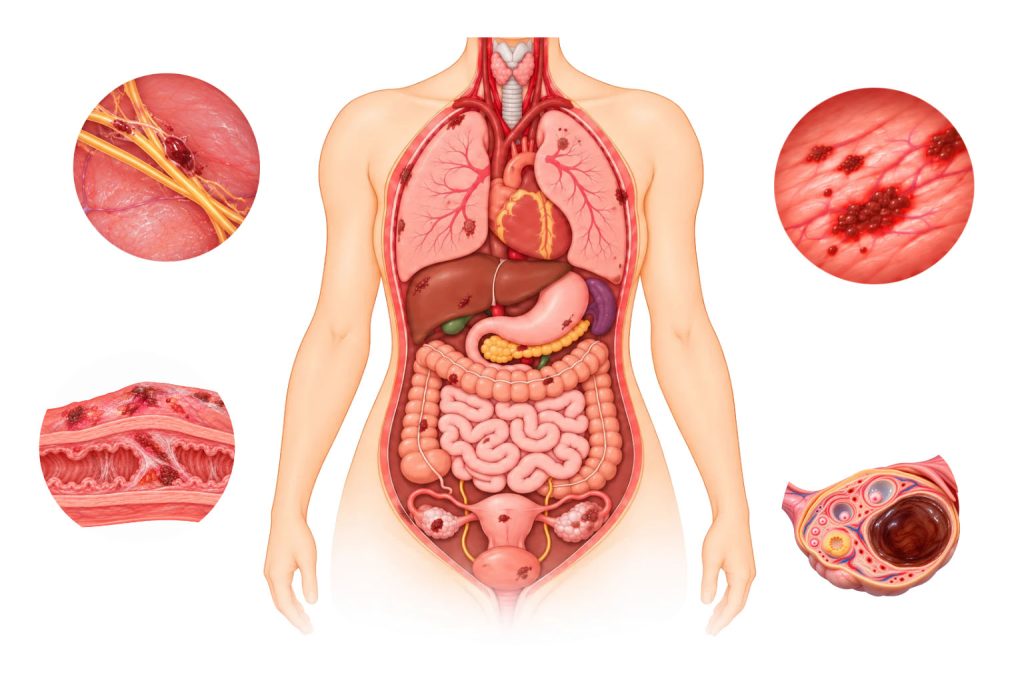
A medical illustration showing endometriosis lesions affecting multiple organs and tissues beyond the reproductive system, including the bowel and chest.
Endometriosis Can Affect More Than the Reproductive Organs
The reproductive organs are closely surrounded by other structures within the pelvis. The bladder lies in front of the uterus, while the rectum is located behind it. The ureters travel through the pelvis to carry urine from the kidneys to the bladder.
Endometriosis may develop on the surfaces of these structures or infiltrate deeper into surrounding tissues.
Deep endometriosis can cause inflammation, fibrosis, and adhesions that distort normal anatomy. However, organ involvement does not necessarily mean that the disease is progressively spreading throughout the body. [1][2]
Which Organs Can Endometriosis Affect?
Endometriosis most commonly affects pelvic structures, although lesions have also been documented in locations outside the pelvis.
Bowel and Rectal Endometriosis
Bowel endometriosis frequently involves the rectum and sigmoid colon.
Lesions may develop on the bowel surface or extend into its muscular wall. Over time, associated inflammation and fibrosis can contribute to tissue thickening and narrowing.
Patients may experience painful bowel movements, constipation, diarrhea, or cyclical rectal bleeding. Severe bowel obstruction is uncommon but can occur in advanced cases. [3]
Bladder and Ureteral Endometriosis
Bladder endometriosis may cause pelvic discomfort, painful urination, urinary urgency, or blood in the urine, particularly around menstruation.
Ureteral endometriosis is especially important because lesions or surrounding fibrosis may compress the ureter and interfere with urine drainage.
This can lead to hydronephrosis, a condition in which urine accumulates in the kidney. Some patients have few or no urinary symptoms despite significant obstruction, making early recognition important. [2][4]
Endometriosis Involving Pelvic Nerves
Endometriosis can affect nerves directly or indirectly through inflammation, fibrosis, and surrounding adhesions.
Depending on the structures involved, patients may experience radiating pelvic pain, buttock pain, or pain extending into the legs.
Direct involvement of major pelvic nerves is uncommon. These symptoms can also result from other neurological or musculoskeletal conditions and require careful evaluation. [1]
Endometriosis of the Diaphragm and Chest
In rare cases, endometriosis develops outside the pelvis, including on the diaphragm or within the thoracic cavity.
Diaphragmatic endometriosis may cause cyclical shoulder pain or upper abdominal discomfort.
Thoracic endometriosis can sometimes cause chest pain, shortness of breath, or catamenial pneumothorax, a collapsed lung associated with menstruation. [5]
Sudden chest pain or difficulty breathing requires urgent medical evaluation.
Why Do Symptoms Differ Between Affected Organs?
Endometriosis symptoms depend partly on where lesions develop and which surrounding structures are affected.
For example, lesions involving the bowel may interfere with bowel movements, while ureteral disease can obstruct urinary drainage without producing obvious pain.
Inflammation, fibrosis, adhesions, and nerve involvement may also contribute to symptoms.
Importantly, the severity of pain does not always reflect the extent of the disease. Some patients with extensive endometriosis experience relatively mild symptoms, while others with limited visible disease report significant pain. [1]
Deep Endometriosis Can Interfere With Organ Function
Endometriosis is a benign disease, but benign does not necessarily mean harmless.
Deep lesions can infiltrate tissues and cause fibrosis that alters the normal structure or movement of nearby organs.
In certain cases, bowel involvement may cause narrowing, while ureteral involvement can obstruct urine flow and potentially damage kidney function.
However, not all endometriosis lesions progress or cause permanent organ damage. The clinical significance depends on their location, depth, and effects on surrounding structures. [2][3]
How Is Endometriosis Involving Other Organs Diagnosed?
Evaluation begins with a detailed medical history, symptom assessment, and physical examination when appropriate.
Specialist transvaginal ultrasound and magnetic resonance imaging (MRI) can help identify deep endometriosis and assess its relationship to the bowel, bladder, and ureters.
Additional investigations may be necessary when urinary tract or other organ involvement is suspected.
However, normal imaging results do not exclude endometriosis, particularly superficial disease. Laparoscopy may be considered when the diagnosis remains uncertain or surgical treatment is appropriate. [1][4]
Treatment Depends on the Location and Extent of Disease
Treatment is individualized according to symptoms, fertility goals, lesion location, and the presence of organ dysfunction.
Hormonal medications may help manage symptoms, while surgery may be considered for persistent pain, selected deep lesions, or complications affecting organ function.
Complex cases involving the bowel, bladder, or ureters may require coordinated care between gynecologic surgeons and other specialists.
The goal is not simply to address visible lesions, but to manage symptoms while protecting the function of affected organs. [1][4]
When Should Patients Seek Specialist Evaluation
Persistent pelvic pain, cyclical bowel or urinary symptoms, and suspected organ involvement deserve appropriate medical evaluation. [4]
At New York Gynecology Surgery & Endometriosis, our specialists provide individualized assessment for patients with suspected or confirmed endometriosis, including complex disease affecting surrounding pelvic structures.
Consider scheduling a consultation to better understand your symptoms, evaluate possible organ involvement, and discuss appropriate treatment options.
References
- Becker, C. M., Bokor, A., Heikinheimo, O., Horne, A., Jansen, F., Kiesel, L., King, K., Kvaskoff, M., Nap, A., Petersen, K., Saridogan, E., Tomassetti, C., van Hanegem, N., Vulliemoz, N., & Vermeulen, N. (2022). ESHRE guideline: Endometriosis. Human Reproduction Open, 2022(2), hoac009. https://doi.org/10.1093/hropen/hoac009
- Burghaus, S., Schäfer, S. D., Beckmann, M. W., Brandes, I., Brünahl, C., Chvatal, R., Drahoňovský, J., Dudek, W., Ebert, A. D., Fahlbusch, C., Fehm, T., Fehr, P. M., Hack, C. C., Häuser, W., Hancke, K., Heinecke, V., Horn, L.-C., Houbois, C., Kramer, H., … Ulrich, U. A. (2021). Diagnosis and treatment of endometriosis: Guideline of the DGGG, SGGG and OEGGG (S2k level, AWMF registry number 015/045, August 2020). Geburtshilfe und Frauenheilkunde, 81(4), 422–446. https://doi.org/10.1055/a-1380-3693
- Habib, N., Centini, G., Lazzeri, L., Amoruso, N., El Khoury, L., Zupi, E., & Afors, K. (2020). Bowel endometriosis: Current perspectives on diagnosis and treatment. International Journal of Women’s Health, 12, 35–47. https://doi.org/10.2147/IJWH.S190326
- National Institute for Health and Care Excellence. (2024). Endometriosis: Diagnosis and management (NICE Guideline No. 73). https://www.nice.org.uk/guidance/ng73
- Topbas Selcuki, N. F., Yilmaz, S., Kaya, C., Usta, T., Kale, A., & Oral, E. (2022). Thoracic endometriosis: A review comparing 480 patients based on catamenial and noncatamenial symptoms. Journal of Minimally Invasive Gynecology, 29(1), 41–55. https://doi.org/10.1016/j.jmig.2021.08.005