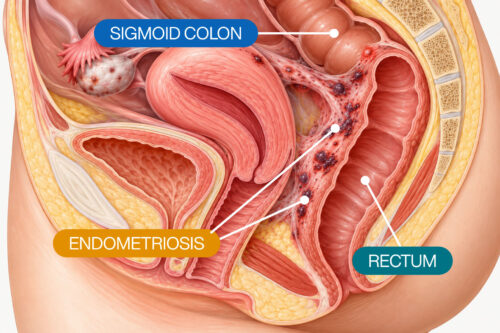


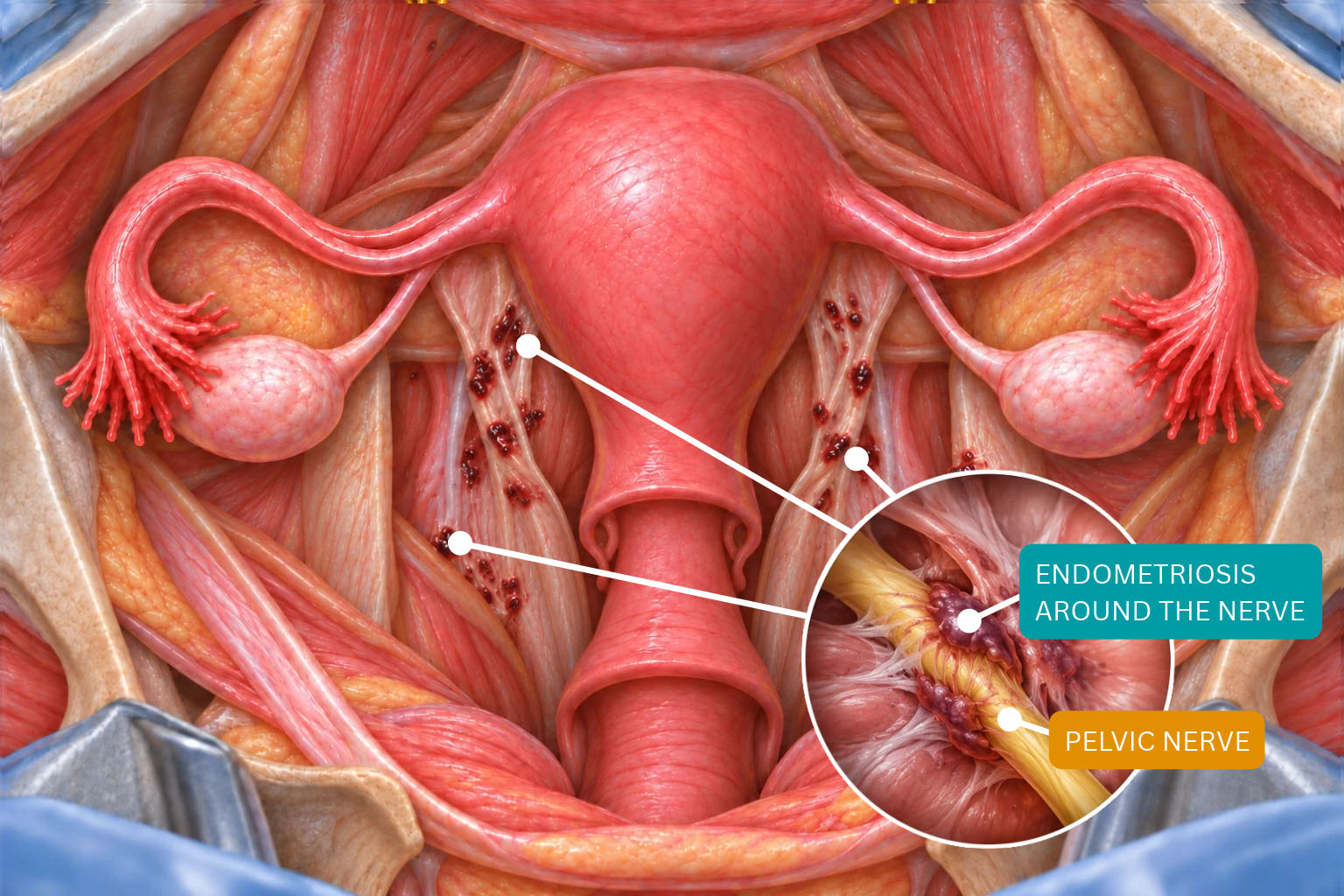
Endometriosis is commonly associated with pelvic pain, but in some patients, pain may also involve the nerves within or around the pelvis.
Endometriotic lesions can develop close to nerves and, in rare cases, directly involve structures such as the sacral plexus or sciatic nerve. Research also suggests that inflammation, new nerve-fiber growth, and sensitization may contribute to endometriosis-associated pain even when a major nerve is not directly affected. [4] [6]
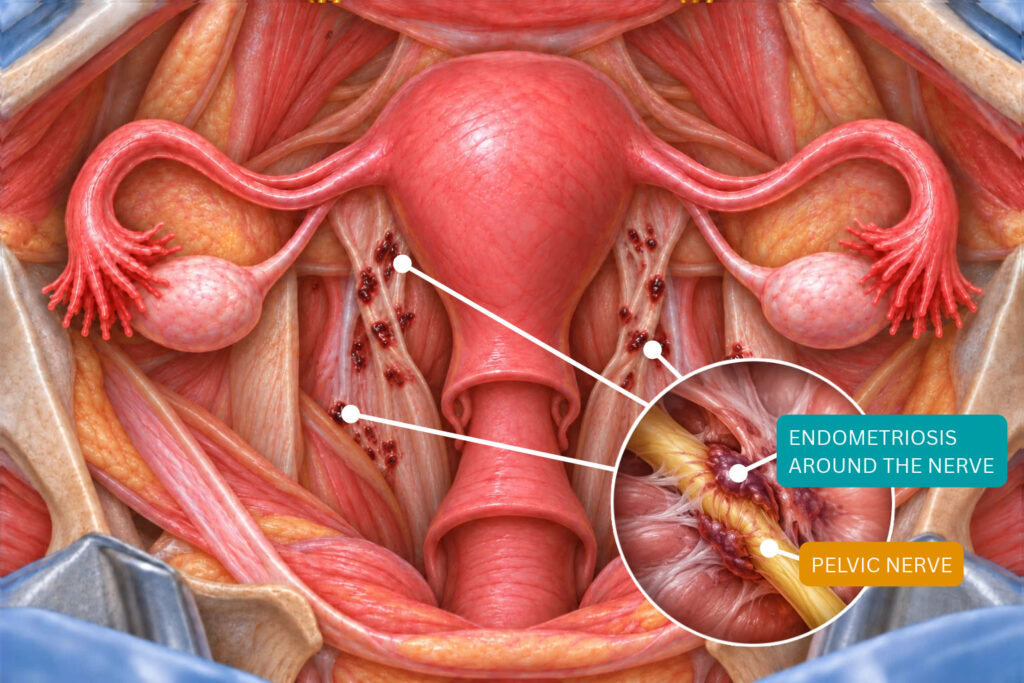
Medical illustration showing endometriosis lesions affecting pelvic nerves.
Can Endometriosis Cause Nerve Pain?
Yes. Endometriosis can contribute to nerve-related pain, although direct involvement of a major pelvic nerve is uncommon.
Several mechanisms may contribute. Endometriosis may directly involve or develop around a nerve, while inflammation and fibrosis can affect nearby tissues. Endometriotic lesions can also contain increased nerve fibers and factors involved in nerve growth and sensitization. [4]
A study of deep endometriosis also found that patients with perineural invasion, where endometriotic tissue was identified around nerves, reported greater dysmenorrhea, dyspareunia, and chronic pelvic pain than patients without this finding. [3]
Endometriosis Does Not Have to Invade a Major Nerve to Cause Pain
Nerve-related mechanisms in endometriosis are more complex than a lesion simply pressing against a nerve.
Endometriosis creates an inflammatory environment that may contribute to peripheral nerve sensitization, while new nerve fibers have been identified in and around endometriotic lesions. Central sensitization may also contribute to persistent endometriosis-associated pain. [4]
This is one reason the severity of pain does not always correspond directly with the amount of endometriosis present.
Which Nerves Can Endometriosis Affect?
Nerve involvement is considered an uncommon manifestation of endometriosis, but several nerves and nerve networks have been reported.
A review of 365 reported cases of peripheral nerve endometriosis found that the sacral plexus and sciatic nerve were the most frequently affected locations. [6]
Pelvic nerve endometriosis may involve structures such as the:
- Sacral plexus
- Sciatic nerve
- Pudendal nerve
- Obturator nerve
- Femoral nerve
- Inferior hypogastric plexus
More recent radiology literature also identifies these structures as important sites to evaluate when pelvic nerve endometriosis is suspected.
What Does Endometriosis Nerve Pain Feel Like?
Symptoms depend on which nerve is affected and where the disease is located.
Possible nerve-related symptoms can include:
- Shooting or radiating pain
- Burning pain
- Pain extending into the buttock or leg
- Sciatica
- Tingling or numbness
- Muscle weakness
- Pain that becomes worse around menstruation
In the review by Sousa et al. (2015), pain was reported in 97% of the published peripheral nerve cases, while numbness and weakness were also described. These figures come from reported cases of nerve endometriosis and should not be interpreted as prevalence estimates for people with endometriosis overall.
Sciatic Nerve Endometriosis Can Cause Leg Symptoms
The sciatic nerve is one of the better-described sites of peripheral nerve endometriosis.
When the sciatic nerve is involved, symptoms may resemble ordinary sciatica, with pain radiating from the pelvis or buttock into the leg. More significant nerve involvement can also produce sensory changes or weakness.
A review of 362 reported patients with isolated sciatic nerve or sacral nerve-root endometriosis found neurological symptoms including leg weakness, sensory changes, foot drop, and pudendal neuralgia, depending on the affected location. [2]
A cyclical pattern, particularly symptoms that repeatedly worsen around menstruation, may raise suspicion for endometriosis. However, sciatica and leg pain have many other possible causes.
How Is Pelvic Nerve Endometriosis Diagnosed?
Diagnosis begins with the patient’s symptoms and medical history. The location, distribution, and timing of pain can provide important clues, particularly when neurological symptoms follow a recognizable nerve pathway.
MRI can be particularly useful when pelvic nerve involvement is suspected. Dedicated imaging can help evaluate deep endometriosis and its relationship with the sacral plexus, sciatic nerve, and other pelvic nerves. Recent radiology guidance emphasizes appropriate MRI protocols because pelvic nerve endometriosis can be overlooked on routine imaging. [1]
Imaging findings still need to be interpreted together with symptoms and clinical evaluation.
Treatment Depends on the Nerve and Extent of Disease
Treatment is individualized according to the location of endometriosis, severity of symptoms, neurological findings, fertility goals, previous treatment, and other disease present within the pelvis.
Confirmed endometriosis involving a major pelvic nerve can be particularly complex because treatment must consider both removal of disease and preservation of nerve function.
Published surgical studies have reported improvement in neuropathic pain following decompression of the sciatic nerve or sacral plexus in selected patients, although much of the evidence is observational and these procedures require specialized expertise.
When Nerve-Like Pain May Need Further Evaluation
Shooting, burning, or radiating pain does not automatically mean that endometriosis has reached a nerve. Many gynecologic, musculoskeletal, spinal, and neurological conditions can produce similar symptoms.
However, recurrent leg or buttock pain that follows the menstrual cycle, persistent numbness, sensory changes, or muscle weakness may warrant further evaluation, particularly in someone with known or suspected endometriosis.
At New York Gynecology Surgery & Endometriosis (NYGSE), Dr. Pankaj Singhal and Dr. Elizabeth McLean evaluate endometriosis in the context of symptoms, imaging findings, pelvic anatomy, and individual treatment needs.
When nerve involvement is suspected, determining the location and extent of disease can help guide further evaluation and treatment planning.
References
- Bourg, J., Ruaux, E., Bolze, P. A., Gavrel, M., Charlot, M., Golfier, F., Thomassin-Naggara, I., & Rousset, P. (2025). Pelvic nerve endometriosis: MRI features and key findings for surgical decision. Insights into Imaging, 16(1), 131. https://doi.org/10.1186/s13244-025-02005-6
- Kale, A., Baydili, K. N. S., Keles, E., Gundogdu, E., Usta, T., & Oral, E. (2022). Comparison of isolated sciatic nerve and sacral nerve root endometriosis: A review of the literature. Journal of Minimally Invasive Gynecology, 29(8), 943–951. https://doi.org/10.1016/j.jmig.2022.05.017
- Liang, Y., Liu, D., Yang, F., Pan, W., Zeng, F., Wu, J., Xie, H., Li, J., & Yao, S. (2018). Perineural invasion in endometriotic lesions contributes to endometriosis-associated pain. Journal of Pain Research, 11, 1999–2009. https://doi.org/10.2147/JPR.S168715
- Morotti, M., Vincent, K., Brawn, J., Zondervan, K. T., & Becker, C. M. (2014). Peripheral changes in endometriosis-associated pain. Human Reproduction Update, 20(5), 717–736. https://doi.org/10.1093/humupd/dmu021
- Racca, C., Franken, J., Cahen, M., Cicchelero, A., Mormont, M., & Cinotti, R. (2026). Efficacy and safety of laparoscopic nerve decompression for neuropathic sciatic pain due to endometriosis: A systematic review and meta-analysis. International Journal of Gynecology & Obstetrics. Advance online publication. https://doi.org/10.1002/ijgo.71087
- Siquara de Sousa, A. C., Capek, S., Amrami, K. K., & Spinner, R. J. (2015). Neural involvement in endometriosis: Review of anatomic distribution and mechanisms. Clinical Anatomy, 28(8), 1029–1038. https://doi.org/10.1002/ca.22617