


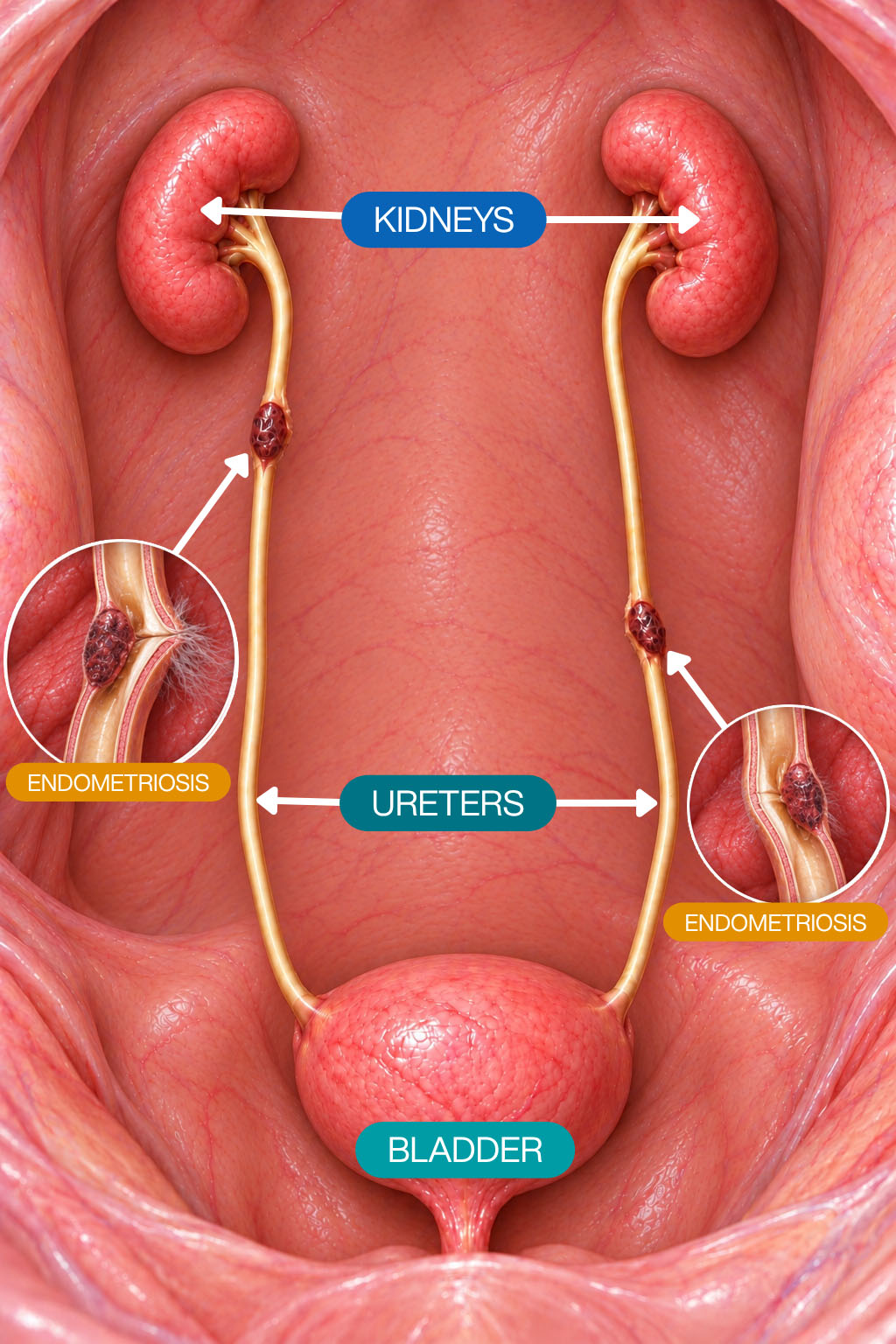
Endometriosis is commonly associated with pelvic pain, painful periods, and fertility concerns. However, in some cases, the condition can also affect the urinary tract, including the ureters, the tubes that carry urine from the kidneys to the bladder.
When endometriosis causes narrowing or obstruction of a ureter, urine may not drain normally from the affected kidney. This can lead to hydronephrosis, a condition in which the kidney’s urine-collecting system becomes swollen because urine cannot drain properly.
Although ureteral endometriosis is uncommon, it can have serious consequences. One concern is that obstruction may develop without noticeable urinary symptoms, allowing kidney function to decline before the condition is discovered. [1][3]
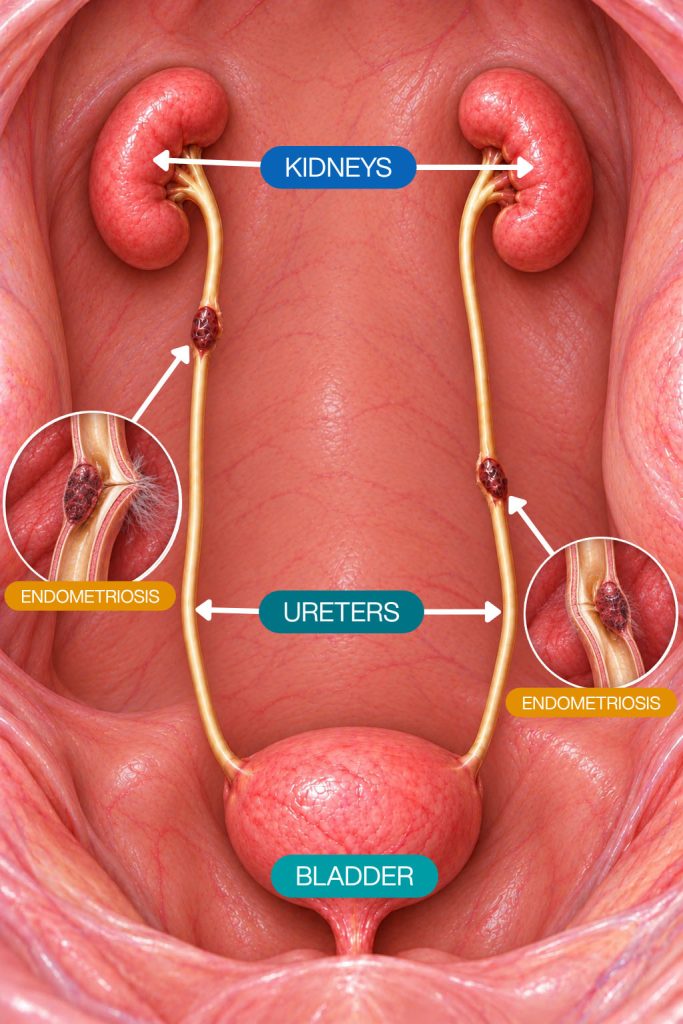
Medical illustration of ureteral endometriosis, showing how endometriosis lesion can obstruct the ureter and cause hydronephrosis.
How Does Endometriosis Affect the Ureter?
The ureters travel from the kidneys through the pelvis before entering the bladder. Their location places them near structures that can be affected by deep endometriosis, including the uterosacral ligaments and pelvic sidewalls.
Ureteral endometriosis generally occurs in two forms:
- Extrinsic ureteral endometriosis: Endometriosis and associated fibrotic tissue develop around the outside of the ureter, potentially compressing or narrowing it.
- Intrinsic ureteral endometriosis: Endometriosis infiltrates the wall of the ureter itself.
Extrinsic involvement is more common. [1]
In either form, narrowing may interfere with urine flow. However, not every endometriosis lesion near a ureter causes an obstruction.
Understanding Hydronephrosis
Hydronephrosis occurs when urine accumulates within the kidney’s collecting system because normal drainage is impaired.
If a ureter becomes narrowed or blocked, pressure can build up above the obstruction, causing the collecting system to dilate. When the ureter is also enlarged, the finding may be described as hydroureteronephrosis.
Hydronephrosis has several possible causes, including kidney stones, urinary tract abnormalities, and compression from surrounding tissues.
Endometriosis is a less common cause, but it deserves consideration in patients with known or suspected deep pelvic endometriosis.
Can Ureteral Endometriosis Damage the Kidney?
Yes. Persistent ureteral obstruction can gradually damage the affected kidney.
The risk depends on how severely the ureter is narrowed and how long the obstruction has been present. Prolonged obstruction may eventually cause irreversible loss of kidney function. [3]
Importantly, normal overall kidney blood test results do not always exclude damage to one kidney, because the other kidney may continue functioning normally.
This is why suspected ureteral obstruction requires timely evaluation, even when symptoms are mild.
Hydronephrosis Without Noticeable Symptoms
Ureteral endometriosis may cause few or no noticeable urinary symptoms, even when obstruction is present. [3]
When symptoms occur, they may include:
- Pelvic or lower abdominal pain
- Lower back or flank pain
- Pain that worsens around menstruation
- Painful urination
- Blood in the urine, although this is uncommon
These symptoms are not specific to ureteral endometriosis and may also occur with kidney stones, urinary infections, or other conditions.
In some patients, hydronephrosis is discovered incidentally during imaging performed for another reason.
The absence of pain does not necessarily mean that urine drainage and kidney function are normal.
How Is Ureteral Endometriosis Diagnosed?
Evaluation focuses on identifying possible endometriosis involvement and determining whether the ureter or kidney has been affected.
Ultrasound can detect dilation of the kidney’s collecting system. A renal ultrasound may be recommended when hydronephrosis or ureteral obstruction is suspected.
Specialist pelvic ultrasound and MRI can help identify deep endometriosis near the ureter and assess its relationship with surrounding pelvic structures. [1][2]
Additional urinary tract imaging may be necessary to determine the location and severity of an obstruction.
Blood tests, including serum creatinine, help assess overall kidney function. In selected cases, a nuclear medicine renal scan may be used to evaluate how much each kidney contributes to total function.
Because hydronephrosis can have causes unrelated to endometriosis, the findings must be interpreted alongside the patient’s medical history and clinical examination.
Treatment Options for Ureteral Endometriosis
Treatment depends on the severity of obstruction, the extent of endometriosis, and the function of the affected kidney.
When significant obstruction threatens kidney function, relieving the obstruction becomes a priority.
Surgical approaches may include:
- Ureterolysis: Freeing the ureter from surrounding endometriosis and scar tissue.
- Ureteral resection: Removing an affected section of the ureter, followed by reconstruction.
- Ureteral reimplantation: Reconnecting the ureter to the bladder when the lower portion requires removal.
The appropriate procedure depends on the location and severity of disease. Some patients may also require temporary urinary drainage through a stent or nephrostomy tube. [2]
Hormonal treatment may help manage endometriosis symptoms, but it should not be relied upon to resolve a significant ureteral obstruction. [1][2]
Complex cases may require collaboration between an endometriosis surgeon and a urologist.
Hydronephrosis and Deep Pelvic Endometriosis
Ureteral endometriosis may occur alongside deep endometriosis affecting nearby pelvic structures, including the uterosacral ligaments, pelvic sidewall, bowel, or bladder.
For example, uterosacral ligament thickening or nodularity may suggest deep endometriosis in the posterior pelvis. However, this finding alone does not establish ureteral involvement.
Imaging helps determine whether disease extends toward the ureter and whether urine drainage has been affected.
Protecting Kidney Function When Endometriosis Affects the Ureter
Hydronephrosis associated with suspected endometriosis deserves prompt medical evaluation, even when urinary symptoms are absent.
Severe flank pain, fever with suspected urinary obstruction, markedly reduced urine output, or signs of acute kidney injury require urgent medical assessment.
At New York Gynecology Surgery & Endometriosis (NYGSE), evaluating complex endometriosis involves considering symptoms, imaging findings, previous treatments, reproductive goals, and possible involvement of nearby pelvic structures.
When ureteral endometriosis is suspected, timely assessment and coordination with appropriate specialists can help guide treatment decisions and protect kidney function.
References
- Barra, F., Scala, C., Biscaldi, E., Vellone, V. G., Ceccaroni, M., Terrone, C., & Ferrero, S. (2018). Ureteral endometriosis: A systematic review of epidemiology, pathogenesis, diagnosis, treatment, risk of malignant transformation and fertility. Human Reproduction Update, 24(6), 710–730. https://doi.org/10.1093/humupd/dmy027
- Keckstein, J., Becker, C. M., Canis, M., Feki, A., Grimbizis, G. F., Hummelshoj, L., Nisolle, M., Roman, H., Saridogan, E., Tanos, V., Tomassetti, C., Ulrich, U. A., Vermeulen, N., & De Wilde, R. L. (2020). Recommendations for the surgical treatment of endometriosis. Part 2: Deep endometriosis. Human Reproduction Open, 2020(1), hoaa002. https://doi.org/10.1093/hropen/hoaa002
- Lužný, R., Heřman, H., Malchar, O., & Pilka, R. (2022). Hydronephrosis as a symptom of clinically silent ureteral endometriosis. Česká gynekologie, 87(3), 188–192. https://doi.org/10.48095/cccg2022188