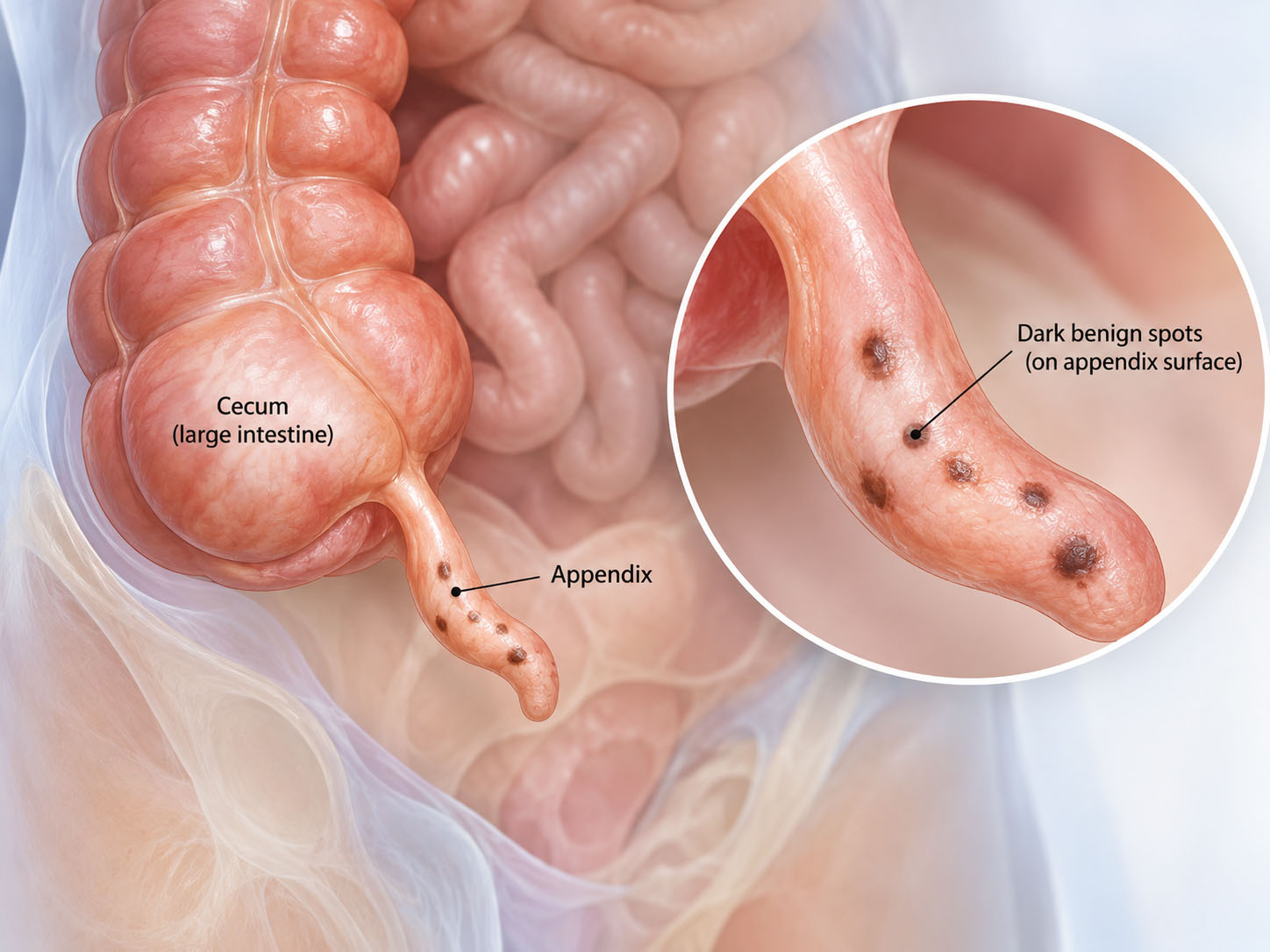
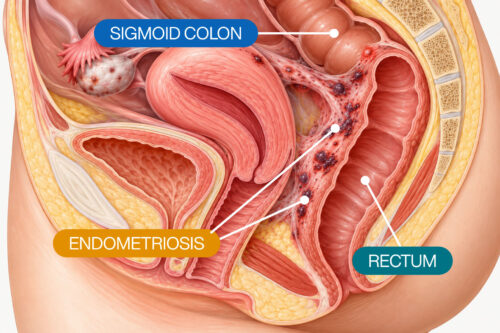
Dark benign spots on the appendix may occasionally be discovered during endometriosis surgery or another pelvic procedure. These spots may appear brown, blue, black, or otherwise discolored and can raise an important question: could they be related to endometriosis?
Endometriosis can involve the appendix. However, the appearance of a dark spot alone cannot determine what it is. Visual findings may raise suspicion, while examination of removed tissue by a pathologist can help establish the diagnosis.
Medical illustration showing dark benign spots on the surface of the appendix.
Can Endometriosis Affect the Appendix?
Yes. Although endometriosis is commonly associated with the ovaries and pelvic peritoneum, the disease can also involve the gastrointestinal tract, including the appendix.
This is known as appendiceal endometriosis.
Appendiceal involvement appears to occur more frequently among some patients with deep or extensive endometriosis. It may also be discovered unexpectedly during surgery, including in patients who did not have symptoms specifically pointing to the appendix.
Why Can Endometriosis Appear as Dark Spots?
Endometriosis does not have one uniform appearance.
During surgery, lesions may appear brown, blue, black, red, clear, white, fibrotic, or otherwise abnormal. Classic dark or “powder-burn” lesions are among the appearances historically associated with endometriosis.
Dark coloration can be associated with previous bleeding and the accumulation of blood-breakdown products such as hemosiderin within or around affected tissue.
Therefore, when a surgeon sees dark benign-appearing spots on the appendix, endometriosis may be one possible explanation, particularly when endometriosis is already present elsewhere in the pelvis.
Do Dark Benign Spots on the Appendix Mean Endometriosis?
Not necessarily.
This is an important distinction because visual appearance alone cannot confirm endometriosis.
A dark spot may look suspicious during surgery but ultimately have another explanation. Conversely, endometriosis does not always produce the classic dark lesions commonly associated with the disease.
The appearance, location, surrounding anatomy, and other surgical findings can help guide the surgeon’s assessment, but they do not replace tissue diagnosis when tissue is removed for examination.
How Is Appendix Endometriosis Confirmed?
If suspicious tissue or the appendix is removed, it can be sent to a pathologist for histopathologic examination.
Under the microscope, pathologists look for characteristic findings associated with endometriosis, including endometrial-type glands and stroma. Other findings may include hemorrhage, hemosiderin-laden macrophages, inflammation, and fibrosis.
A useful way to understand the distinction is:
What the surgeon sees may raise suspicion. What the pathologist finds can establish the tissue diagnosis.
This is why a surgical photograph showing dark spots cannot, by itself, establish that the appendix contains endometriosis.
Can Appendix Endometriosis Cause Symptoms?
It can, although some patients may have no symptoms specifically attributable to their appendix.
Reported presentations of appendiceal endometriosis include right lower abdominal or pelvic pain, and in some cases symptoms can resemble acute or recurrent appendicitis.
Other patients have appendiceal involvement discovered incidentally during surgery for known or suspected endometriosis.
Because abdominal and pelvic pain have many possible causes, right-sided pain alone does not establish appendiceal endometriosis.
Does an Abnormal-Looking Appendix Always Need to Be Removed?
No. Finding dark or unusual areas on the appendix does not automatically mean that every patient undergoing endometriosis surgery needs an appendectomy.
The decision may depend on the appearance of the appendix, the location and extent of disease, the patient’s symptoms and surgical history, other findings during surgery, and the surgeon’s clinical judgment.
If an appendectomy is being considered, the potential benefits and risks should be evaluated for the individual patient.
Why the Appendix May Matter During Endometriosis Surgery
Endometriosis is not necessarily confined to the reproductive organs.
In some patients, disease may involve structures such as the bowel, bladder, ureters, appendix, and other areas of the pelvis or abdomen. This is one reason a comprehensive assessment of the surgical anatomy can be important, particularly when treating complex disease.
A dark spot on the appendix may turn out to represent endometriosis, another benign finding, or something else entirely.
The appearance is a clue, not a diagnosis.
At New York Gynecology Surgery & Endometriosis (NYGSE), our endometriosis specialists evaluate the complete pattern of a patient’s symptoms, imaging, previous treatments, surgical history, and operative findings when determining the appropriate approach to suspected or complex endometriosis.