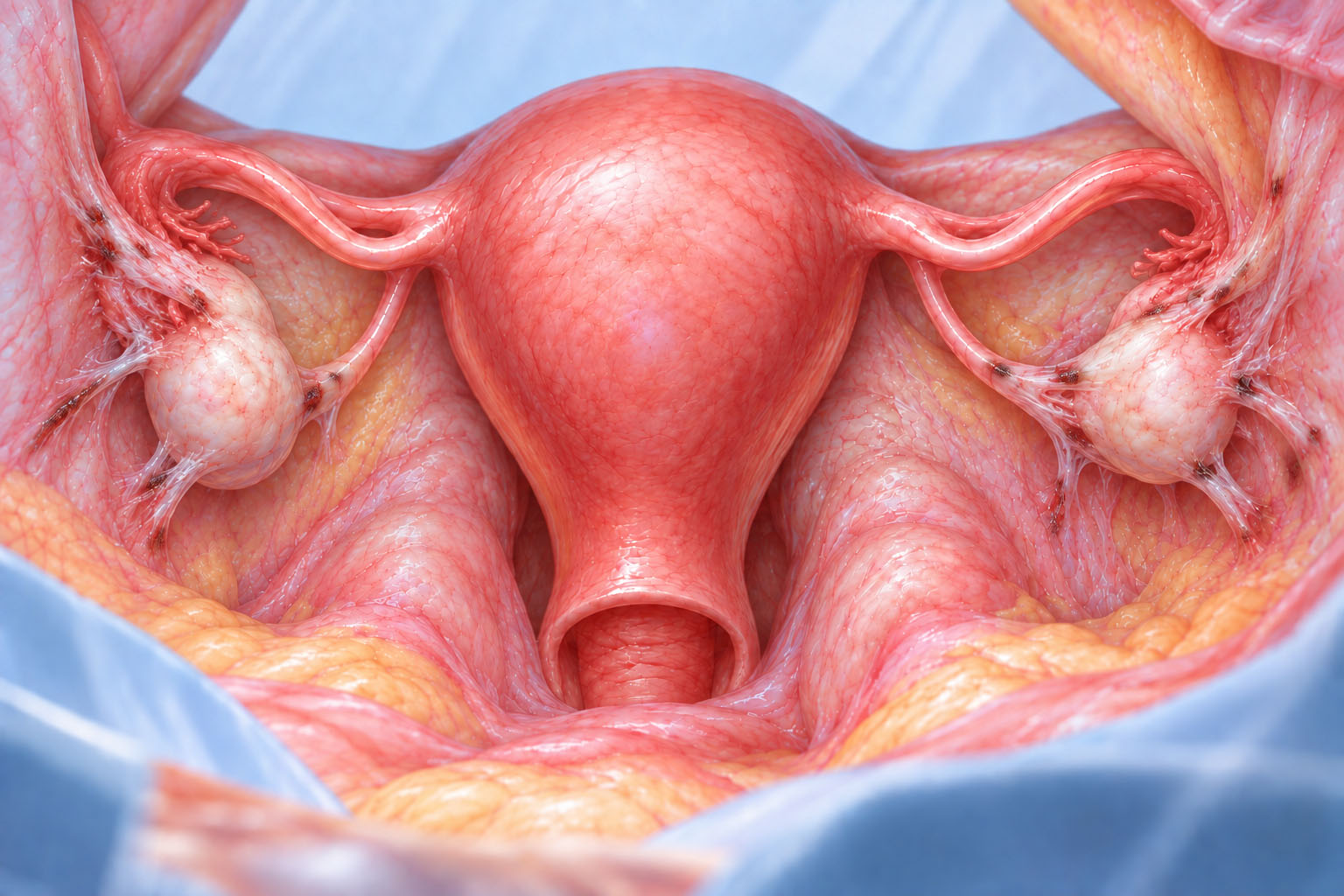
During an ultrasound or endometriosis surgery, some patients may be told that an ovary is “stuck” to the pelvic wall.
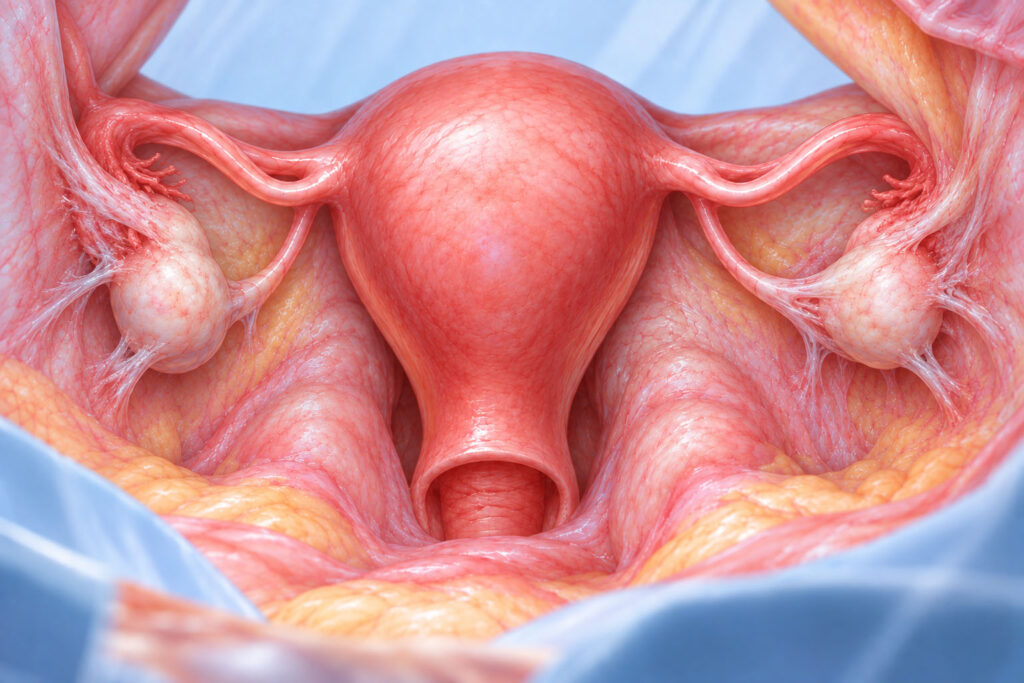
Normally, the ovaries have some mobility within the pelvis. When an ovary becomes fixed to the pelvic sidewall, adherencias may be restricting its movement.
Endometriosis is one condition that can contribute to these adhesions, although other causes are possible.
Medical illustration showing an ovary stuck to the pelvic wall by adhesions.
What Does an Ovary Stuck to the Pelvic Wall Mean?
A “stuck ovary” is not a formal diagnosis. It generally means that the ovary has become fixed or adherent to surrounding tissue rather than moving normally.
Research using transvaginal ultrasound has defined a fixed ovary as one adherent laterally to the pelvic sidewall or medially to the uterus. [2]
An ovary may become adherent to the:
Pelvic sidewall
Uterus
Fallopian tube
Bowel
Other surrounding pelvic tissues
Can Endometriosis Cause an Ovary to Stick to the Pelvic Wall?
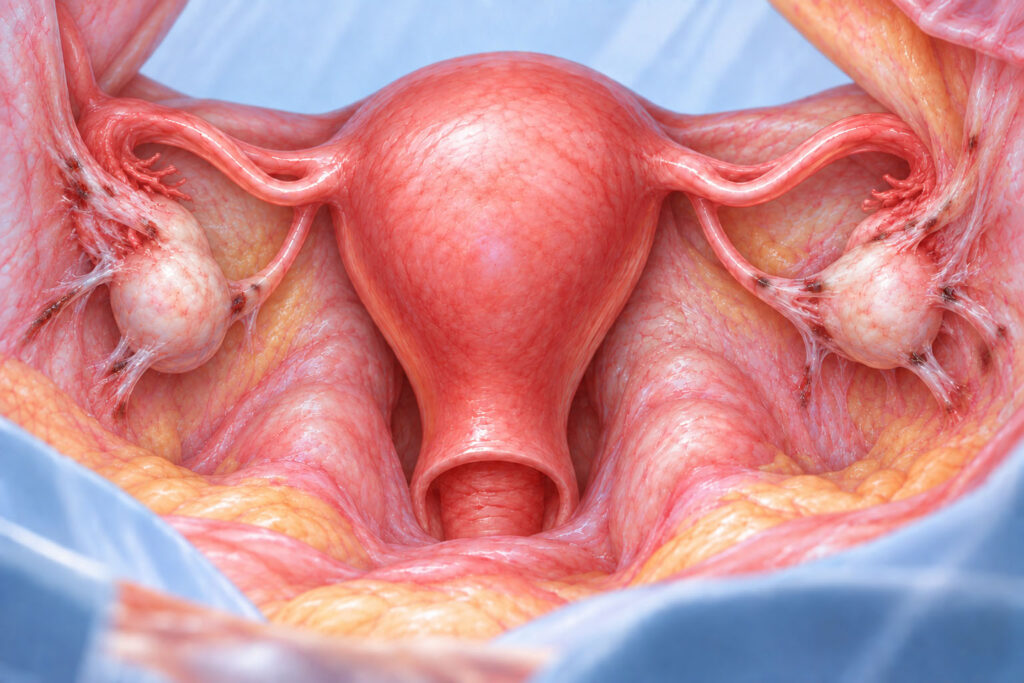
Yes. Endometriosis can contribute to adhesions that cause an ovary to become fixed to the pelvic sidewall.
Endometriosis is associated with inflammation, fibrosis, and adhesion formation. These changes can cause normally separate pelvic tissues to become attached, restricting the ovary’s normal mobility.
Ovarian fixation has also been associated with other findings of endometriosis, including ovarian endometriomas, deep endometriosis, and more extensive pelvic disease. [3]
However, a fixed ovary is not specific to endometriosis. Pelvic surgery, infection, and other inflammatory conditions can also cause adhesions.
Medical illustration showing an ovary fixed to the pelvic wall by adhesions associated with endometriosis.
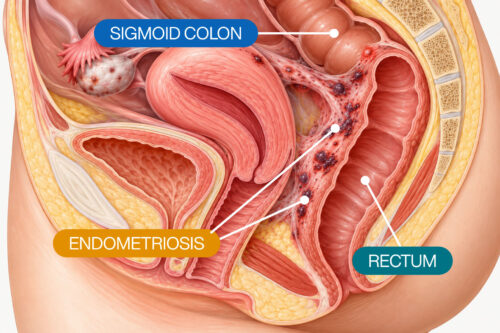
Endometriosis Can Cause Ovarian Adhesions
Endometriosis can be associated with inflammation, fibrosis, and adhesions that alter normal pelvic anatomy.
When adhesions develop around an ovary, they may restrict its mobility and tether it to the pelvic sidewall or another nearby structure.
An ovarian endometrioma may also occur alongside ovarian fixation, but a fixed ovary does not automatically mean that an endometrioma is present.
What Symptoms Can a Fixed Ovary Cause?
Some people with ovarian adhesions may have few or no symptoms.
When symptoms occur, they may include:
These symptoms can occur with endometriosis but cannot determine by themselves whether an ovary is attached to the pelvic wall. ESHRE recommends considering endometriosis in patients with symptoms such as dysmenorrhea, deep dyspareunia, dyschezia, urinary symptoms, fatigue, and infertility. [1]
Ultrasound Can Assess Ovarian Mobility
During a specialized transvaginal ultrasound, the clinician can assess whether the ovary moves freely or remains fixed against surrounding structures.
A 2014 study comparing ultrasound with laparoscopic findings found that fixed ovaries on transvaginal ultrasound had 78.4% sensitivity and 94.2% specificity for detecting endometriosis in its study population. [2]
More recent radiology guidance also recognizes immobility of an ovary relative to the pelvic sidewall, uterus, bowel, or opposite ovary as a useful indirect observation of endometriosis. [4]
A Fixed Ovary May Be a Clue to More Extensive Disease
Ovarian fixation can sometimes provide information about the extent of disease.
In a study of 66 women with pelvic pain who underwent ultrasound followed by endometriosis surgery, ovarian fixation was significantly associated with ovarian endometrioma, pouch of Douglas obliteration, deep endometriosis, and moderate-to-severe endometriosis. [3]
The finding was also associated with an increased likelihood of requiring pelvic sidewall dissection during surgery. However, ovarian fixation alone does not determine the severity of endometriosis in an individual patient.
Can an Ovary Stuck to the Pelvic Wall Affect Fertility?
Potentially, but a fixed ovary does not automatically mean infertility.
Adhesions can alter the normal relationship between the ovary and fallopian tube. If this anatomy is significantly distorted, the fallopian tube’s ability to capture the released egg may potentially be affected.
Fertility depends on many other factors, so ovarian fixation alone cannot determine whether someone can become pregnant naturally.
What an Ovary Stuck to the Pelvic Wall May Mean
An ovary stuck to the pelvic wall may be a sign of adhesions and, in some patients, may be associated with endometriosis. However, the finding should be considered together with symptoms, imaging, medical history, and other clinical findings.
If imaging shows an ovary fixed to the pelvic sidewall, evaluation with an endometriosis specialist can help determine what the finding may mean and whether further evaluation or treatment is appropriate.
Becker, C. M., Bokor, A., Heikinheimo, O., Horne, A., Jansen, F., Kiesel, L., King, K., Kvaskoff, M., Nap, A., Petersen, K., Saridogan, E., Tomassetti, C., van Hanegem, N., Vulliemoz, N., y Vermeulen, N. (2022). ESHRE guideline: Endometriosis. Human Reproduction Open, 2022(2), hoac009. https://doi.org/10.1093/hropen/hoac009
Marasinghe, J. P., Senanayake, H., Saravanabhava, N., Arambepola, C., Condous, G., & Greenwood, P. (2014). History, pelvic examination findings and mobility of ovaries as a sonographic marker to detect pelvic adhesions with fixed ovaries. Journal of Obstetrics and Gynaecology Research, 40(3), 785–790. https://doi.org/10.1111/jog.12234
Rao, T., Condous, G., & Reid, S. (2022). Ovarian immobility at transvaginal ultrasound: An important sonographic marker for prediction of need for pelvic sidewall surgery in women with suspected endometriosis. Journal of Ultrasound in Medicine, 41(5), 1109–1113. https://doi.org/10.1002/jum.15800
Young, S. W., Jha, P., Chamié, L., Rodgers, S., Kho, R. M., Horrow, M. M., Glanc, P., Feldman, M., Groszmann, Y., Khan, Z., Young, S. L., Poder, L., Burnett, T. L., Hu, E. M., Egan, S., & VanBuren, W. (2024). Society of Radiologists in Ultrasound consensus on routine pelvic US for endometriosis. Radiology, 311(1), e232191. https://doi.org/10.1148/radiol.232191