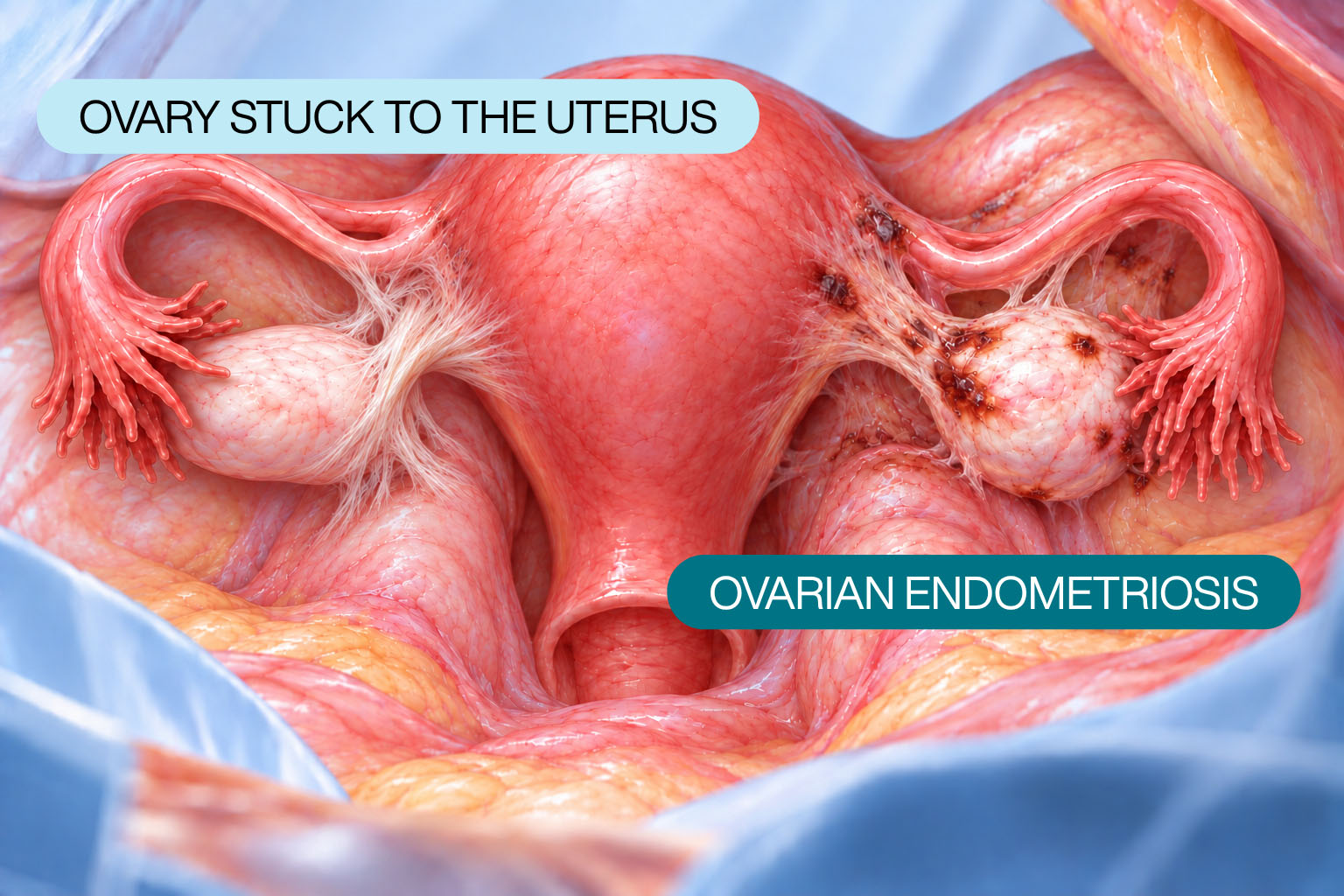
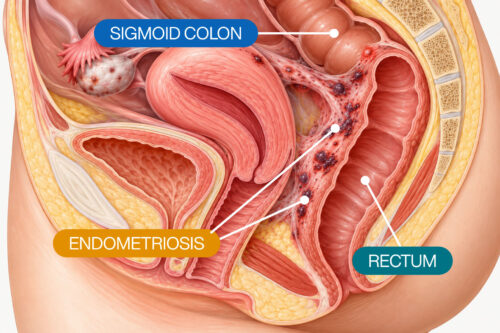
During an ultrasound, MRI, or endometriosis surgery, some patients may be told that an ovary appears to be “stuck” to the uterus.
Normally, the ovaries have some mobility within the pelvis. When an ovary is fixed to the uterus or another pelvic structure, adherencias may be restricting its movement. Endometriosis is one condition that can contribute to the formation of these adhesions.
In fact, research has specifically evaluated ovarian fixation to the uterus on transvaginal ultrasound as a marker of adherencias pélvicas in patients with suspected endometriomas. [2]
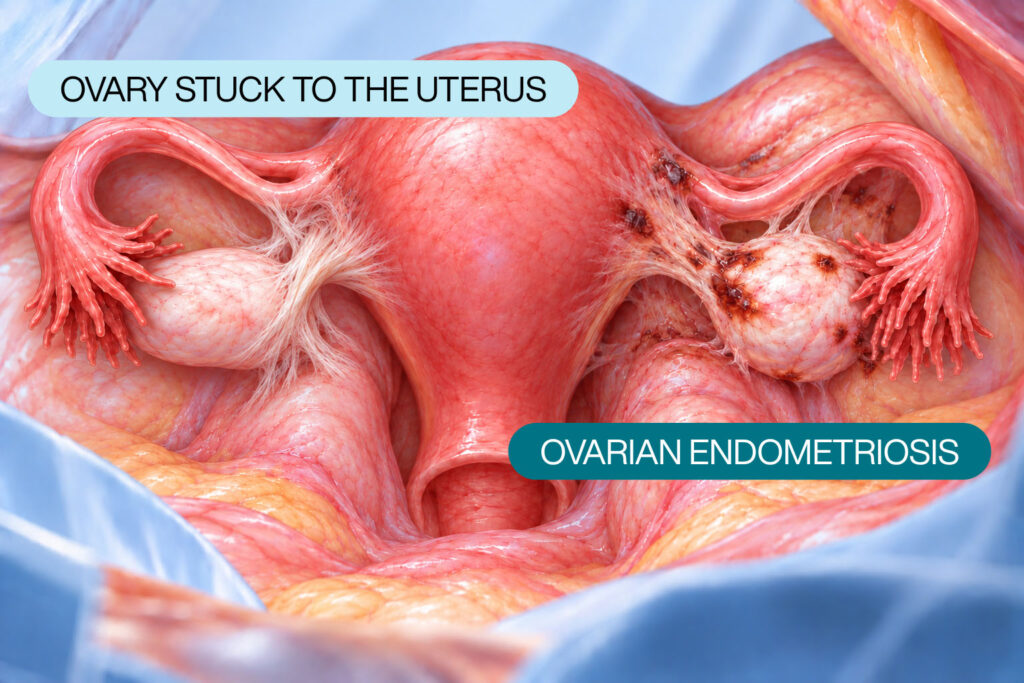
Medical illustration showing pelvic adhesions causing the ovaries to become attached or “stuck” to the uterus, with endometriosis lesions shown on the right side.
What Does It Mean When an Ovary Is “Stuck”?
A “stuck ovary” is not a formal diagnosis. It generally describes an ovary that has become fixed or adherent to nearby tissue rather than moving normally within the pelvis.
The ovary may become attached to structures such as the:
Uterus
Pelvic sidewall
Fallopian tube
Bowel
Other surrounding pelvic tissues
A study evaluating women with chronic pelvic pain or subfertility defined a fixed ovary on ultrasound as one that was adherent laterally to the pelvic sidewall or medially to the uterus. The ultrasound findings were then compared with findings during laparoscopy. [3]
Endometriosis Can Cause the Ovary to Adhere to Nearby Organs
Endometriosis is associated with inflammation and can contribute to adhesion formation and fibrosis within the pelvis. Over time, adhesions can alter the normal relationships between pelvic organs.
An ovary may therefore become attached to the uterus or another nearby structure.
This can occur alongside an endometrioma ovárico, but an adherent ovary does not necessarily mean an endometrioma is present. Likewise, adhesions are not exclusive to endometriosis. Previous pelvic surgery, infection, and other inflammatory conditions can also contribute to adhesion formation.
For this reason, an ovary that appears stuck to the uterus can be an important clue, but it does not establish a diagnosis of endometriosis by itself.
What Symptoms Can an Adherent Ovary Cause?
Some people with pelvic adhesions have no obvious symptoms.
When symptoms are present, they may occur alongside other features associated with endometriosis, including:
Períodos menstruales dolorosos
Dolor pélvico crónico
Pain during or after sex
Evacuaciones intestinales dolorosas
Pain at other points in the menstrual cycle
Difficulty becoming pregnant
ESHRE recommends considering endometriosis in patients with cyclical or noncyclical symptoms including dysmenorrhea, deep dyspareunia, dyschezia, urinary symptoms, fatigue, and infertility. [1]
Symptoms alone, however, cannot determine whether an ovary is adherent or identify exactly where adhesions are located.
Ultrasound and MRI Can Help Identify Ovarian Adhesions
During a specialized transvaginal ultrasound, the clinician may assess whether an ovary moves freely or appears fixed to surrounding structures.
In one study, ovarian fixation to the uterus on ultrasound showed 89% sensitivity and 90% specificity for pelvic adhesions among women undergoing surgery for an endometrioma. [2]
Ultrasound and MRI can help evaluate suspected endometriosis, although normal imaging does not completely exclude the condition. [1]
Can a Stuck Ovary Affect Fertility?
Potentially, but a stuck ovary does not automatically mean infertility.
Adhesions can distort the normal relationship between the ovary and fallopian tube, potentially interfering with the tube’s ability to capture the released egg. However, the effect on fertility varies from person to person.
Finding an ovary attached to the uterus therefore does not determine whether someone can become pregnant naturally.
Treatment Depends on Symptoms and Disease Extent
A fixed ovary does not automatically mean surgery is necessary. Treatment depends on symptoms, fertility goals, imaging findings, and the extent of suspected endometriosis.
When surgery is appropriate, it may involve releasing adhesions and treating endometriosis while preserving surrounding pelvic structures when possible. [1]
An Ovary Stuck to the Uterus Can Be an Important Clue
An ovary that appears stuck to the uterus may indicate pelvic adhesions, including those associated with endometriosis. However, the finding should be considered alongside symptoms, medical history, and imaging.
En New York Gynecology Surgery & Endometriosis (NYGSE), Dr. Pankaj Singhal and Dr. Elizabeth McLean evaluate suspected endometriosis and develop treatment plans based on each patient’s individual needs.
If imaging suggests a fixed ovary, an evaluation with an especialista en endometriosis can help determine the appropriate next step.
Becker, C. M., Bokor, A., Heikinheimo, O., Horne, A., Jansen, F., Kiesel, L., King, K., Kvaskoff, M., Nap, A., Petersen, K., Saridogan, E., Tomassetti, C., van Hanegem, N., Vulliemoz, N., y Vermeulen, N. (2022). ESHRE guideline: Endometriosis. Human Reproduction Open, 2022(2), hoac009. https://doi.org/10.1093/hropen/hoac009
Guerriero, S., Ajossa, S., Garau, N., Alcazar, J. L., Mais, V., & Melis, G. B. (2010). Diagnosis of pelvic adhesions in patients with endometrioma: The role of transvaginal ultrasonography. Fertility and Sterility, 94(2), 742–746. https://doi.org/10.1016/j.fertnstert.2009.03.035
Reid, S., Leonardi, M., Lu, C., & Condous, G. (2019). The association between ultrasound-based ‘soft markers’ and endometriosis type/location: A prospective observational study. European Journal of Obstetrics & Gynecology and Reproductive Biology, 234, 171–178. https://doi.org/10.1016/j.ejogrb.2019.01.018