

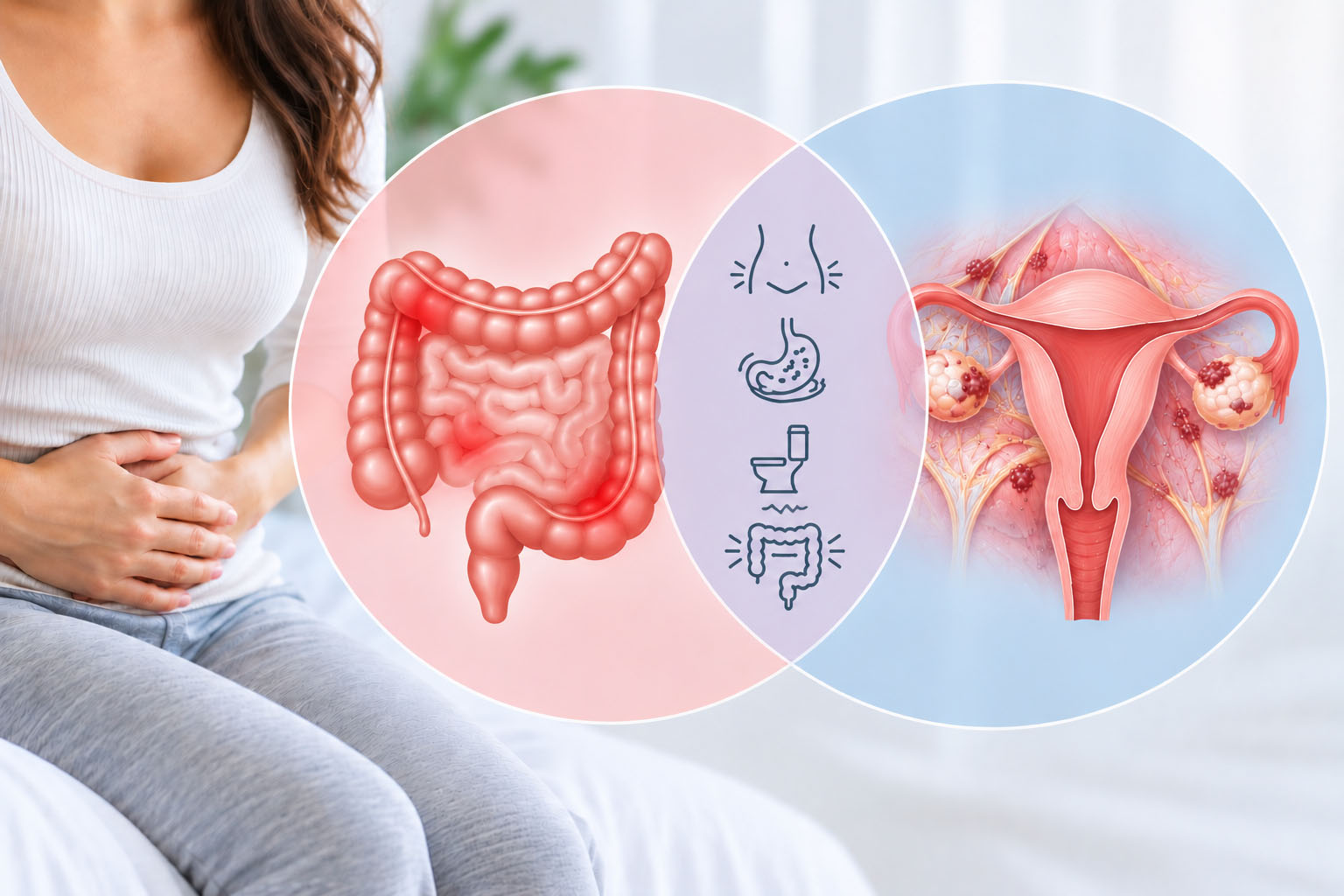
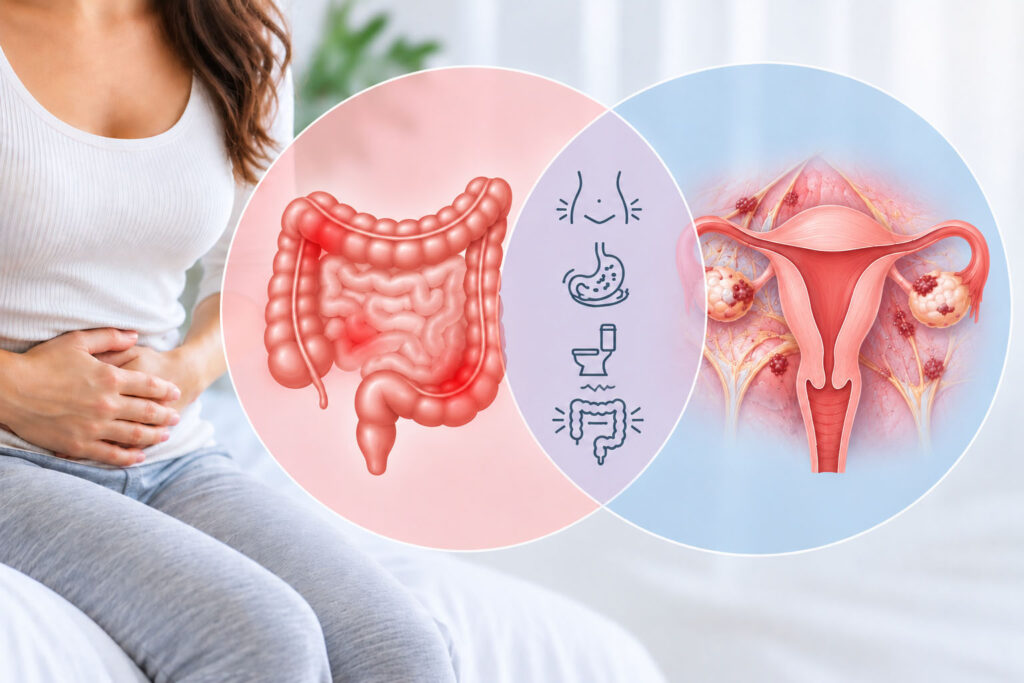
Bloating, abdominal pain, constipation, diarrhea, and changes in bowel habits are commonly associated with irritable bowel syndrome (IBS). But these symptoms can also occur in people with endometriosis.
This overlap can make it difficult to determine where gastrointestinal symptoms are coming from. Some people with endometriosis may initially be diagnosed with IBS, while others may actually have both conditions.
One important clue is how bowel symptoms relate to the menstrual cycle. When gastrointestinal symptoms consistently become worse before or during a period, endometriosis may be worth investigating.
Why Can IBS and Endometriosis Feel So Similar?
IBS is a disorder involving the interaction between the gut and the brain. It can cause abdominal pain and changes in bowel movements without the structural abnormalities seen with diseases such as inflammatory bowel disease.
Endometriosis is different. It occurs when tissue similar to the lining of the uterus grows outside the uterus, potentially causing inflammation, fibrosis, adhesions, and pain.
Despite being different conditions, their symptoms can overlap considerably.
| Symptom | IBS | Endometriosis |
|---|---|---|
| Bloating | Common | Common |
| Abdominal or pelvic pain | Common | Common |
| Estreñimiento | Common | Can occur |
| Diarrhea | Common | Can occur |
| Abdominal cramping | Common | Can occur |
| Evacuaciones intestinales dolorosas | Can occur | Can occur |
| Dolor durante las relaciones sexuales | Not typical | Can occur |
| Severe menstrual pain | Not caused by IBS | Common |
| Symptoms worsening around periods | May occur | Important clue |
Because symptoms alone may not clearly distinguish the two conditions, looking at the overall pattern of symptoms is important.
Can You Have IBS and Endometriosis at the Same Time?
Yes.
IBS should not simply be considered another name for endometriosis. The two are separate conditions, and a person can have either one or both.
Research suggests that IBS is considerably more common among people with endometriosis.
A 2022 systematic review and meta-analysis examined 11 studies involving more than 96,000 participants. The researchers found that people with endometriosis had approximately three times the odds of having IBS compared with controls. In six studies examining IBS prevalence, approximately 23% of women with endometriosis also had IBS (Nabi et al., 2022).
Researchers are still investigating why the conditions occur together so frequently. The association does not necessarily mean that endometriosis causes IBS.
When Could IBS-Like Symptoms Be Related to Endometriosis?
There is no single gastrointestinal symptom that proves someone has endometriosis.
However, certain patterns may raise suspicion.
Bowel Symptoms Get Worse Around Your Period
The relationship between gastrointestinal symptoms and menstruation can provide an important clue.
For example, someone may experience:
- increased bloating before or during menstruation
- constipation or diarrhea that predictably worsens with periods
- painful bowel movements during menstruation
- pelvic or rectal pain associated with bowel movements
European Society of Human Reproduction and Embryology (ESHRE) guidelines recommend considering endometriosis in patients with symptoms including painful periods, deep pain during sex, painful bowel movements, painful rectal bleeding, urinary symptoms, fatigue, and infertility (Becker et al., 2022).
Importantly, these symptoms may be cyclical or non-cyclical, so endometriosis should not automatically be ruled out simply because symptoms occur outside menstruation.
Bowel Symptoms Occur With Other Endometriosis Symptoms
The overall symptom pattern matters.
Bloating or constipation alone can have many possible causes. But gastrointestinal symptoms occurring alongside severe menstrual pain, chronic pelvic pain, painful sex, painful bowel movements, or infertility may warrant an evaluation for endometriosis.
Keeping a symptom diary can sometimes help identify whether gastrointestinal and pelvic symptoms follow a pattern during the menstrual cycle.
If you are experiencing bowel symptoms alongside pelvic pain, painful periods, painful sex, or other symptoms that may be associated with endometriosis, the NYGSE Endometriosis Symptom Checker can help you compare your symptoms with common patterns linked to the condition.
Does Bowel Endometriosis Mean Endometriosis Is Inside the Bowel?
No necesariamente.
Endometriosis may develop on the tissues surrounding the bowel without growing through its inner lining.
The rectum and sigmoid colon are among the areas that can be affected by deep endometriosis. Depending on the location and depth of disease, symptoms may include painful bowel movements, constipation, bloating, pelvic pressure, or other gastrointestinal complaints.
However, having gastrointestinal symptoms does not automatically mean that endometriosis has invaded the bowel. Pelvic inflammation, adhesions, nearby lesions, IBS, and other gastrointestinal conditions can produce similar symptoms.
This distinction is important when determining the appropriate evaluation and treatment.
Can You Have a Normal Colonoscopy and Still Have Endometriosis?
Yes.
A colonoscopy allows a gastroenterologist to examine the inner lining of the colon and rectum. It can be extremely useful for investigating gastrointestinal symptoms and detecting conditions affecting the inside of the bowel.
But endometriosis often develops on the outside of the bowel or elsewhere in the pelvis. These lesions may therefore not be visible during a routine colonoscopy.
A normal colonoscopy does not rule out endometriosis.
At the same time, this does not mean colonoscopy is unnecessary. Gastrointestinal symptoms can have many causes, and a gastroenterologist may recommend testing to investigate other conditions based on a patient’s symptoms, age, medical history, and risk factors.
How Do Doctors Distinguish IBS From Endometriosis?
There is no single test that can always distinguish IBS-related symptoms from those associated with endometriosis.
Evaluation usually begins with a detailed medical history.
A physician may ask:
- When did the bowel symptoms begin?
- Do they change around menstruation?
- Are bowel movements painful?
- Is there severe menstrual or pelvic pain?
- Is intercourse painful?
- Are there urinary symptoms?
- Are there fertility concerns?
- Has the patient previously been diagnosed with IBS?
Pelvic examination and imaging, including ultrasound or MRI when appropriate, may also be used during an endometriosis evaluation.
Importantly, negative imaging does not necessarily exclude endometriosis. Current ESHRE guidelines specifically note that negative imaging cannot rule out the condition, particularly superficial disease.
Depending on the symptoms, evaluation by both a gynecologist familiar with endometriosis and a gastroenterologist may be appropriate.
Individualized Care for IBS and Endometriosis Symptoms
IBS and endometriosis can cause similar symptoms, and some patients may have both conditions. Determining what is contributing to bloating, constipation, diarrhea, abdominal pain, or painful bowel movements requires looking at the complete pattern of symptoms, including whether they change with the menstrual cycle.
En New York Gynecology Surgery & Endometriosis (NYGSE), evaluation and treatment are individualized based on each patient’s symptoms, medical history, and findings. If persistent bowel symptoms occur alongside pelvic pain, painful periods, painful sex, or painful bowel movements, an endometriosis evaluation may help determine whether endometriosis is contributing to your symptoms and guide the next steps in care.
Referencias
Nabi, M. Y., Nauhria, S., Reel, M., Londono, S., Vasireddi, A., Elmiry, M., & Ramdass, P. V. A. K. (2022). Endometriosis and irritable bowel syndrome: A systematic review and meta-analyses. Frontiers in Medicine, 9, 914356. https://doi.org/10.3389/fmed.2022.914356
Becker, C. M., Bokor, A., Heikinheimo, O., Horne, A., Jansen, F., Kiesel, L., King, K., Kvaskoff, M., Nap, A., Petersen, K., Saridogan, E., Tomassetti, C., van Hanegem, N., Vulliemoz, N., y Vermeulen, N. (2022). ESHRE guideline: Endometriosis. Human Reproduction Open, 2022(2), hoac009. https://doi.org/10.1093/hropen/hoac009