Pelvic pain does not always occur during a period.
Some people experience pelvic pain around the middle of the menstrual cycle, close to when an ovary releases an egg. This is known as ovulation pain or mittelschmerz and may affect more than 40% of women of reproductive age. [2]
Although ovulation pain is often harmless, recurring or significant mid-cycle pain can also occur in people with endometriosis, particularly when accompanied by other symptoms.
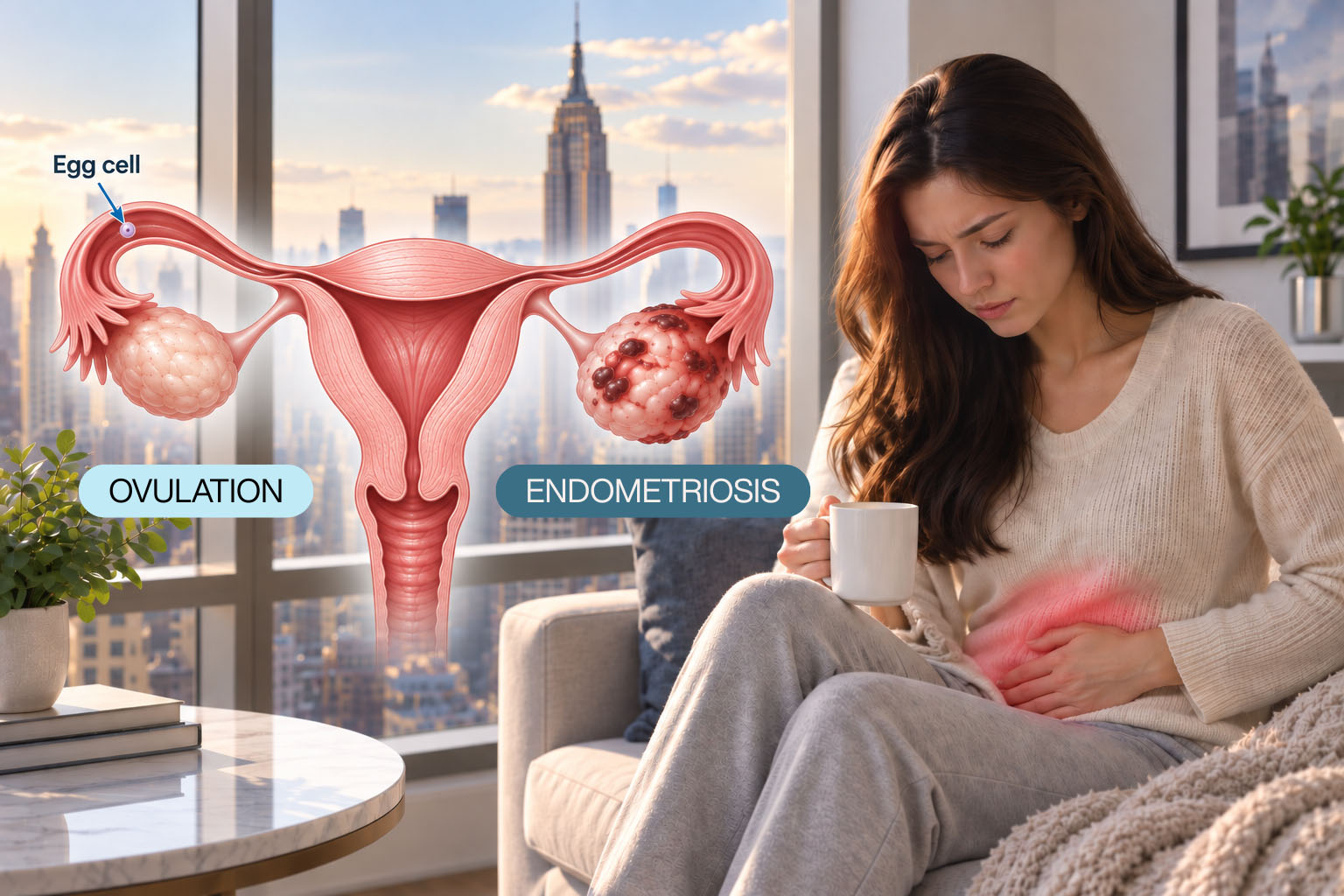
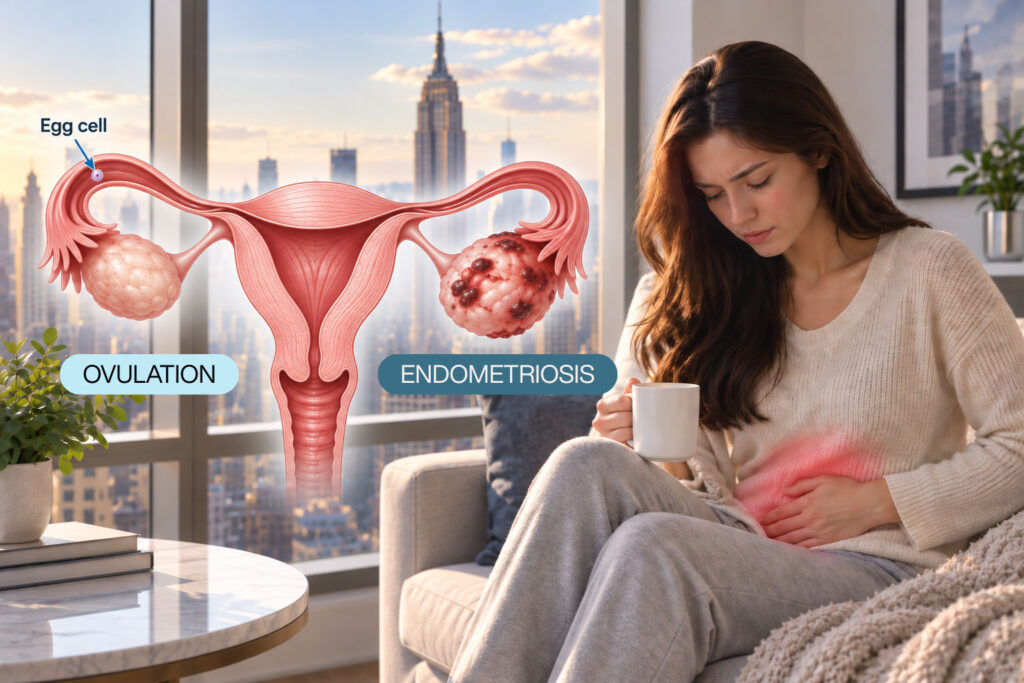
Medical illustration showing ovulation (when the ovary releases an egg cell) on the left side and endometriosis on the right side.
What Does Ovulation Pain Feel Like?
Ovulation pain typically occurs around the middle of the menstrual cycle and is often felt on one side of the lower abdomen or pelvis.
The discomfort may be mild, but some people experience more noticeable pain.
Research using ultrasound has demonstrated small amounts of free pelvic fluid around ovulation in otherwise healthy women. In one study, free fluid was detected in 40% of observed cycles and in two-thirds of cycles associated with mid-cycle pain, supporting the relationship between normal ovulation and mittelschmerz. [3]
Why Can Ovulation Cause Pain?
During each ovulatory cycle, a follicle develops within an ovary before releasing an egg.
Normal physiological changes occur in the ovary during this process. Ultrasound studies have demonstrated changes involving the developing follicle, corpus luteum, and small amounts of pelvic fluid around the time of ovulation. [3]
This means that experiencing some discomfort around ovulation does not automatically indicate endometriosis or another pelvic disorder.
Can Endometriosis Cause Pain Around Ovulation?
Yes, pain associated with endometriosis does not necessarily occur only during menstruation.
Endometriosis-associated pelvic pain can have several patterns. A review of pain in endometriosis specifically describes dysmenorrhea and ovulatory pain as symptoms associated with cyclical changes, while other patients may experience chronic non-cyclical pelvic pain, deep pain during intercourse, painful bowel movements, or urinary pain. [4]
Endometriosis is also an important pathological cause to consider in patients experiencing chronic cyclical pelvic pain. [5]
However, ovulation pain alone does not mean that someone has endometriosis. The timing of pain is only one part of the overall clinical picture.
Ovulation Pain vs. Endometriosis Pain
Typical mittelschmerz occurs around ovulation and can happen in people without endometriosis. Endometriosis-related pain may follow a more complex or persistent pattern.
Further evaluation may be appropriate when mid-cycle pain is accompanied by symptoms such as:
ESHRE recommends that clinicians consider endometriosis in patients with cyclical and non-cyclical signs and symptoms including dysmenorrhea, deep dyspareunia, dysuria, dyschezia, fatigue, and infertility. [1]
When Should Ovulation Pain Be Evaluated?
Occasional mild mid-cycle discomfort may represent normal mittelschmerz.
Recurring, severe, persistent, or worsening pain deserves more attention, particularly when it interferes with daily activities or occurs alongside other symptoms associated with endometriosis.
Importantly, pelvic pain has many possible causes. Endometriosis is one important consideration, but other gynecologic and non-gynecologic conditions can also produce cyclical or chronic pelvic pain. [5]
Understanding the Pattern of Your Pelvic Pain
Pain around ovulation can occur as part of a normal menstrual cycle. But when mid-cycle pain becomes severe, persistent, or repeatedly occurs alongside other symptoms, it may be worth investigating whether endometriosis or another condition is contributing to the pain.
At New York Gynecology Surgery & Endometriosis (NYGSE), Dr. Pankaj Singhal and Dr. Elizabeth McLean evaluate pelvic pain in the context of each patient’s symptoms, medical history, imaging findings, and individual treatment goals.
If recurring ovulation pain is affecting your daily life or occurs alongside other symptoms of endometriosis, an evaluation with an NYGSE endometriosis specialist can help determine an appropriate next step.
Becker, C. M., Bokor, A., Heikinheimo, O., Horne, A., Jansen, F., Kiesel, L., King, K., Kvaskoff, M., Nap, A., Petersen, K., Saridogan, E., Tomassetti, C., van Hanegem, N., Vulliemoz, N., & Vermeulen, N. (2022). ESHRE guideline: Endometriosis. Human Reproduction Open, 2022(2), hoac009. https://doi.org/10.1093/hropen/hoac009
3. Hann, L. E., Hall, D. A., Black, E. B., & Ferrucci, J. T., Jr. (1979). Mittelschmerz: Sonographic demonstration. JAMA, 241(25), 2731–2732. https://doi.org/10.1001/jama.241.25.2731
5. Won, H. R., & Abbott, J. (2010). Optimal management of chronic cyclical pelvic pain: An evidence-based and pragmatic approach. International Journal of Women’s Health, 2, 263–277. https://doi.org/10.2147/IJWH.S7991