

The condition formerly called PCOS was renamed in 2026. As endometriosis surgeons, we explain why it so often travels with endometriosis, why the combination is missed, and what it changes about diagnosis, surgery and fertility care.
By Pankaj Singhal, MD, MS, MHCM, FACOG, and Virginia McLean, MD
New York Gynecology Surgery & Endometriosis, Babylon, NY
Dr. Singhal is double board certified in obstetrics and gynecology and in gynecologic oncology, with more than 18 years in practice and more than 12,000 surgeries.
In May 2026, the condition long known as polycystic ovary syndrome, or PCOS, received a new name: polyendocrine metabolic ovarian syndrome, or PMOS. The change came out of a global consensus process published in The Lancet that brought together 56 medical and patient organizations and surveyed more than 14,000 patients and clinicians. [1]
We welcomed the new name because it describes the condition far more accurately. It has also brought a question into our office more often: can a woman have PMOS and endometriosis at the same time?
She can, and in our experience it happens more often than most women, and many doctors, expect. Because we spend much of our working lives operating on endometriosis, we see the overlap directly, sometimes in women who were told for years that their pain was simply part of PCOS.
This article explains what each condition is, why they were long assumed to be opposites, what recent research shows, and what the combination means for you.
Two different conditions
PMOS is a hormonal and metabolic condition that affects roughly one in eight women of reproductive age.[1][2] The ovaries contain many small follicles, which are fluid-filled sacs that each hold an immature egg, and those follicles tend to stall before an egg is released. Insulin levels often run high, and high insulin drives the ovaries to produce more androgens, the hormones such as testosterone that women make in smaller amounts than men.
The result is irregular or absent periods and difficulty ovulating, and many women also have acne, unwanted hair growth and a higher long-term risk of type 2 diabetes and heart disease. Despite the old name, those follicles are not cysts and do not need to be removed.
Endometriosis is a chronic inflammatory disease in which tissue similar to the lining of the uterus grows outside it, most often on the lining of the pelvis (the peritoneum), the ovaries, the ligaments behind the uterus, the bowel and the bladder. It affects about one in ten women of reproductive age. [3]
Its main symptom is pain: painful periods, pain with sex, pain with bowel movements or urination, and pelvic pain between periods. It is also a common cause of infertility. Endometriosis grows in response to estrogen, and the lesions themselves can produce estrogen locally.
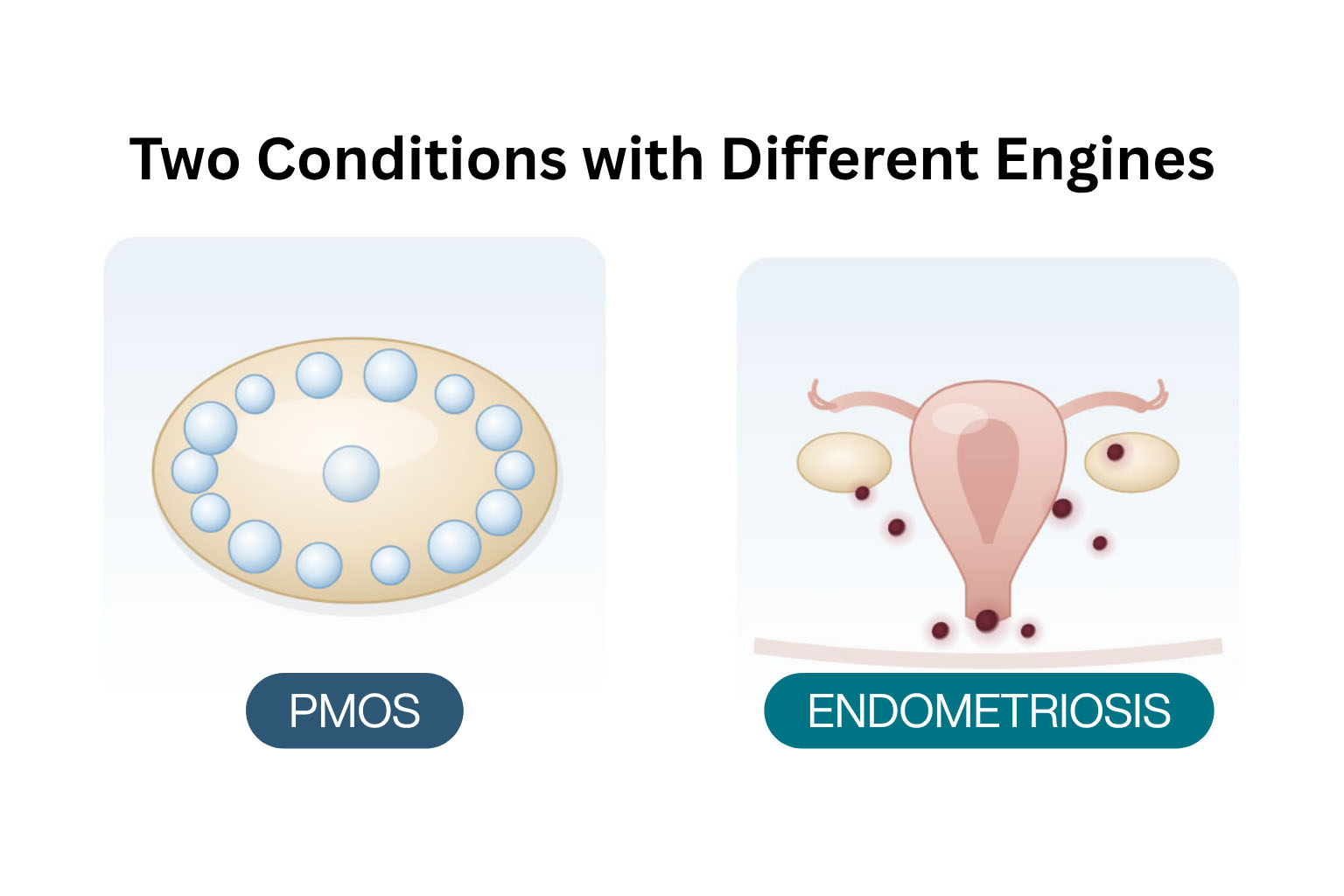
In short, PMOS mainly disrupts ovulation and metabolism, while endometriosis mainly causes inflammation, scarring and pain. They have different causes, but they can affect the same woman.
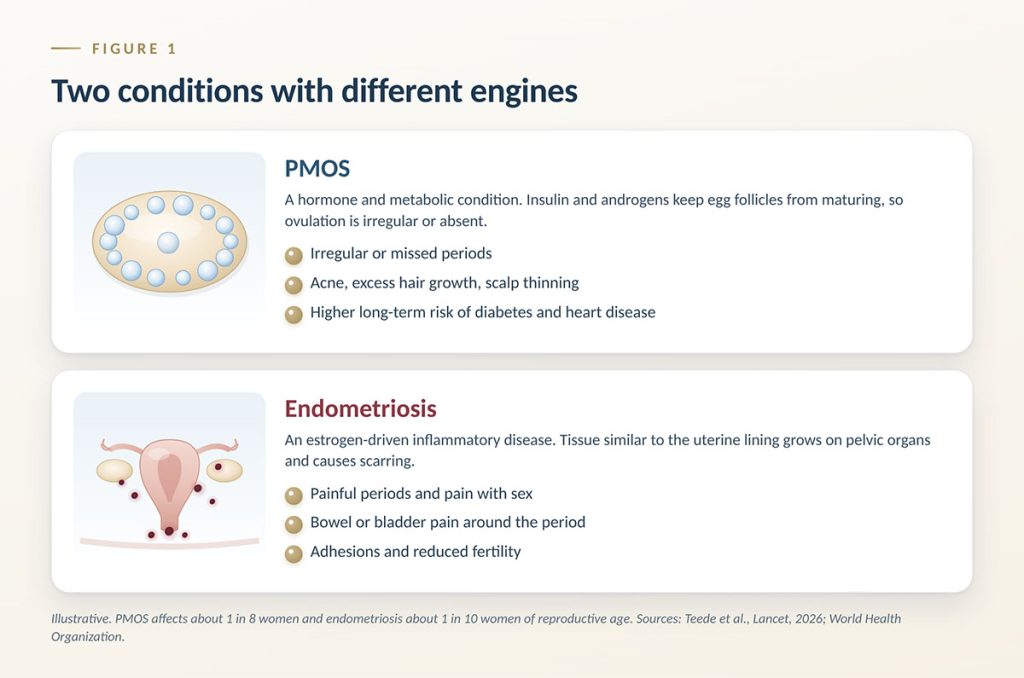
Figure 1. PMOS and endometriosis differ in cause and in their typical symptoms.
Why they were thought to be opposites
For many years, clinicians assumed the two conditions rarely occurred together, and the reasoning seemed sound. Endometriosis depends on estrogen and on regular menstruation; one leading theory holds that it begins when menstrual tissue flows backward through the fallopian tubes into the pelvis.
Women with PMOS often have infrequent periods and higher androgen levels. Some researchers have even proposed that the two sit at opposite ends of a hormonal spectrum, shaped in part by testosterone exposure before birth.[4]
That hypothesis is interesting biology, but it encouraged a habit in everyday practice. Once a woman carries a PCOS diagnosis, her pelvic pain is frequently attributed to “cysts” and no one looks further. The old name made that easy to do. We have cared for many women whose endometriosis was found only after years of being told their symptoms were explained.
What the research now shows
Several recent studies point the same way, even though they use different methods.
- Ultrasound. In a 2026 study from McMaster University, published in Ultrasound in Obstetrics & Gynecology under the title “Challenging prior assumptions,” 35% of women found to have endometriosis on advanced ultrasound also had polycystic ovarian morphology, the ovarian appearance that is one of the diagnostic features of PMOS. [5]
- Clinical diagnosis. Among 380 women with endometriosis studied in 2026, 24.5% also met criteria for PCOS. After adjusting for age, women with both conditions had nearly twice the odds of infertility and reported more severe symptoms than women with endometriosis alone. [6]
- Surgery. A 2019 study from Vienna examined 225 women with PCOS who had laparoscopic ovarian drilling because ovulation pills had not worked. None had typical endometriosis symptoms, yet 16.9% were found to have endometriosis at surgery, all of it early stage. Pooled with other drilling studies, the figure was 7.7%. [7]
- Genetics. A 2024 analysis of genetic data from more than 470,000 women in endometriosis studies and more than 210,000 in PCOS studies found a positive genetic correlation between the two conditions and 12 shared genetic regions. [8]
These studies come from different populations, including specialist referral clinics, so they do not give one precise figure for how often the conditions overlap. Taken together, they show that the overlap is real and large enough to change how women should be evaluated.
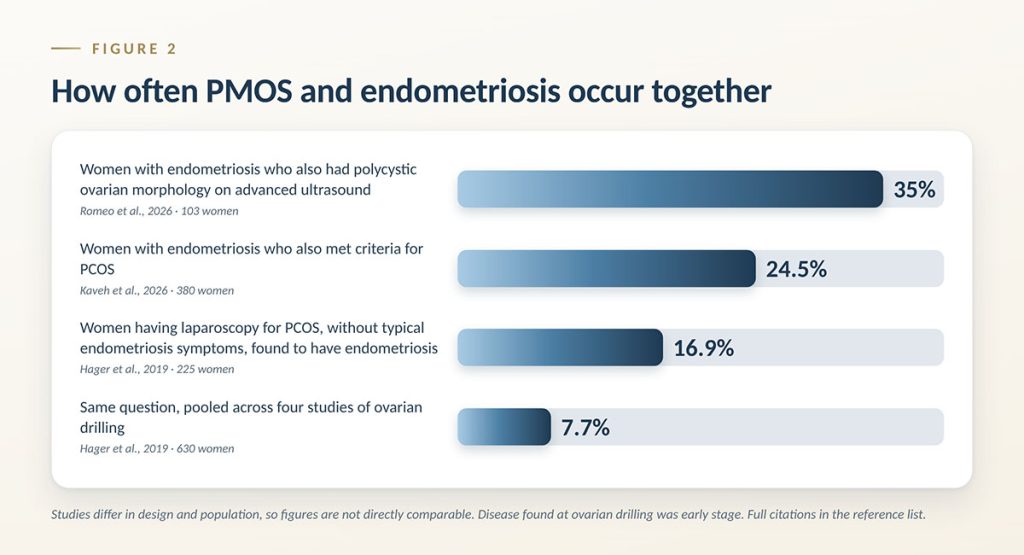
Figure 2. Reported overlap between PMOS and endometriosis across recent studies.
Why the combination is easy to miss
Pelvic pain is not a typical feature of PMOS. Some women feel discomfort from enlarged ovaries, but periods that keep you home from school or work, pain during sex, and pain with bowel movements or urination around your period point toward endometriosis, whatever other diagnosis you already have.
Imaging also has limits. The many small follicles of PMOS are easy to see on ultrasound. Endometriomas, which are endometriosis cysts inside the ovary, and deep endometriosis can often be identified by an experienced sonographer or on MRI. Superficial endometriosis on the pelvic lining, which is the most common form of the disease, usually cannot be seen on any scan. International guidance is clear that a normal ultrasound does not exclude endometriosis.[9]
Treatment can also mask both conditions. Birth control pills are reasonable for each: they regulate bleeding and protect the uterine lining in PMOS, and they can reduce endometriosis pain. Because they control symptoms rather than remove disease, many women discover both problems at once when they stop the pill to try for a pregnancy.
What it means for surgery
This is the point we most want patients and colleagues to take from this article. When a woman with PMOS has laparoscopy, whether for ovarian drilling, an infertility evaluation or pain, the surgeon should systematically inspect the entire pelvis and abdomen and remove any suspicious tissue for examination under the microscope. The Vienna study found endometriosis in women who had no symptoms of it at all. [7]
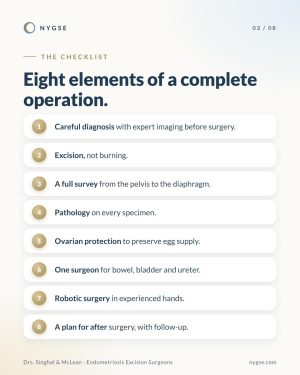
We treat endometriosis by excision, which means cutting the lesion out at its base rather than burning its surface. Excision provides tissue for the pathologist to confirm the diagnosis, and it allows us to remove disease that extends below the surface. That matters most when endometriosis involves the bowel, bladder or ureters. Because our training includes gynecologic oncology, we perform those portions of the operation ourselves, so a woman with deep disease does not need a second surgical team.
Protecting the ovaries requires particular care in a woman with both conditions. Women with PMOS usually have a generous supply of eggs, but removing an endometrioma lowers anti-Müllerian hormone (AMH), a blood marker of the remaining egg supply, according to a meta-analysis of prospective studies. [10] Ovarian drilling also removes some ovarian tissue. Every step that touches the ovary should be weighed against what it offers for pain or fertility, and healthy tissue should be preserved wherever possible.
There is also a cancer-prevention side to PMOS that our oncology training keeps in view. Years without ovulation leave the uterine lining exposed to estrogen without the hormone signal that tells it to shed, which raises the risk of endometrial cancer. [11] A woman who goes three months or longer without a period should be evaluated, whether or not she is trying to conceive.
What it means for fertility
For women with PMOS who want to conceive, letrozole is the first-line medicine to restore ovulation. In a landmark 2014 trial of 750 women, letrozole produced more live births than clomiphene, the older standard (27.5% versus 19.1%). [2][12]
When endometriosis is also present, restoring ovulation addresses only part of the problem. Endometriosis can lower the chance of pregnancy through inflammation in the pelvis, scarring around the ovaries and damage to the fallopian tubes, and ovulation medicine does not treat any of those.
Our practical advice is to confirm that ovulation is actually happening, and then to set a clear point for reassessment. If you are ovulating and are still not pregnant after several cycles, ask whether endometriosis has been considered and whether your tubes have been checked. Agree on a timeline with your doctor, particularly if you are 35 or older. Depending on your findings, the next step may be surgery to remove endometriosis or a referral for IVF, which works well in both conditions when the protocol is designed with each in mind.
Questions to bring to your appointment
- Could my pain be caused by endometriosis rather than PMOS?
- Has anything actually ruled out superficial endometriosis, or only the forms ultrasound can see?
- If I have surgery, will the whole pelvis be examined, and will any endometriosis be excised and sent to pathology?
- How will my ovaries and my egg supply be protected during surgery?
- Who is following my blood sugar, blood pressure and cholesterol over the long term?
The bottom line
PMOS and endometriosis are separate conditions, and having one does not protect you from the other. When pain, irregular cycles or difficulty conceiving do not fit neatly under a single diagnosis, it is reasonable to ask for a fuller evaluation. Both conditions are common, and both are treatable when they are recognized. The new name for PMOS is a good opportunity to look at the whole picture, and that includes asking whether endometriosis is part of it.
About the authors. Pankaj Singhal, MD, MS, MHCM, FACOG, and Virginia McLean, MD, are endometriosis excision surgeons at New York Gynecology Surgery & Endometriosis in Babylon, NY. Dr. Singhal is double board certified in obstetrics and gynecology and in gynecologic oncology, has performed more than 12,000 surgeries, more than 6,000 of them robotic, and holds a national designation as a master robotic surgeon.
This article is for general education and is not a substitute for individual medical advice. Please speak with your own physician about your symptoms and treatment.
References
- Teede HJ, Khomami MB, Morman R, et al. Polyendocrine metabolic ovarian syndrome, the new name for polycystic ovary syndrome: a multistep global consensus process. Lancet. 2026;407(10545):2329-2339. doi:10.1016/S0140-6736(26)00717-8
- Teede HJ, Tay CT, Laven J, et al. Recommendations from the 2023 International Evidence-based Guideline for the Assessment and Management of Polycystic Ovary Syndrome. Fertil Steril. 2023;120(4):767-793. doi:10.1016/j.fertnstert.2023.07.025
- World Health Organization. Endometriosis fact sheet. Geneva: WHO; 2023.
- Dinsdale NL, Crespi BJ. Endometriosis and polycystic ovary syndrome are diametric disorders. Evol Appl. 2021. doi:10.1111/eva.13244
- Romeo P, Freger SM, Kalani N, et al. Challenging prior assumptions: coexistence of polycystic ovarian morphology and endometriosis on transvaginal ultrasound. Ultrasound Obstet Gynecol. 2026;68(3):406-412. doi:10.1002/uog.70289
- Kaveh M, Moghadam MN, Iranpour Z, et al. Epidemiological study and clinical consequences of endometriosis and PCOS co-occurrence in a clinical population of women: a cross-sectional study. BMC Womens Health. 2026;26(1). doi:10.1186/s12905-026-04327-z
- Hager M, Wenzl R, Riesenhuber S, et al. The prevalence of incidental endometriosis in women undergoing laparoscopic ovarian drilling for clomiphene-resistant polycystic ovary syndrome: a retrospective cohort study and meta-analysis. J Clin Med. 2019;8(8):1210. doi:10.3390/jcm8081210
- Tan H, Long P, Xiao H. Dissecting the shared genetic architecture between endometriosis and polycystic ovary syndrome. Front Endocrinol (Lausanne). 2024;15:1359236. doi:10.3389/fendo.2024.1359236
- Becker CM, Bokor A, Heikinheimo O, et al. ESHRE guideline: endometriosis. Hum Reprod Open. 2022;2022(2):hoac009. doi:10.1093/hropen/hoac009
- Raffi F, Metwally M, Amer S. The impact of excision of ovarian endometrioma on ovarian reserve: a systematic review and meta-analysis. J Clin Endocrinol Metab. 2012;97(9):3146-3154. doi:10.1210/jc.2012-1558
- Barry JA, Azizia MM, Hardiman PJ. Risk of endometrial, ovarian and breast cancer in women with polycystic ovary syndrome: a systematic review and meta-analysis. Hum Reprod Update. 2014;20(5):748-758. doi:10.1093/humupd/dmu012
- Legro RS, Brzyski RG, Diamond MP, et al. Letrozole versus clomiphene for infertility in the polycystic ovary syndrome. N Engl J Med. 2014;371(2):119-129. doi:10.1056/NEJMoa1313517