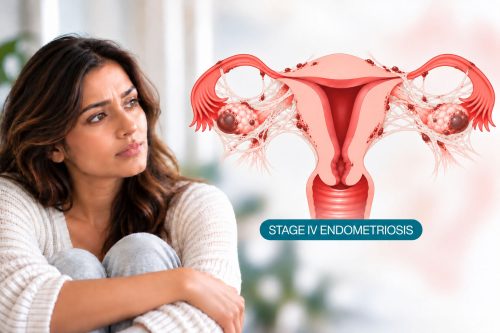


“We Didn’t Find Endometriosis.”
You are still in pain. What that sentence means, what it does not mean, and why it is the middle of the story rather than the end.
Dr. Pankaj Singhal and Dr. Virginia McLean
Gynecologic and robotic surgeons specializing in endometriosis · New York Gynecology Surgery & Endometriosis (NYGSE™) · www.nygse.com
© 2026 New York Gynecology Surgery & Endometriosis. Proprietary NYGSE material. No reproduction or distribution without written permission.
You are still half under when the surgeon comes to the bay. The words are kind, and they are quick. We had a good look around. We didn’t find any endometriosis. Good news.
Then the curtain closes and everyone moves on to the next patient, and you are left holding the one thing nobody has explained.
You are still in pain.
We meet women at exactly that moment, and we meet women who have been living inside it for years. They come in apologizing. They have been told the surgery was normal, and somewhere between the recovery bay and the parking lot they concluded — or were allowed to conclude — that if the surgery was normal, then the abnormal thing must be them. Some have stopped saying the word pain out loud at home. Some have quietly begun to wonder whether they made it up.
So before any of the science, one sentence.
A negative laparoscopy does not mean your pain is imaginary
Pain is not a finding on a photograph. It is what you feel, and it is real whether or not a camera found the reason for it. A laparoscopy that found nothing tells you something about what was seen through a lens, on one day, by one pair of hands. It tells you nothing whatsoever about what you feel.
Nobody gets to hand you the word normal and take your symptoms away with it.
The next question is the one that matters: how was the laparoscopy performed?
This is not a challenge to your surgeon. It is a question about a procedure, and it has real answers, most of which are written down somewhere with your name on them.
- Was there a system? Was the pelvis systematically evaluated — in an order, on purpose — rather than looked over?
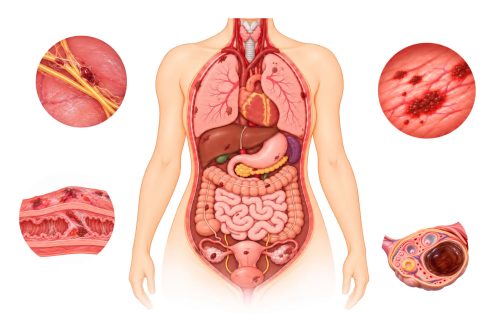
- Which areas were actually inspected? The ovaries. The pelvic sidewalls. The cul-de-sac, which is the pocket behind the uterus. The uterosacral ligaments. The bladder. The bowel and the appendix. The ureters. The diaphragm, up under the ribs, which is often not looked at at all.
- Were photographs or video recorded? A written description is good. Images are better, because they can be reviewed later by someone else.
- Were biopsies taken, or only pictures? This is the single most important question on the list, and we will come back to it.
- How long did the operation take? A thorough inspection of every one of those areas is not a ten-minute operation.
Endometriosis can be subtle. It can be clear or white rather than the dark spots most people picture. It can be hidden underneath adhesions, or tucked into anatomy that scarring has pulled out of its usual shape. It can sit behind a surface that looks perfectly normal from above. And it can be somewhere the camera never went.
What the research says about being missed
These are not our opinions. They are published numbers, and they are not comfortable ones.
- Early disease is the hardest to see. In a study of 1,439 biopsies from 431 patients, the surgeon’s eye was correct in only 49.7 percent of the mildest, stage I disease. Deep lesions were about two and a half times more likely to be identified correctly than superficial ones — and superficial disease is exactly the kind that causes years of pain.
- Surgeons are wrong in both directions. In a study of 2,005 tissue samples, tissue the surgeon looked at and judged not to be endometriosis came back from the laboratory as endometriosis 24.3 percent of the time. Roughly one in four.
- Sometimes it is invisible. In 142 women whose pelvis looked entirely normal at surgery for pelvic pain, surgeons biopsied the normal-looking tissue anyway. Thirty-nine percent of those women had endometriosis under the microscope.
- And the eye and the microscope often disagree. In a 2026 review of 1,309 women, what the surgeon saw and what the pathologist found disagreed 56 percent of the time.
READ THIS PART CAREFULLY
That 39 percent figure is powerful and it is also a single retrospective study, and microscopic endometriosis has been found in women who have no pain at all. So a positive biopsy of normal-looking tissue does not automatically explain your symptoms, and we are not going to pretend it does.
What these studies establish is narrower and still important: “nothing was seen” and “nothing is there” are two different claims, and only the first one is ever really being made.
Who holds the camera changes the answer
This is the part we most want you to take with you.
That 2026 study looked at 1,309 women having surgery for pelvic pain and asked a simple question: who did the operation? A negative laparoscopy was about two and a half times more likely when the surgery was done by a gynecologist without fellowship training in this field than when it was done by an accredited fellowship-trained surgeon. Of the cases called negative on sight alone, 85 percent were done by non-fellowship-trained surgeons who took no biopsy at all.
Nobody in that study did anything careless. Recognizing subtle endometriosis is a skill, and skills are built by doing an operation over and over until the eye changes. That is precisely why the national guidelines say what they say: a diagnostic laparoscopy should include a systematic inspection of the pelvis, performed by a gynecologist with training and skills in laparoscopic surgery for endometriosis.
If you are still in pain after a negative laparoscopy, the most useful thing you can do is not necessarily another operation. It is a second opinion from someone who does this operation every week.
The harm is not only the missed disease
We want to name something that rarely gets written down in a medical article, because it is the part we see most often in our consultation room.
When endometriosis is missed, you do not simply walk out with untreated disease. You walk out with a document that says nothing is wrong with you. And that document then goes to work on your life.
It becomes the reason the next doctor does not look. It becomes the sentence your mother repeats to relatives, gently, to explain why you are still like this. It becomes what your partner heard when they were told the surgery went well. It becomes the note in your chart that every
clinician reads before they meet you, so that you walk into every appointment for the next several years already carrying the word normal.
And worst of all, it goes to work on you. You start bargaining with your own body. Maybe this is what periods are. Maybe everybody feels like this and copes better. Maybe I have a low pain threshold. Maybe I am difficult. Women tell us they stopped calling out sick because they no longer felt entitled to. They stopped mentioning the pain to their partner. They cancelled less, and pushed through more, and got quieter, and felt more alone in it every year.
All of that from a sentence delivered in ninety seconds by somebody who was doing their best with the training they had.
Meanwhile the disease, if it is there, is not waiting. It is not sitting still out of respect for the operative report. Some of the women we operate on have had a negative laparoscopy several years earlier, and what we find has had all of those years to establish itself, with adhesions and scarring that would have been simpler to treat when she first asked for help.
That is the true cost of an incomplete laparoscopy. Not one missed lesion — a missed lesion plus a certificate of normality plus the years it buys.
If any of that is you: you were not wrong about your own body. You were told something incorrect with great confidence, and you believed it, because that is what a reasonable person does with a surgeon’s words.
THE WORD THAT DOES ALL THE WORK
The UK’s national guideline body, NICE, says: “If a full, systematic laparoscopy is performed and is normal, explain to the woman that she does not have endometriosis, and offer alternative management.” We agree with that sentence.
Read it again and notice the word full. That is a condition, not a courtesy. Almost every woman who has been handed the second half of that sentence was never told whether the first half was true.
And even then, the European guideline is careful: negative histology does not entirely rule out the disease. Both of these statements are true at the same time. Holding both is not fence-sitting — it is the honest position.
If the laparoscopy really was complete, and really was normal
Then something important has happened: the field has narrowed. That is genuinely useful, and it is not the same as nothing is wrong. It means the investigation moves, not that it stops. Pelvic pain has other causes, and most of them can be found in a clinic rather than an operating room.
- Adenomyosis. Endometriosis inside the muscle of the uterus. A laparoscopy looks at the outside of the uterus, so this can be entirely invisible at surgery. It is found on imaging — usually a careful ultrasound or MRI.
- Pelvic floor muscle pain. The muscles of the pelvic floor can develop tight, painful trigger points that reproduce almost exactly the pain of endometriosis. In the classic series of women referred on after a negative laparoscopy, this was the single most common diagnosis eventually found — and about three quarters of the women who received a diagnosis improved or fully resolved once it was named and treated. It is found by examination, by hand, by someone looking for it.
- Bladder pain syndrome. A bladder that hurts as it fills, urgency and frequency without infection. Common, treatable, and routinely mistaken for gynecologic pain.
- Bowel conditions. Irritable bowel syndrome and small intestinal bacterial overgrowth both overlap heavily with endometriosis symptoms and with each other.
- Nerve pain. Pudendal neuralgia, nerve entrapment, and pain trapped in a caesarean or laparoscopy scar. These produce a burning, electric, or stabbing quality that is often described very differently from period pain.
- Blood vessels, hernias, and leftovers. Congested pelvic veins, an occult hernia, or ovarian tissue left behind after previous surgery.
Each of those has a test or an examination that finds it. None of them is found by being told nothing is wrong.
And sometimes the pain system itself is the problem
When pain goes on long enough, the nervous system adapts to it. Nerves that carry pain signals become easier to trigger. The spinal cord and brain turn up the volume. Sensations that used to be mild register as severe, and touch that should not hurt does. This has names — central sensitization, hyperalgesia, allodynia — and it is measurable.
This is not the same as the pain being in your head. It is in your nervous system, which is an organ, like a kidney, and it can be injured and treated like one.
The evidence here is sobering and clarifying at once. In a study following women for 12 to 18 months after laparoscopy, pain and quality of life were unchanged — and, crucially, unchanged regardless of whether the laparoscopy had found anything. Surgery, by itself, was not what determined how these women were doing a year later. That is an argument for treating the pain system, not for operating again on a hope.
WHAT WE CAN TELL YOU WITH CONFIDENCE
You did not imagine this. Nothing in the research above requires you to have exaggerated anything.
You are not starting from zero. You have a surgery, an operative report and a pathology report, and those three things are more information than most women arrive with.
Almost every remaining possibility on that list is findable, and most of them are findable in a clinic rather than an operating room.
And whatever is causing this, pain that has gone on this long is treatable. Not always curable — treatable. Those are different words and we choose the honest one.
What we are not saying
We are not saying every negative laparoscopy was done badly. Many are excellent, and a normal result from a truly complete operation is real information you are entitled to trust.
We are not saying you should have another operation. Repeat surgery with no new information is its own harm, with its own scarring and its own risks, and we will tell you so if you ask us for one and we do not think it will help you.
And we are not saying it must be endometriosis after all. It might not be. What we are saying is that “we didn’t find endometriosis” is a finding, not a verdict, and a finding is something you are allowed to ask questions about.
Five things to do, starting this week
1. Request your operative report and your pathology report. You are entitled to both. Do not settle for a phone summary. You want the surgeon’s own description of what was inspected and what was seen, and you want the pathologist’s report separately.
2. Find out whether any tissue was actually sent to the laboratory. If the pathology report does not exist, then no tissue was sent, and the word negative in your chart means only that nothing looked wrong to that surgeon on that day. That is worth knowing before you make any other decision.
3. Read the operative report with a highlighter. Compare it to the list earlier in this article. Look specifically for the cul-de-sac, the uterosacral ligaments, the ureters, the appendix and the diaphragm. Areas that are not mentioned were very often not examined.
4. Ask to be examined, not only scanned. A careful examination of the pelvic floor muscles, done by hand by someone who is looking for trigger points, finds things that no scan and no camera will ever show.
5. Get a second opinion from a specialist endometriosis surgeon. Bring the operative report, the pathology report and the images. A surgeon who works in this field every week can often tell you a great deal from those three documents before laying a hand on you.
Where to start
Call us, or ask your doctor to send us your records. Bring the operative report and the pathology report if you have them, and bring the story you have stopped telling people because it made them uncomfortable. We will read the documents, examine you properly, and tell you honestly what we think is going on — including if we think the answer is not surgery.
You have been carrying this by yourself since the recovery bay. You do not have to keep carrying it alone, and you do not have to keep proving that it hurts.
No visible endometriosis does not mean no explanation for your pain. It means the investigation must continue.
Sources: NICE guideline NG73, Endometriosis: diagnosis and management (recommendations on diagnostic laparoscopy, systematic inspection and biopsy). · Becker CM, et al. ESHRE guideline: endometriosis. Human Reproduction Open. 2022 (PMID 35350465). · Reliability of visual diagnosis of endometriosis. Journal of Minimally Invasive Gynecology. 2013 (PMID 24183270). · Laparoscopic excision of lesions suggestive of endometriosis or otherwise atypical in appearance. Journal of Minimally Invasive Gynecology. 2008 (PMID 18262141). · Prevalence of occult microscopic endometriosis in clinically negative peritoneum during laparoscopy for chronic pelvic pain. International Journal of Gynaecology and Obstetrics. 2020 (PMID 32644227). · The incidence of negative laparoscopy for pelvic pain stratified by level of training and location of service provision. Australian and New Zealand
Journal of Obstetrics and Gynaecology. 2026 (PMID 42104671). · Nongynecologic somatic pathology in women with chronic pelvic pain and negative laparoscopy. Journal of Reproductive Medicine. 1991 (PMID 1830102). · Chronic pelvic pain and quality of life after laparoscopy. European Journal of Obstetrics & Gynecology and Reproductive Biology. 2007 (PMID 16730874). This article is general education, not individual medical advice, and it is not a comment on the care of any particular patient or the work of any particular surgeon. Decisions about further surgery should be made with a specialist who has reviewed your own records and examined you. If you develop severe or sudden pelvic pain, fever, heavy bleeding, or fainting, seek medical care promptly rather than waiting for a routine visit.