

Bloated by Dinnertime, Every Single Day?
Endo belly, bacterial overgrowth in the small intestine, and what the newest research does and does not show.
Dr. Pankaj Singhal and Dr. Virginia McLean
Gynecologic and robotic surgeons specializing in endometriosis · New York Gynecology Surgery & Endometriosis (NYGSE™) · www.nygse.com
© 2026 New York Gynecology Surgery & Endometriosis. Proprietary NYGSE material. No reproduction or distribution without written permission.
Almost every week, a patient waits until the end of the visit to mention the bloating. She has already described the pain, the heavy bleeding, the years of being told it was normal. Then, on the way out, she says something like: this is probably nothing, but my stomach blows up every afternoon.
It is not nothing. She can be flat in the morning and look several months pregnant by dinner. Her clothes stop fitting by evening. It hurts. It gets worse around her period. She has been told to cut out gluten, or dairy, or to relax. Online she has found a name for it, endo belly, and a long list of people willing to sell her something for it.
So it is worth saying clearly what is known, what was published this year, and what the research does not support.
Understanding Endo Belly and Bacterial Overgrowth
What Is Endo Belly?
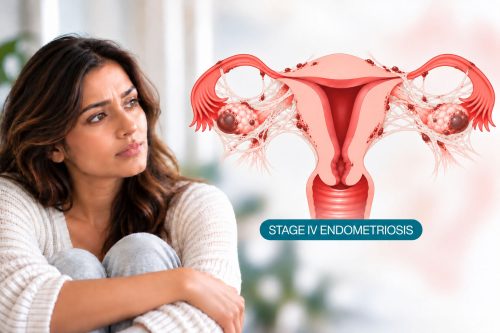
There is no medical condition called endo belly. The phrase describes something real that patients noticed long before anyone studied it: abdominal distension that builds through the day, often flares with the cycle, and can be severe enough to change how a person dresses and eats.
Because it is a description rather than a diagnosis, it has more than one cause, and those causes can stack. Bowel gas from fermentation. Slowed transit and constipation. Inflammation in the pelvis. Bowel loops tethered by adhesions or by endometriosis growing on the bowel itself. Bracing the abdominal wall against pain. Several of these can be true in the same person on the same day.
What Is SIBO (Small Intestinal Bacterial Overgrowth)?
Most gut bacteria live in the colon. The small intestine, where food is actually absorbed, is meant to stay relatively sparse. When bacteria settle there in large numbers, the condition is called small intestinal bacterial overgrowth, or SIBO. When the dominant organisms are methane producers, it is called intestinal methanogen overgrowth, or IMO.
The mechanism is simple enough to explain in a sentence. Carbohydrate that should be absorbed gets fermented instead, gas is produced in the wrong part of the bowel, and the result is distension, cramping, and either constipation or diarrhea depending on which gas dominates. Methane in particular slows the bowel down and tracks with constipation.
It is measured with a breath test. The patient drinks a sugar solution, then breathes into collection tubes over the next two to three hours while the laboratory measures hydrogen and methane. It is not an invasive test, and that is part of why it gets ordered so freely.
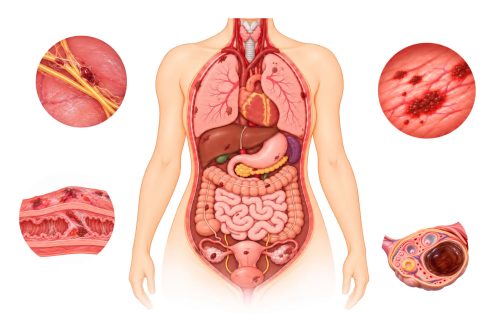
Endometriosis can be subtle. It can be clear or white rather than the dark spots most people picture. It can be hidden underneath adhesions, or tucked into anatomy that scarring has pulled out of its usual shape. It can sit behind a surface that looks perfectly normal from above. And it can be somewhere the camera never went.
The Link Between SIBO and Endometriosis
What the Research Actually Shows
A study published in 2025 in the International Journal of Gynaecology and Obstetrics compared 148 women with endometriosis against 148 women without it, and breath-tested them all. In the endometriosis group, 136 of 148 tested positive for bacterial overgrowth, which is 91.9 percent. In the comparison group, 123 of 148 tested positive, which is 83.1 percent. The difference reached statistical significance at a p value of 0.0223.
The symptom findings in the same study are, to us, more useful than the breath tests. Women with endometriosis reported altered bowel transit far more often, 85.8 percent against 71 percent, and constipation 67.8 percent against 44.7 percent. Among everyone who tested positive, methane was the dominant gas in 63.2 percent of cases, which fits the constipation pattern rather than the diarrhea one.
This is not a new idea, only a newly measured one. A study from 1998 in Fertility and Sterility examined 50 women with surgically confirmed endometriosis and gastrointestinal symptoms. All 50 had an abnormality of bowel motility on testing, and 40 of them, 80 percent, had bacterial overgrowth. That study had no comparison group, so it could not tell anyone how unusual those numbers were. Now we have some idea.
READ THIS PART CAREFULLY
Look again at the comparison group in the 2025 study.
Eighty three percent of the women without endometriosis also tested positive. A test that is positive in five out of every six healthy people is not telling you much that is specific to you. The gap between the two groups was real, but it was about nine percentage points, not the dramatic finding it gets turned into online.
This is an association between two things that often occur together. It is not proof that endometriosis causes bacterial overgrowth, and it is certainly not proof that bacterial overgrowth causes endometriosis.
Why SIBO and Endometriosis May Occur Together
Nobody has established the direction of the arrow. Several explanations are under discussion, and they can all be partly true at once.
- Endometriosis slows the bowel down. Inflammation in the pelvis, adhesions that tether loops of bowel, and disease growing on the bowel wall all interfere with normal motility. Bacteria overgrow where contents sit still. On this explanation, the endometriosis comes first and the overgrowth follows.
- Nerve signalling is disturbed. The 1998 study found abnormal motility in every single patient tested. Endometriosis involves and irritates the nerves that coordinate the gut, and that disturbance does not stop at the pelvis.
- Shared inflammation and estrogen handling. Gut bacteria influence how the body recycles estrogen, and estrogen drives endometriosis. Several 2025 and 2026 reviews argue this loop runs in both directions. All of it is still hypothesis.
- The treatments contribute. Opioids for pain, iron supplements for heavy bleeding, and long periods of limited activity after surgery all slow the bowel, and slower bowels grow more bacteria.
- The delay itself. Both bloating and pelvic pain get attributed to stress and diet before anyone investigates them. Years of that leaves patients doing their own experiments with food, and it leaves the underlying disease undiagnosed for longer.
What to Do About Endo Belly and Bloating
Five Things Worth Doing
- Get the endometriosis question answered first. If your bloating comes with painful periods, pain with sex, pain with bowel movements during your period, or bleeding heavy enough to affect your iron, the gut is not the whole story. A 2025 case report describes a woman with seven endometriosis lesions in her small bowel who had been managed for years as irritable bowel syndrome with dysbiosis. That is the outcome we are trying to prevent.
- Then ask your gastroenterologist about breath testing, as a parallel question rather than a substitute. It is a reasonable test to run. Just hold the result loosely, given how often it is positive in people with no gynecologic disease at all, and do not let a positive result close the file on everything else.
- Track the bloating against your cycle for two months. Note the day, how bad it is, and what your bowels are doing. A pattern that locks onto your period points somewhere different from one that follows meals regardless of the date. This is the single most useful thing you can bring to an appointment.
- Be careful with elimination diets. A 2024 review in AJOG Global Reports concluded there is no evidence to recommend a gluten-free diet for endometriosis. Cutting out whole food groups without guidance narrows the diet, can worsen the gut bacteria you were trying to fix, and delays the appointment that would have answered the question.
- Tell us if the bowel symptoms are cyclical. Pain with bowel movements during your period, blood in the stool at the time of your period, or a distinct worsening of constipation in the days before bleeding are the symptoms that make us look specifically for disease on or near the bowel, with imaging chosen for that question.
What SIBO Research Does Not Mean for Endometriosis
We are not saying that endometriosis causes bacterial overgrowth. We are not saying that treating bacterial overgrowth treats endometriosis, or that excision surgery is a treatment for bloating. Some patients do report that their gut settles after surgery, and some do not, and we will not promise you a result we cannot predict.
We are also not saying that every woman with endo belly has bacterial overgrowth. Given how often the test is positive in healthy people, a positive result explains less than it appears to.
What we are saying is narrower. Bloating is a real symptom, it is common in endometriosis, it is now measured rather than dismissed, and it belongs in the conversation instead of at the end of the visit.
When to See a Specialist for Endo Belly and Bloating
Bring it up early in your next appointment, not on the way out. Tell us when the bloating starts in the day, whether it tracks your cycle, what your bowels are doing, and what you have already tried. We will look at the gynecologic causes properly, check your iron, and coordinate with gastroenterology when the picture calls for it.
You should not have to choose which of your symptoms is worth mentioning.
Sources: Halfon P, et al. High prevalence of small intestinal bacterial overgrowth and intestinal methanogen overgrowth in endometriosis patients: a case-control study. International Journal of Gynaecology and Obstetrics. 2025. · Mathias JR, et al. Relation of endometriosis and neuromuscular disease of the gastrointestinal tract. Fertility and Sterility. 1998. · Bar-El L, et al. Current Opinion in Obstetrics and Gynecology. 2025. · van Haaps AP, et al. AJOG Global Reports. 2024. · Chiminacio I, et al. Case Reports in Women’s Health. 2025.
This article is general education, not individual medical advice. Bacterial overgrowth is diagnosed and treated together with gastroenterology. If you have blood in your stool outside of your period, unexplained weight loss, persistent vomiting, or a sudden change in bowel habit, seek medical care promptly rather than waiting for a routine visit.