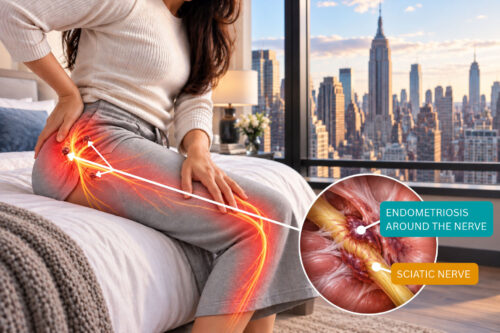
A sudden, sharp pain in or around the rectum during your period can feel like stabbing, shooting, or electric-like pain. It may appear suddenly and disappear just as quickly.
There are several possible causes of rectal pain. However, when the pain repeatedly occurs or becomes worse around menstruation, endometriosis is one condition that may need to be considered.
Painful bowel movements, also called dyschezia, are among the symptoms recognized in clinical guidelines for endometriosis. [1]
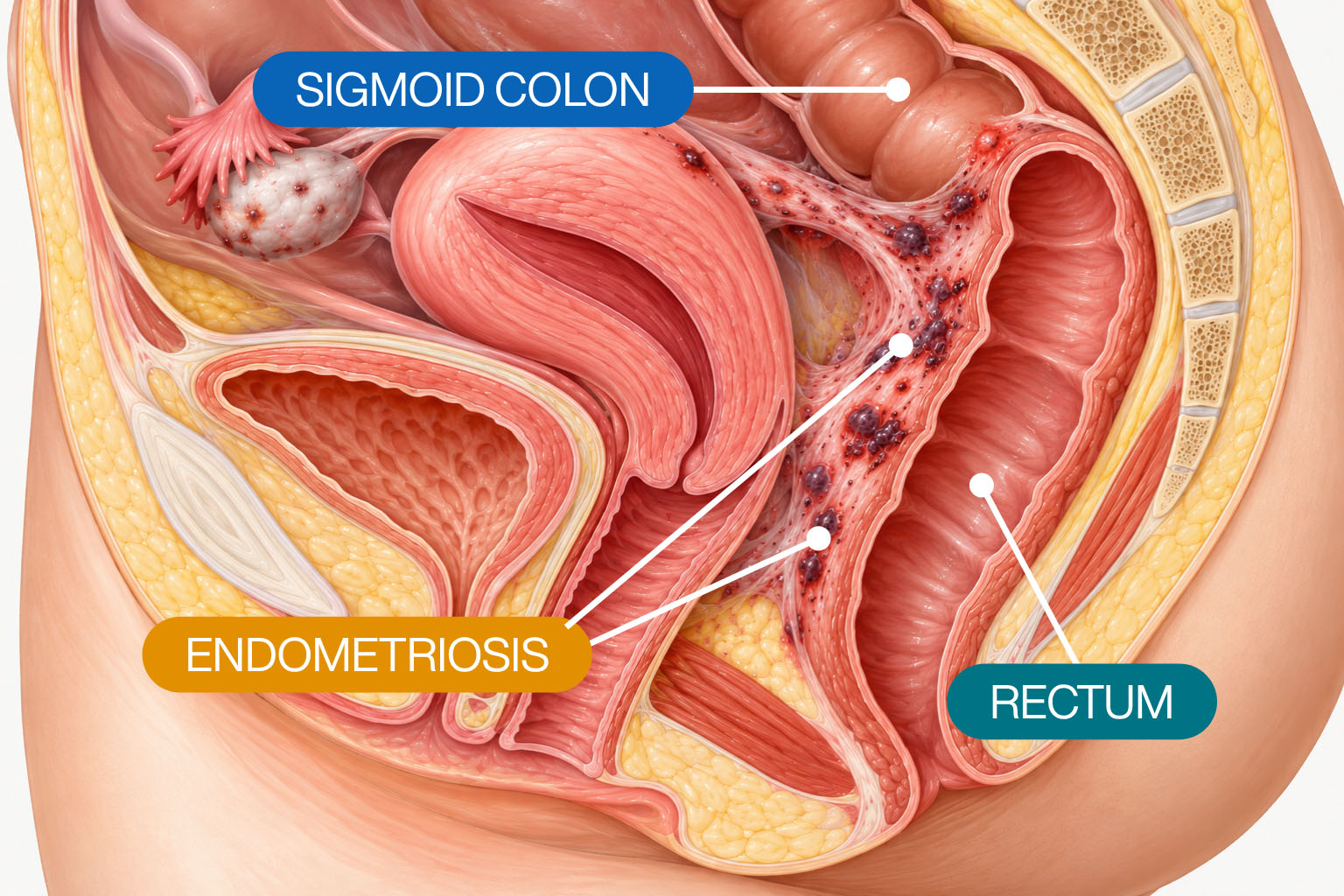
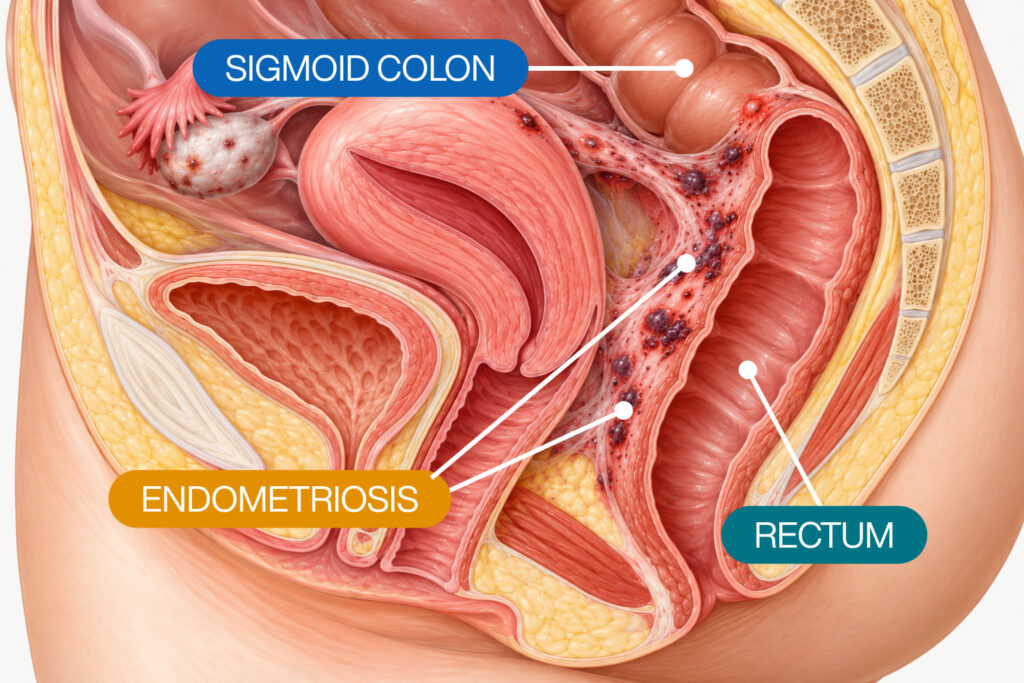
Medical illustration showing endometriosis near the rectum and cul-de-sac.
Sharp Rectal Pain and Endometriosis
Endometriosis can be associated with rectal pain, particularly when symptoms follow the menstrual cycle.
Endometriosis can develop in the posterior pelvis, including areas close to the rectum, bowel, and tissue behind the uterus. In some patients, deep endometriosis can directly involve the bowel.
Inflammation, fibrosis, adhesions, and deep endometriotic lesions in this region may contribute to pain and painful bowel movements. [2]
However, rectal pain does not automatically mean that endometriosis is affecting the bowel.
What Endometriosis-Related Rectal Pain Can Feel Like
Symptoms vary from person to person and may include:
Sharp or stabbing rectal pain
Pain during bowel movements
Deep pressure or aching in the rectal area
Pain that becomes worse during menstruation
Pelvic pain occurring with rectal pain
Constipation or diarrhea around menstruation
Less commonly, painful rectal bleeding
Some patients informally use the term “butt lightning” to describe sudden, intense, electric or stabbing pain in the rectal area. Butt lightning is not a medical diagnosis, and this type of pain can have several possible causes.
Dyschezia and painful rectal bleeding are among the symptoms clinicians are advised to consider when evaluating possible endometriosis. [1]
National Institute for Health and Care Excellence specifically identifies period-related or cyclical gastrointestinal symptoms, particularly painful bowel movements, as symptoms that should raise consideration of endometriosis. [3]
The timing of symptoms can therefore provide an important clinical clue. Rectal pain that repeatedly appears or becomes worse during the same part of the menstrual cycle may deserve further evaluation.
Rectal Pain and Bowel Endometriosis
Bowel endometriosis is a form of deep endometriosis in which endometriotic disease affects the bowel. The rectum and sigmoid colon are commonly affected locations. [2]
Symptoms can include painful bowel movements, pelvic pain, changes in bowel habits, and other symptoms that become more noticeable around menstruation. However, symptoms alone cannot determine whether endometriosis has affected the bowel.
Rectal pain can also occur without bowel endometriosis. Disease elsewhere in the posterior pelvis and other gastrointestinal, anorectal, pelvic floor, gynecologic, musculoskeletal, or neurological conditions may produce similar symptoms.
When endometriosis is suspected, ultrasound or MRI may be used as part of the diagnostic evaluation, particularly when deep endometriosis is suspected. Importantly, normal imaging does not completely rule out endometriosis, especially superficial peritoneal disease. [1]
When Rectal Pain Should Be Evaluated
An occasional brief episode of rectal pain does not necessarily indicate endometriosis. But recurrent rectal pain that consistently becomes worse before or during menstruation, particularly when accompanied by painful periods, pelvic pain, painful bowel movements, or pain during sex, may warrant further evaluation.
New or unexplained rectal bleeding, severe or persistent pain, fever, or significant changes in bowel habits should also be medically evaluated rather than assumed to be caused by endometriosis.
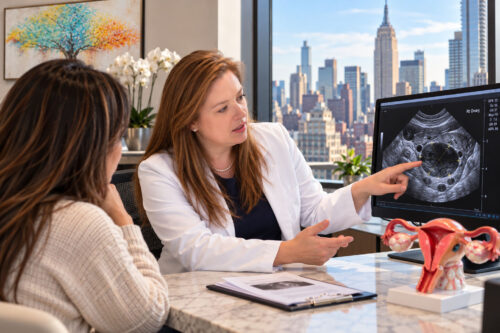
At New York Gynecology Surgery & Endometriosis (NYGSE), Dr. Pankaj Singhal and Dr. Elizabeth McLean evaluate symptoms in the context of the menstrual pattern, medical history, imaging findings, and overall pelvic anatomy.
Understanding when the pain occurs and which symptoms occur with it can help determine whether endometriosis or another condition may be contributing.
Becker, C. M., Bokor, A., Heikinheimo, O., Horne, A., Jansen, F., Kiesel, L., King, K., Kvaskoff, M., Nap, A., Petersen, K., Saridogan, E., Tomassetti, C., van Hanegem, N., Vulliemoz, N., & Vermeulen, N. (2022). ESHRE guideline: Endometriosis. Human Reproduction Open, 2022(2), hoac009. https://doi.org/10.1093/hropen/hoac009
Habib, N., Centini, G., Lazzeri, L., Amoruso, N., El Khoury, L., Zupi, E., & Afors, K. (2020). Bowel endometriosis: Current perspectives on diagnosis and treatment. International Journal of Women’s Health, 12, 35–47. https://doi.org/10.2147/IJWH.S190326
National Institute for Health and Care Excellence. (2024). Endometriosis: Diagnosis and management (NICE guideline NG73). https://www.nice.org.uk/guidance/ng73