Seeing blood after a bowel movement can be concerning at any time. When rectal bleeding repeatedly occurs around the same time as your menstrual period, the pattern deserves particular attention.
There are many possible causes of rectal bleeding, including hemorrhoids and anal fissures. However, when bleeding appears to follow the menstrual cycle, especially alongside painful bowel movements, pelvic pain, or other endometriosis symptoms, bowel endometriosis may be one condition to consider.
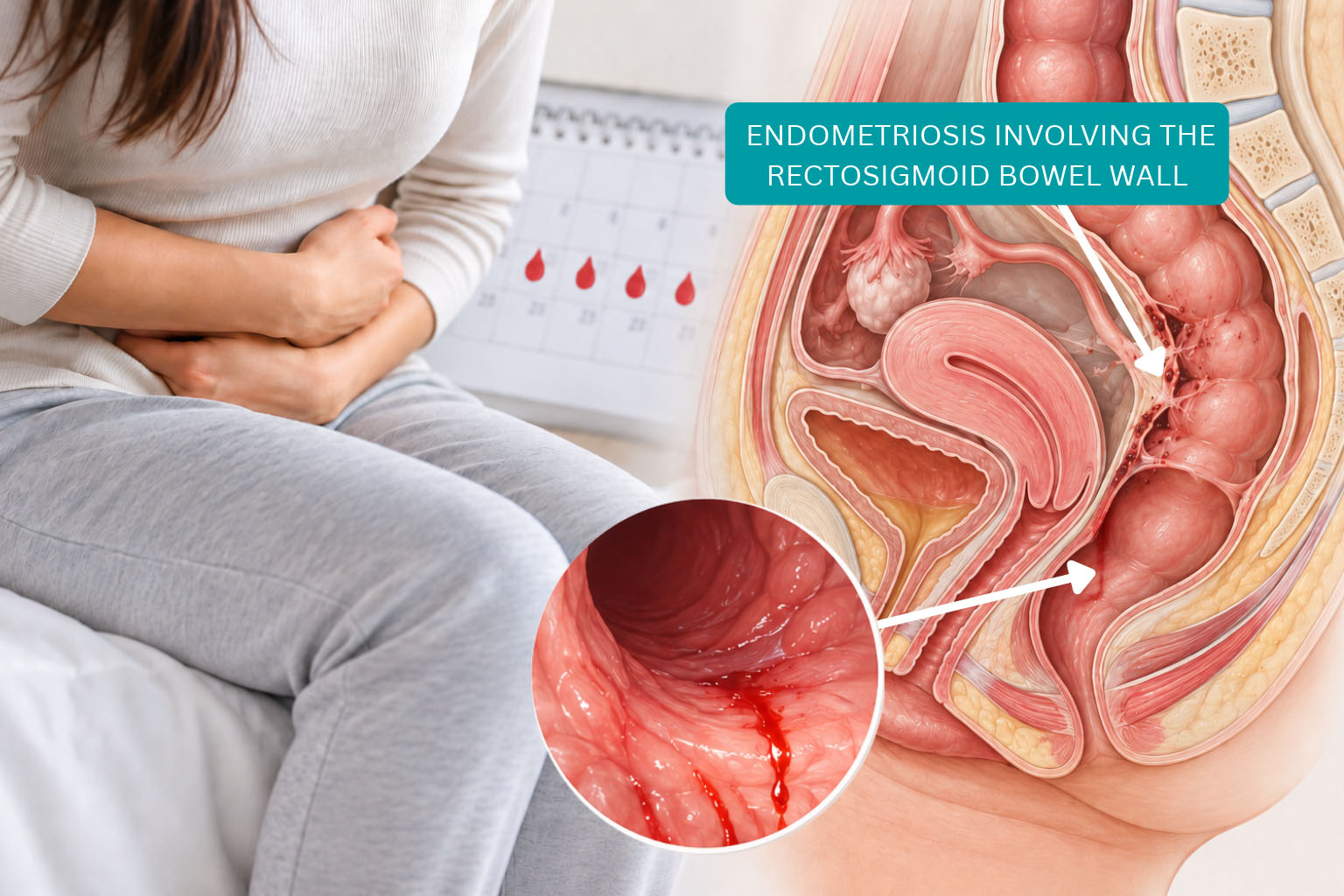
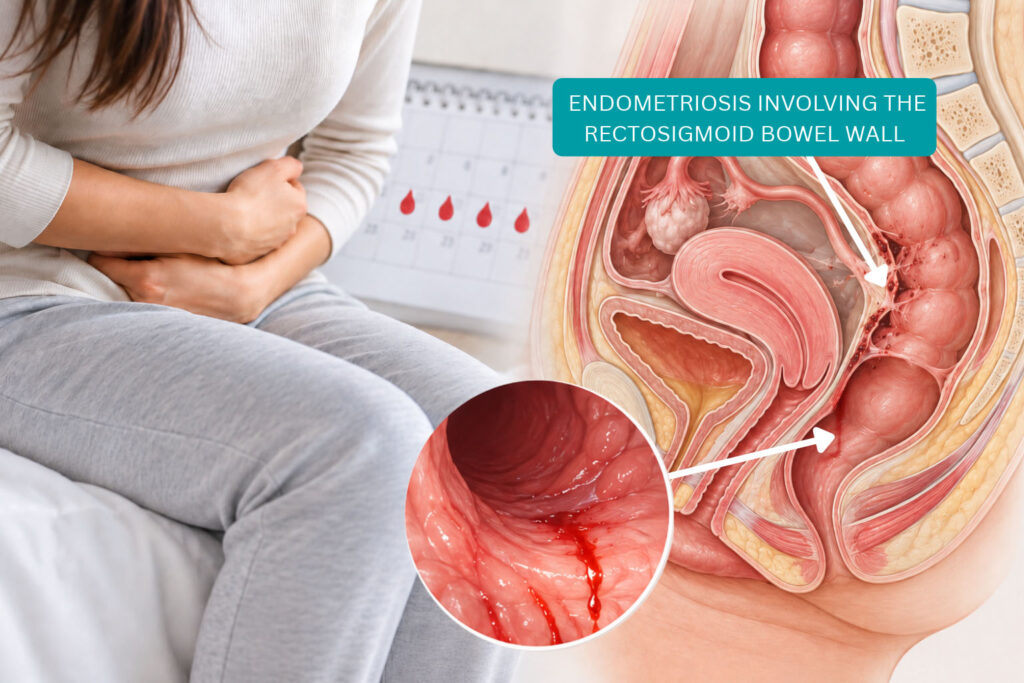
Medical illustration showing bowel endometriosis near the rectum and rectosigmoid area.
Can Endometriosis Cause Rectal Bleeding?
Yes, but it is relatively uncommon.
Bowel endometriosis occurs when endometriosis affects the intestine. The rectum and sigmoid colon are among the most commonly affected areas of the bowel. [1][3]
Patients with bowel endometriosis are more likely to experience symptoms such as painful bowel movements, constipation, diarrhea, abdominal or pelvic pain, painful periods, or pain during sex. Rectal bleeding can occur, particularly when bowel symptoms worsen around menstruation, but bleeding alone does not establish a diagnosis of endometriosis.
Why Can Bleeding Occur During Your Period?
The relationship between bowel endometriosis and rectal bleeding is more complicated than it may initially seem.
Endometriosis involving the bowel commonly affects its outer and deeper muscular layers rather than the inner lining, or mucosa, where stool passes. Because the mucosa is less commonly involved, visible rectal bleeding is considered an unusual symptom of bowel endometriosis. [1][3]
Still, cyclical rectal bleeding has been reported in patients with intestinal endometriosis. A recurring pattern, such as blood appearing during menstruation and improving afterward, can therefore provide useful clinical information, particularly when accompanied by other pelvic or bowel symptoms.
This does not mean that rectal bleeding during a period is automatically caused by endometriosis. Other gastrointestinal and anorectal conditions remain possible and need to be considered.
Other Symptoms of Bowel Endometriosis
Bowel endometriosis can present differently from one patient to another. Some people have few symptoms, while others experience significant bowel and pelvic symptoms.
Possible symptoms include:
Painful bowel movements, also called dyschezia
Deep pelvic or rectal pain
Constipation or diarrhea
Abdominal bloating
Painful periods
Pain during sex
Changes in bowel habits that worsen around menstruation
Less commonly, rectal bleeding
The timing can provide useful information. Bowel symptoms that repeatedly become worse before or during menstruation may raise suspicion for endometriosis, although symptoms do not always have to follow a menstrual pattern. [1][2]
Rectal Bleeding Can Have Other Causes
Even when rectal bleeding occurs during menstruation, it should not automatically be attributed to endometriosis.
Common causes include hemorrhoids and anal fissures. Other possibilities include inflammatory bowel disease, diverticular disease, polyps, proctitis, and other colorectal conditions that may require separate evaluation.
This is one reason it is important to tell your doctor exactly what you are seeing and when it happens.
It can also be useful to note whether the blood is bright red, dark red or maroon, mixed with the stool, visible on toilet paper, or appearing in the toilet bowl. Keeping track of whether it consistently occurs before, during, or after menstruation can help identify a pattern.
How Is Bowel Endometriosis Evaluated?
Evaluation begins with a detailed medical history.
Your doctor may ask about painful periods, pelvic pain, painful bowel movements, changes in bowel habits, pain during sex, previous endometriosis treatment, and whether bowel symptoms consistently change with your menstrual cycle.
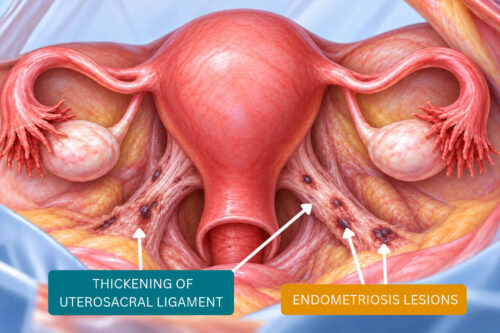
Depending on the symptoms and suspected location of disease, evaluation may include a pelvic examination, specialized transvaginal ultrasound, MRI, or other testing. Ultrasound and MRI can be particularly useful when deep endometriosis involving the bowel is suspected. [1][2][4]
A gastrointestinal evaluation may also be appropriate when rectal bleeding is present, particularly when another bowel condition needs to be excluded.
Importantly, the appropriate evaluation depends on the individual patient. No single test should be expected to explain every case of rectal bleeding or suspected endometriosis.
When Rectal Bleeding Needs Prompt Medical Attention
Rectal bleeding should not simply be assumed to be part of your period.
Seek prompt medical care for heavy or continuous bleeding, black or tarry stools, severe abdominal pain, dizziness, lightheadedness, fainting, or other signs of significant blood loss. Significant bleeding accompanied by weakness, confusion, rapid breathing, or other signs of shock requires emergency medical attention.
Even small amounts of recurrent rectal bleeding should be discussed with a healthcare professional so that the source can be properly evaluated.
When the Pattern May Point Toward Endometriosis
Rectal bleeding has many possible causes. But when it repeatedly appears around menstruation, particularly alongside painful bowel movements, pelvic pain, painful periods, pain during sex, or other recurring pelvic symptoms, the menstrual pattern is worth discussing with an endometriosis specialist.
At New York Gynecology Surgery & Endometriosis (NYGSE), we look at the complete pattern of a patient’s symptoms to determine whether endometriosis may be contributing and whether further evaluation is appropriate.
Afors, K., Murtada, R., Centini, G., Fernandes, R., Meza, C., Castellano, J., Bignardi, T., & Jurkovic, D. (2020). Bowel endometriosis: Current perspectives on diagnosis and treatment. International Journal of Women’s Health, 12, 35–47. https://doi.org/10.2147/IJWH.S190326
Becker, C. M., Bokor, A., Heikinheimo, O., Horne, A., Jansen, F., Kiesel, L., King, K., Kvaskoff, M., Nap, A., Petersen, K., Saridogan, E., Tomassetti, C., van Hanegem, N., Vulliemoz, N., & Vermeulen, N. (2022). ESHRE guideline: Endometriosis. Human Reproduction Open, 2022(2), hoac009. https://doi.org/10.1093/hropen/hoac009
Charatsi, D., Koukoura, O., Ntavela, I. G., Chintziou, F., Gkorila, G., Tsagkoulis, M., Mikos, T., Pistofidis, G., Hajiioannou, J., & Daponte, A. (2018). Gastrointestinal and urinary tract endometriosis: A review on the commonest locations of extrapelvic endometriosis. Advances in Medicine, 2018, 3461209. https://doi.org/10.1155/2018/3461209
National Institute for Health and Care Excellence. (2024). Endometriosis: Diagnosis and management (NICE Guideline NG73).https://www.nice.org.uk/guidance/ng73