

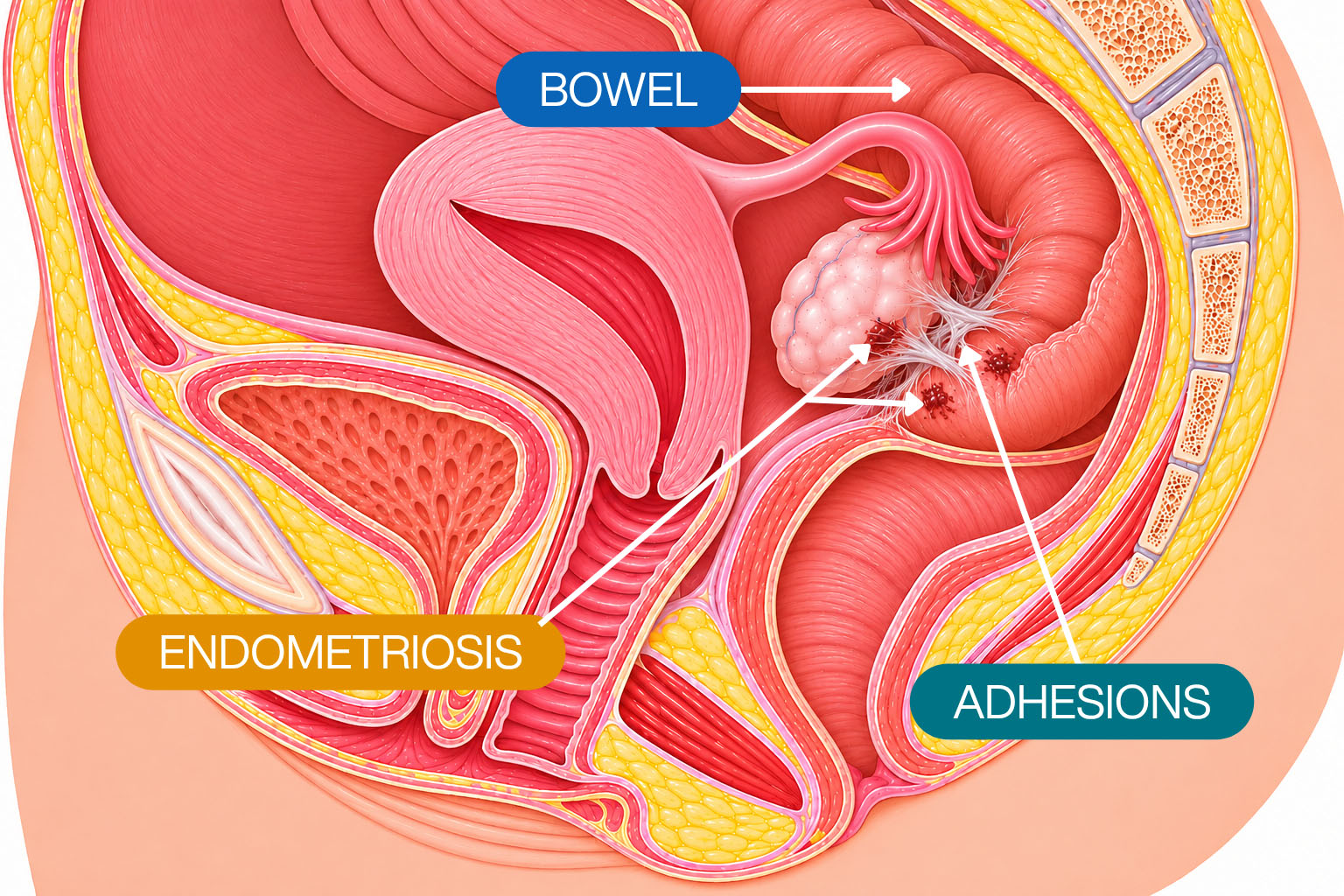
An ovary can become attached to the bowel through bands of fibrous tissue called pelvic adhesions. This may occur in women with endometriosis, particularly when inflammation and fibrosis affect the tissues surrounding the ovaries and intestines.
Normally, the ovaries have some freedom of movement within the pelvis. When adhesions develop, an ovary may become fixed to nearby structures, including the uterus, pelvic sidewall, or bowel.
An ovary stuck to the bowel does not necessarily mean endometriosis has invaded the bowel wall. Understanding this distinction is important because adhesions and endometriosis lesions may require different treatment approaches.
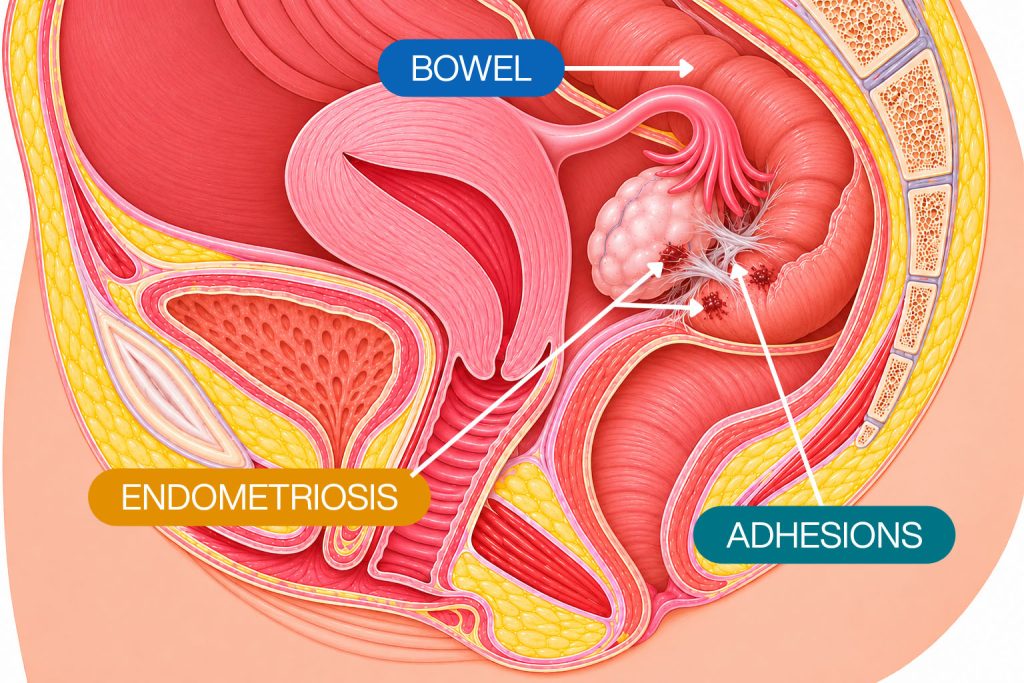
An ovary stuck to the bowel by fibrous adhesions, a condition that can occur with endometriosis.
Understanding an Ovary Stuck to the Bowel
The ovaries are normally located on opposite sides of the uterus, near the ends of the fallopian tubes. Portions of the bowel, particularly the sigmoid colon and rectum, may lie close to the ovaries.
These organs normally move relative to one another. An ovary becomes adherent or fixed when fibrous tissue restricts this movement and connects it to another structure.
The attachment may be thin and limited or dense enough to distort pelvic anatomy.
A fixed ovary is an anatomical finding, not a diagnosis. The important question is what caused the attachment and whether endometriosis is present within or near the affected tissues.
Can Endometriosis Cause an Ovary to Stick to the Bowel?
Yes. Endometriosis can cause inflammation and fibrosis that contribute to pelvic adhesions.
Endometriosis lesions contain tissue resembling the uterine lining but develop outside the uterus. These lesions may occur on the pelvic lining, ovaries, ligaments, and bowel.
Inflammatory activity and tissue repair can produce fibrous connections between structures that normally remain separate. Over time, an ovary may become attached to the bowel or other pelvic organs. [1][3]
How Endometriosis-Related Adhesions Form
Adhesions develop as part of the body’s response to tissue injury and repair.
However, an adhesion is not necessarily an endometriosis lesion. An ovary may be attached to the bowel by fibrous tissue even when no endometriosis lesion is visible at the point of attachment.
Previous pelvic surgery, infections, and other inflammatory conditions can also produce adhesions. [3]
Can an Endometrioma Cause Ovarian Adhesions?
An ovarian endometrioma is a cyst associated with endometriosis that develops within the ovary.
Endometriomas frequently coexist with pelvic adhesions and may be associated with deeper disease affecting nearby structures. [1][3]
However, having an endometrioma does not automatically mean the ovary is attached to the bowel.
Symptoms of an Ovary Adhered to the Bowel
Some women experience persistent pelvic pain, while others have few or no symptoms.
Possible symptoms include:
- One-sided or persistent pelvic pain
- Painful bowel movements, particularly during menstruation
- Deep pain during sexual intercourse
- Pelvic discomfort associated with movement
- Difficulty becoming pregnant when reproductive anatomy is affected
These symptoms are not specific to ovarian adhesions. They may also arise from endometriosis lesions, pelvic floor dysfunction, or gastrointestinal conditions. [1]
The severity of pain does not reliably indicate the extent of adhesions.
Why Can Bowel Movements Become Painful?
Bowel movements involve muscular contractions and movement of pelvic structures.
When endometriosis affects tissues near the rectum or sigmoid colon, these movements may become painful. Adhesions restricting normal organ movement may also contribute to discomfort.
However, painful bowel movements do not prove that an ovary is attached to the bowel.
Diagnosing an Ovary Stuck to the Bowel
Diagnosis begins with symptoms, medical history, pelvic examination, and imaging.
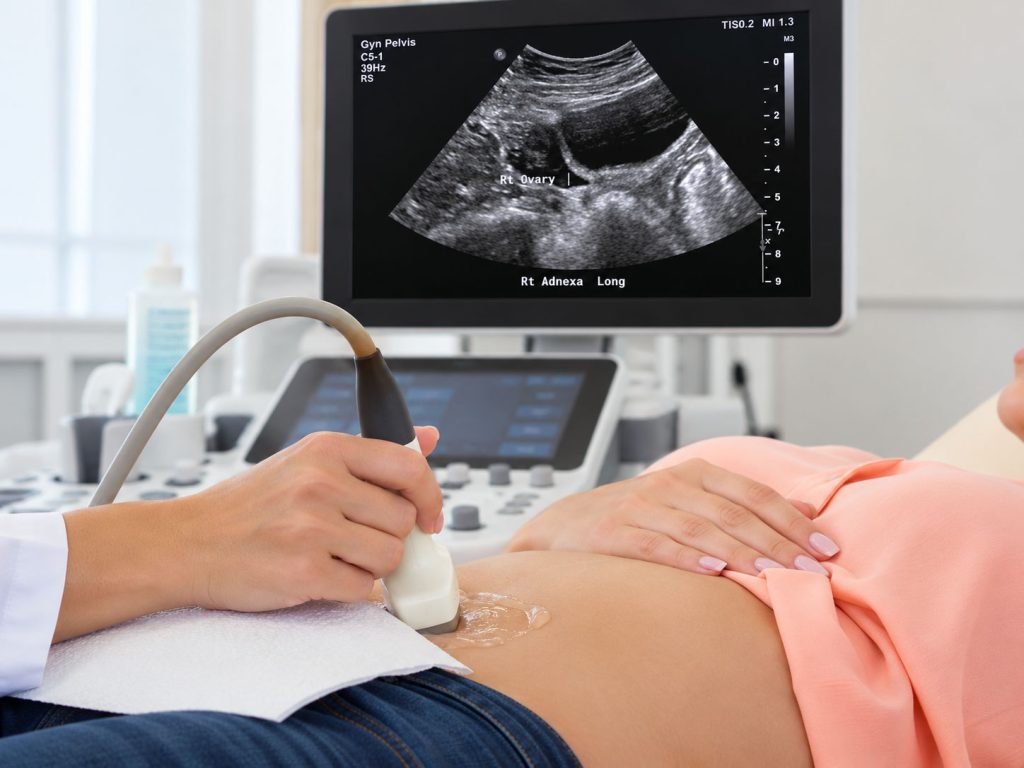
A specialized transvaginal ultrasound may identify an ovary that does not move normally relative to nearby structures.
During a dynamic examination, the clinician may assess organ mobility using gentle pressure and sliding maneuvers.
The 2024 Society of Radiologists in Ultrasound consensus recognizes ovarian fixation and abnormal organ mobility as useful indirect findings of endometriosis. [3]
Can Ultrasound or MRI Detect Pelvic Adhesions?
Specialized ultrasound can suggest adhesions by demonstrating restricted movement between pelvic organs.
MRI may help identify endometriomas, deep endometriosis, and anatomical distortion, particularly when bowel involvement is suspected.
However, neither examination reliably identifies every adhesion or superficial endometriosis lesion.
Laparoscopy allows direct inspection of the pelvis but is not automatically necessary solely to confirm ovarian fixation. [1][2]
Can an Endometriosis Risk Predictor Help?
The NYGSE Endometriosis Risk Predictor is a free online tool designed to help women assess symptoms that may be associated with endometriosis.
The predictor asks questions about symptoms and medical history to provide an estimated risk assessment. While it cannot diagnose endometriosis or determine whether an ovary is attached to the bowel, it may help patients better understand their symptoms before consulting a specialist.

An Ovary Stuck to the Bowel Does Not Always Mean Bowel Endometriosis
An ovary may be attached to the outer surface of the bowel through fibrous adhesions without endometriosis penetrating the intestinal wall.
Bowel endometriosis refers to endometriosis lesions involving the bowel itself, potentially extending into deeper layers of its wall.
These conditions may occur together, but they are not interchangeable.
This distinction matters during surgical planning. Separating an ovary from the bowel is different from removing endometriosis that infiltrates the bowel wall.
Can an Ovary Stuck to the Bowel Affect Fertility?
Pelvic adhesions may affect fertility when they distort the relationship between the ovary and fallopian tube.
Normally, the fallopian tube must capture an egg released from the ovary. Extensive adhesions may interfere with this process by restricting movement or altering reproductive anatomy.
However, ovarian fixation does not automatically cause infertility. Fertility also depends on tubal function, ovarian reserve, age, and other factors. [1][2]
Treatment for an Ovary Stuck to the Bowel
Treatment depends on symptoms, underlying disease, fertility goals, and whether nearby organs are affected.
Hormonal medication may reduce endometriosis-associated pain, but it does not physically separate an ovary from the bowel or remove established fibrous adhesions.
Surgery may be considered when symptoms remain significant, anatomical distortion affects treatment planning, or deep endometriosis requires surgical management. [1][2]
Surgical Separation of the Ovary From the Bowel
A procedure called adhesiolysis involves carefully dividing adhesions to separate attached organs.
When endometriosis lesions are identified, surgical excision may also be considered.
Separating the ovary from the bowel and removing endometriosis are two different surgical objectives.
Dividing an adhesion may restore mobility, but it does not necessarily remove the disease responsible for its formation.
Surgery carries risks, including bowel injury, bleeding, and new adhesion formation. Complex bowel involvement may require collaboration with a colorectal surgeon.
Is Surgery Always Necessary?
No. An ovary attached to the bowel does not automatically require surgical separation.
The decision depends on symptoms, suspected disease extent, reproductive goals, and the potential benefits and risks of treatment. [1][2]
For selected patients, monitoring or medical management may be appropriate.
When to Seek Specialist Evaluation
Persistent pelvic pain, painful bowel movements, ovarian endometriomas, or imaging findings suggesting a fixed ovary may indicate the need for specialist evaluation. [2]
At New York Gynecology Surgery & Endometriosis (NYGSE), specialists consider symptoms, medical history, imaging findings, previous treatments, and individual reproductive goals.
An ovary stuck to the bowel does not always require surgery. However, pelvic adhesions may affect fertility by restricting ovarian mobility and disrupting the normal relationship between the ovary and fallopian tube.
Suspected deep endometriosis or fertility concerns should be assessed by an endometriosis specialist.
This article is for general education and isn’t medical advice for any individual. If you have sudden severe pelvic pain, heavy bleeding, fever or fainting, seek urgent care.
References
- Becker, C. M., Bokor, A., Heikinheimo, O., Horne, A., Jansen, F., Kiesel, L., King, K., Kvaskoff, M., Nap, A., Petersen, K., Saridogan, E., Tomassetti, C., van Hanegem, N., Vulliemoz, N., & Vermeulen, N. (2022). ESHRE guideline: Endometriosis. Human Reproduction Open, 2022(2), hoac009. https://doi.org/10.1093/hropen/hoac009
- National Institute for Health and Care Excellence. (2024). Endometriosis: Diagnosis and management (NICE Guideline NG73). https://www.nice.org.uk/guidance/ng73
- Young, S. W., Jha, P., Chamié, L., Rodgers, S., Kho, R. M., Horrow, M. M., Glanc, P., Feldman, M., Groszmann, Y., Khan, Z., Young, S. L., Poder, L., Burnett, T. L., Hu, E. M., Egan, S., & VanBuren, W. (2024). Society of Radiologists in Ultrasound consensus on routine pelvic US for endometriosis. Radiology, 311(1), e232191. https://doi.org/10.1148/radiol.232191