

Endometriosis has no established cure that guarantees the disease will never return, but that does not mean patients must live with pain indefinitely. Treatment can remove visible disease, reduce symptoms, and sometimes provide long-lasting relief.
The important distinction is between removing endometriosis lesions, controlling symptoms, and preventing recurrence. These are different outcomes, and no current treatment can guarantee all three. [3]
Why Endometriosis Has No Guaranteed Cure
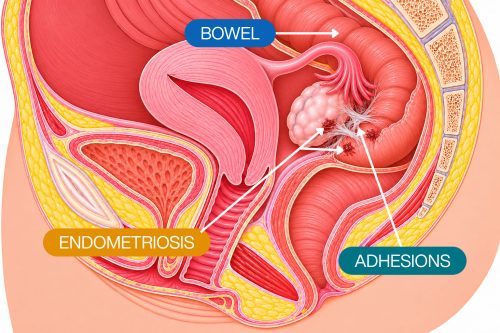
Endometriosis occurs when tissue similar to the uterine lining develops outside the uterus. These lesions may involve the pelvic lining, ovaries, ligaments, bowel, or bladder. [2][3]
Unlike the normal uterine lining, endometriosis lesions are located outside the uterine cavity. They can contribute to inflammation, fibrosis, adhesions, and irritation of surrounding nerves.[1]
Endometriosis is considered a chronic condition because disease or symptoms may persist or recur. However, chronic does not mean that every patient will experience lifelong pain or repeated surgery. [1][3]
Some patients achieve substantial improvement after treatment, while others require continued management. Outcomes depend on disease location, treatment response, and other contributing causes of pelvic pain.[1][3]
Excision Surgery Can Remove Visible Endometriosis Lesions
Excision surgery involves carefully cutting out identifiable endometriosis lesions from affected tissues. Its objective is to remove diseased tissue while preserving healthy anatomical structures whenever possible. [1][2]
Unlike hormonal medication, which primarily controls symptoms and hormonal stimulation, excision physically removes visible lesions.
Excision may be considered when endometriosis extends beneath the pelvic surface or involves deeper anatomical structures, such as the uterosacral ligaments, bowel, bladder, or tissue surrounding the ureters. These procedures require careful assessment of potential benefits and surgical risks. [1][2]
Some patients experience substantial, long-lasting improvement after surgery. However, removing all visible lesions does not guarantee that microscopic disease is absent or that every source of pelvic pain has been eliminated. [1]
Surgical outcomes depend on disease location, complexity, completeness of removal, and other contributing conditions.
Hormonal Treatment Controls Symptoms but Does Not Remove Lesions
Hormonal treatments can reduce endometriosis-associated pain by limiting hormonal stimulation of the disease.
Combined hormonal contraceptives, progestins, and medications that suppress ovarian hormone activity are commonly used for symptom management. [1][2]
However, hormonal suppression does not surgically remove endometriosis lesions, fibrosis, or adhesions, although some treatments may reduce lesion activity or size. Symptoms may return after medication is discontinued. [1]
For some patients, hormonal treatment remains an effective long-term management option. It may also be recommended after surgery to reduce certain forms of recurrence when pregnancy is not immediately desired. [1]
Does Endometriosis Always Return After Surgery?
No. Recurrence is possible, but it is not inevitable.
An important distinction exists between residual disease and recurrent disease.
Residual disease refers to endometriosis that remains after treatment, including lesions that were not identified or removed. Recurrent disease refers to endometriosis detected again after treatment, although it is not always possible to determine whether lesions are newly developed or previously undetected.
Medical studies do not always distinguish these outcomes consistently. Some define recurrence by returning symptoms, while others require imaging or surgical evidence.
The return of pelvic pain does not automatically mean that endometriosis has returned. [1]
Persistent pain may also involve adenomyosis, pelvic floor dysfunction, nerve sensitization, adhesions, or other conditions. Consequently, recurrent symptoms deserve evaluation rather than an automatic assumption of recurrent lesions. [1]
Is Hysterectomy a Cure for Endometriosis?
A hysterectomy removes the uterus, but endometriosis lesions can exist outside it.
Therefore, removing the uterus does not automatically eliminate endometriosis affecting the ovaries, pelvic lining, bowel, or other structures.
Hysterectomy may be appropriate for selected patients, particularly when adenomyosis or other uterine conditions contribute to symptoms and future pregnancy is not desired. [1][2]
When hysterectomy is performed as part of endometriosis treatment, visible endometriosis lesions should also be addressed when appropriate. [1][2]
Even after hysterectomy, persistent or recurrent symptoms remain possible. Hysterectomy is not a guaranteed cure for endometriosis. [1][2]
Does Endometriosis Go Away After Menopause?
Endometriosis symptoms often improve after menopause because ovarian estrogen production declines.
However, existing lesions do not necessarily disappear, and some patients continue to experience symptoms after menopause. [1][3]
Pregnancy can also temporarily change symptoms, but it does not reliably eliminate endometriosis.
Neither menopause nor pregnancy should be considered a cure. [1][3]
The NYGSE Endometriosis Risk Predictor Helps Patients Review Their Symptoms
Before considering treatment, an important question is whether endometriosis may be contributing to a patient’s symptoms.
The NYGSE Endometriosis Risk Predictor helps patients organize symptoms and medical history that may be associated with endometriosis.
The tool considers reported symptoms such as painful periods, pelvic pain outside menstruation, painful bowel movements, and deep pain during intercourse. These patterns are recognized in clinical guidelines as possible indicators of endometriosis. [1][2]
The predictor cannot diagnose endometriosis, determine disease severity, or establish whether surgery is necessary. Its numerical estimate is intended for education and should not be interpreted as a clinically validated diagnostic probability.
For patients experiencing persistent symptoms without a clear explanation, reviewing these patterns may help prepare for a more focused medical evaluation.
Long-Term Relief Is Possible Without a Guaranteed Cure
Effective endometriosis treatment begins with identifying the likely sources of pain and understanding what previous treatments have accomplished.
While surgical removal of visible disease may provide lasting improvement, some patients require additional management for overlapping conditions involving pelvic floor muscles, nerves, or other tissues. [1][3]
At New York Gynecology Surgery & Endometriosis (NYGSE), evaluation considers symptoms, medical history, imaging findings, and individual treatment goals.
This article is for general education and isn’t medical advice for any individual. If you have sudden severe pelvic pain, heavy bleeding, fever or fainting, seek urgent care.
References
- Becker, C. M., Bokor, A., Heikinheimo, O., Horne, A., Jansen, F., Kiesel, L., King, K., Kvaskoff, M., Nap, A., Petersen, K., Saridogan, E., Tomassetti, C., van Hanegem, N., Vulliemoz, N., & Vermeulen, N. (2022). ESHRE guideline: Endometriosis. Human Reproduction Open, 2022(2), hoac009. https://doi.org/10.1093/hropen/hoac009
- National Institute for Health and Care Excellence. (2024). Endometriosis: Diagnosis and management (NICE Guideline NG73). https://www.nice.org.uk/guidance/ng73
- World Health Organization. (2025, October 15). Endometriosis. https://www.who.int/news-room/fact-sheets/detail/endometriosis