For patients with endometriosis who want to become pregnant, an important question after surgery may be: What are my chances of becoming pregnant naturally?
The Endometriosis Fertility Index (EFI) is a clinical scoring system designed to help estimate the likelihood of pregnancy without assisted reproductive technology after surgical treatment of endometriosis. Rather than relying on endometriosis stage alone, the EFI combines a patient’s fertility history with findings documented during surgery. [1]
What Is the Endometriosis Fertility Index?
The EFI was developed specifically for patients with surgically documented endometriosis who are trying to conceive.
It produces a score ranging from 0 to 10. In general, higher EFI scores are associated with a greater likelihood of pregnancy without assisted reproductive technology after endometriosis surgery. [1]
The EFI is different from endometriosis staging. While staging describes the extent of disease found during surgery, the EFI was designed specifically to provide information about fertility prognosis after surgery.
How Is the EFI Calculated?
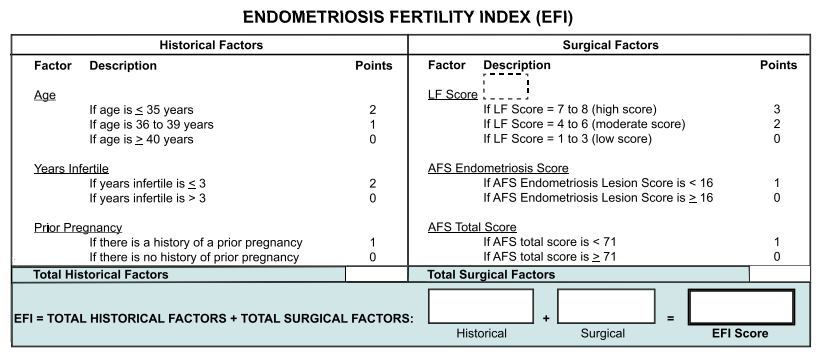
The EFI combines historical factors with findings documented during surgery.
The historical factors include:
the patient’s age
duration of infertility
whether the patient has previously been pregnant
The surgical portion considers findings related to endometriosis and, importantly, how well certain reproductive structures appear to function after surgery. [1]
Together, these factors generate an EFI score between 0 and 10.
Endometriosis Fertility Index (EFI). The EFI combines historical factors and surgical findings to calculate a score from 0 to 10. Source: Adamson and Pasta (2010).
What Is the Least Function Score?
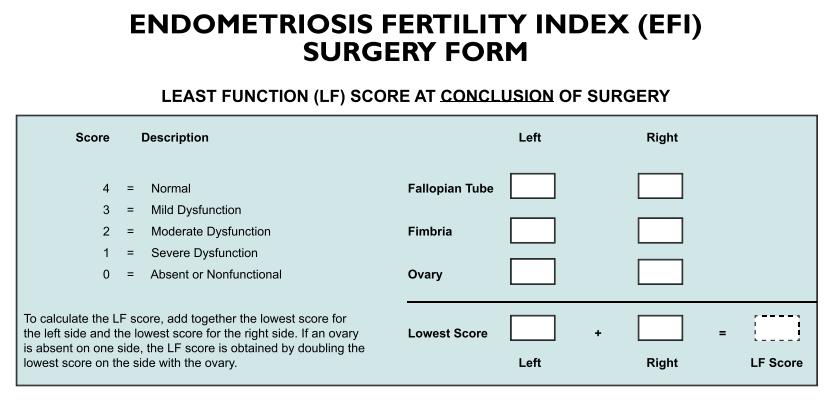
One of the most important components of the EFI is the Least Function Score.
During surgery, the surgeon evaluates the functional condition of the:
right fallopian tube
left fallopian tube
right ovary
left ovary
fimbria on each side
The fimbriae are the delicate structures at the end of the fallopian tubes that help capture the egg after ovulation.
The surgeon assesses how well these reproductive structures appear to function after surgical treatment. The EFI calculation uses the lower functional assessment from each side to help estimate reproductive potential. [1]
This makes the surgeon’s intraoperative assessment an important part of calculating the EFI.
Endometriosis Fertility Index (EFI) Surgery Form. The Least Function Score assesses the fallopian tubes, fimbriae, and ovaries at the conclusion of surgery. Source: Adamson and Pasta (2010).
What Does an EFI Score Mean?
A higher EFI score generally indicates a greater probability of pregnancy without assisted reproductive technology, while a lower score is associated with a lower probability. [1]
However, the EFI is not a guarantee.
A high score does not mean that a patient will become pregnant naturally, and a low score does not mean that pregnancy is impossible.
Other factors can also affect fertility, including ovarian reserve, ovulation, sperm factors, tubal function, age, and other reproductive conditions.
The EFI should therefore be understood as a prognostic tool rather than a prediction of an individual patient’s outcome.
Can the EFI Help Guide Fertility Planning?
Yes. The EFI can provide useful information when patients and their physicians discuss fertility options following endometriosis surgery.
The European Society of Human Reproduction and Embryology (ESHRE) recommends using the EFI to help counsel patients about their chances of pregnancy after surgery and to help identify patients who may benefit from assisted reproductive technology. [2]
Depending on the individual patient, the discussion may include attempting natural conception, fertility evaluation, or assisted reproductive technology such as in vitro fertilization (IVF).
The decision should not be based on the EFI alone. Age, ovarian reserve, semen analysis, previous fertility treatment, reproductive history, and the patient’s individual goals should also be considered.
Understanding Your EFI After Endometriosis Surgery
For patients hoping to become pregnant after endometriosis surgery, the EFI provides more information than simply knowing the stage of endometriosis.
At New York Gynecology Surgery & Endometriosis (NYGSE), our endometriosis specialists consider surgical findings, reproductive anatomy, fertility history, and each patient’s individual goals when discussing fertility after endometriosis treatment.
Adamson, G. D., & Pasta, D. J. (2010). Endometriosis fertility index: The new, validated endometriosis staging system. Fertility and Sterility, 94(5), 1609–1615. https://doi.org/10.1016/j.fertnstert.2009.09.035
Becker, C. M., Bokor, A., Heikinheimo, O., Horne, A., Jansen, F., Kiesel, L., King, K., Kvaskoff, M., Nap, A., Petersen, K., Saridogan, E., Tomassetti, C., van Hanegem, N., Vulliemoz, N., & Vermeulen, N. (2022). ESHRE guideline: Endometriosis. Human Reproduction Open, 2022(2), hoac009. https://doi.org/10.1093/hropen/hoac009