

Leg pain during your period can feel like aching, cramping, heaviness, burning, or pain that travels from the buttock or hip down the leg. For some people, it happens occasionally. For others, the pain returns or becomes noticeably worse around the same time each menstrual cycle.
There are many possible causes of leg pain during a period, and the symptom alone does not mean you have endometriosis. However, a recurring menstrual pattern can be an important clue, particularly when leg pain occurs alongside severe period pain, pelvic pain, painful bowel movements, pain during sex, or other symptoms associated with endometriosis. [1]
ESHRE recommends considering both cyclical and non-cyclical symptoms when evaluating suspected endometriosis.
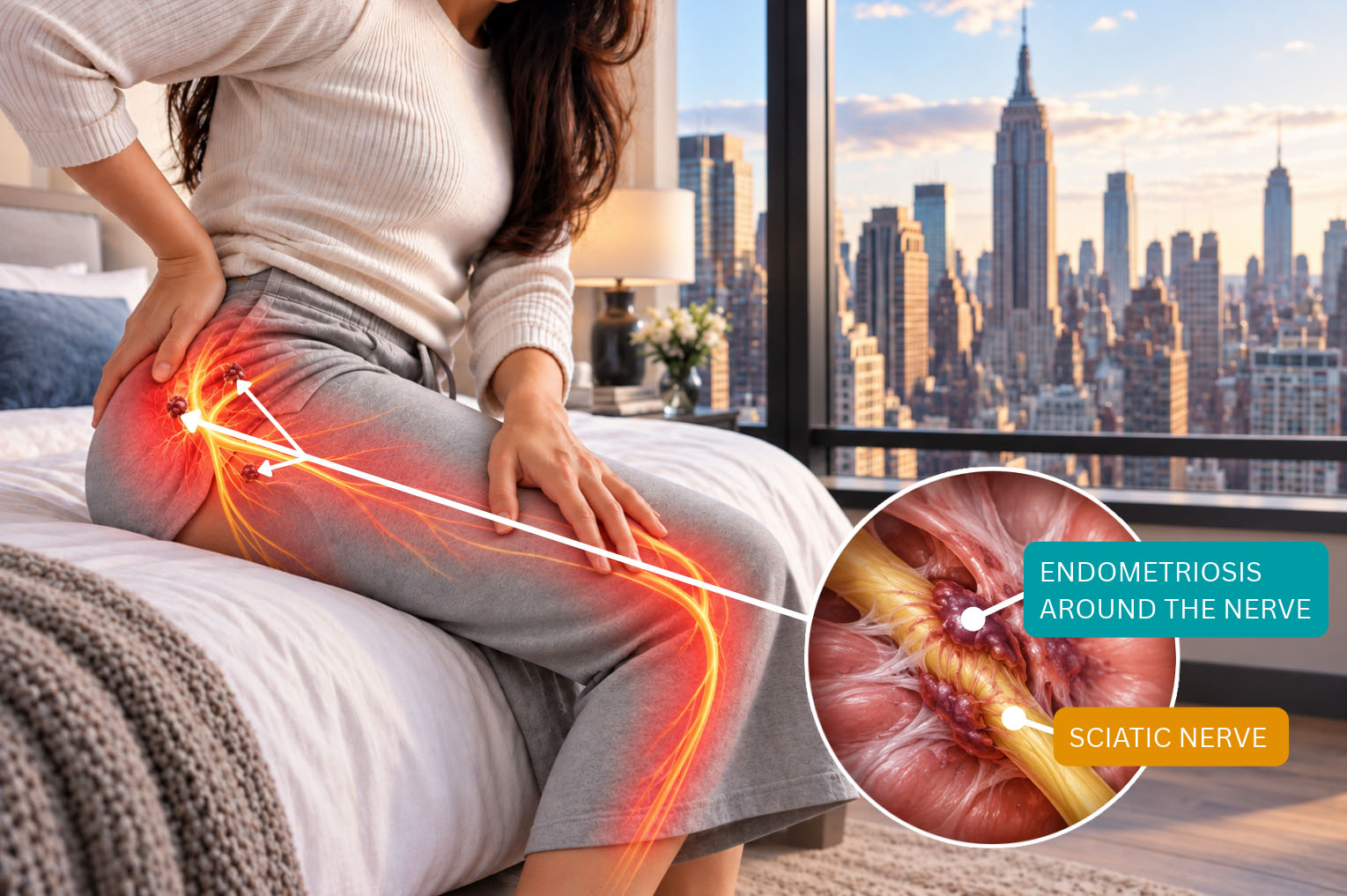
Endometriosis may sometimes be associated with pain that travels from the pelvis or buttock into the leg, particularly when pelvic nerves are involved.
How Endometriosis Can Be Associated With Leg Pain
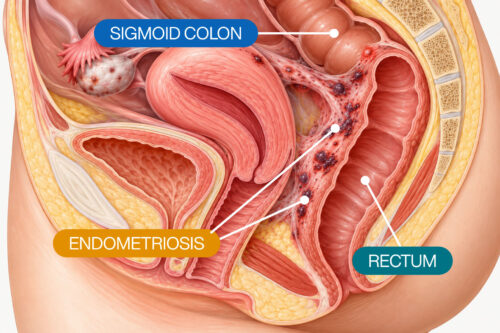
Endometriosis can cause pain through several mechanisms. Inflammation, fibrosis, adherencias, altered pain processing, and irritation of structures within the pelvis can all contribute to how and where pain is experienced.
Importantly, leg pain does not necessarily mean endometriosis is growing on a nerve.
In less common cases, endometriosis can affect nerves within or near the pelvis. The sciatic nerve and lumbosacral plexus are among the neural structures reported to be affected by endometriosis. When this occurs, pain may extend from the pelvis or buttock into the leg. [6]
The location and pattern of the pain can provide useful information, but symptoms alone cannot determine whether a nerve is involved.
Sciatica That Gets Worse During Your Period
Sciatica typically causes pain that follows the course of the sciatic nerve, often beginning around the lower back or buttock and traveling down the back of the thigh and leg.
Most sciatica is not caused by endometriosis. However, sciatic nerve endometriosis is a documented but uncommon form of endometriosis. One characteristic presentation described in the medical literature is cyclical sciatica, in which sciatic-type pain repeatedly appears or becomes worse around menstruation. [4]
The pain may initially occur mainly around menstruation. According to Possover (2021), in a surgical series of 267 patients with isolated sciatic nerve endometriosis, 76% of patients who underwent surgery within one year of the onset of sciatic pain presented with cyclical sciatica.
This menstrual pattern can therefore be an important part of the medical history when otherwise unexplained sciatica repeatedly accompanies a period.
Numbness, Tingling, or Weakness in the Leg
Nerve-related symptoms can extend beyond pain.
Depending on which nerve fibers are affected, symptoms may include:
- Shooting or electric-like pain
- Burning pain
- Pins and needles
- Tingling
- Numbness
- Muscle weakness
- Difficulty moving the foot
These symptoms have many possible causes, including conditions involving the spine, muscles, joints, or peripheral nerves. They should not automatically be attributed to endometriosis.
However, progressive neurological symptoms have been reported with sciatic nerve and sacral nerve root endometriosis, including sensory disturbances and motor weakness. [4]
New or worsening weakness deserves medical evaluation rather than waiting to see whether it disappears after menstruation.
How Period-Related Leg Pain Is Evaluated
El timing of the symptoms can be particularly useful.
Keeping track of when the pain starts, where it travels, whether it disappears after menstruation, and whether numbness or weakness occurs can help identify a cyclical pattern. ESHRE notes that a symptom diary or app can be useful as part of history taking for suspected endometriosis. [1]
When endometriosis is suspected, ultrasound or MRI may be used as part of the diagnostic work-up. ESHRE cautions that negative imaging does not rule out endometriosis, particularly superficial disease. [1]
When nerve involvement is specifically suspected, MRI can help evaluate the course of pelvic nerves and surrounding structures and identify features that may be relevant to surgical planning. [2] [3]
When Leg Pain During Your Period Should Be Evaluated
Occasional leg discomfort during menstruation does not necessarily indicate endometriosis. Evaluation may be particularly useful when leg pain:
- Repeatedly appears or becomes worse during your period
- Begins around the buttock or pelvis and travels down the leg
- Occurs with significant menstrual or pelvic pain
- Is accompanied by numbness or tingling
- Causes weakness in the leg or foot
- Becomes progressively more frequent or persistent
The menstrual pattern is important, but it is only one part of the evaluation. Other neurological, orthopedic, vascular, and gynecologic causes of leg pain may also need to be considered.
En New York Gynecology Surgery & Endometriosis (NYGSE), Dr. Pankaj Singhal and Dr. Elizabeth McLean evaluate pelvic and cyclical symptoms in the context of each patient’s complete clinical picture. When leg pain repeatedly becomes worse during menstruation, identifying the timing, location, and associated symptoms can help determine whether endometriosis should be considered.
Referencias
- Becker, C. M., Bokor, A., Heikinheimo, O., Horne, A., Jansen, F., Kiesel, L., King, K., Kvaskoff, M., Nap, A., Petersen, K., Saridogan, E., Tomassetti, C., van Hanegem, N., Vulliemoz, N., y Vermeulen, N. (2022). ESHRE guideline: Endometriosis. Human Reproduction Open, 2022(2), hoac009. https://doi.org/10.1093/hropen/hoac009
- Bourg, J., Ruaux, E., Bolze, P. A., Gavrel, M., Charlot, M., Golfier, F., Thomassin-Naggara, I., & Rousset, P. (2025). Pelvic nerve endometriosis: MRI features and key findings for surgical decision. Insights into Imaging, 16(1), 131. https://doi.org/10.1186/s13244-025-02005-6
- Colak, C., Chamie, L. P., Youngner, J., Forney, M. C., Luna Russo, M. A., Gubbels, A., VanBuren, W. M., & Feldman, M. (2024). MRI features of pelvic nerve involvement in endometriosis. RadioGraphics, 44(1), e230106. https://doi.org/10.1148/rg.230106
- Kale, A., Baydili, K. N. S., Keles, E., Gundogdu, E., Usta, T., & Oral, E. (2022). Comparison of isolated sciatic nerve and sacral nerve root endometriosis: A review of the literature. Journal of Minimally Invasive Gynecology, 29(8), 943–951. https://doi.org/10.1016/j.jmig.2022.05.017
- Possover, M. (2021). Laparoscopic morphological aspects and tentative explanation of the aetiopathogenesis of isolated endometriosis of the sciatic nerve: A review based on 267 patients. Facts, Views & Vision in ObGyn, 13(4), 369–375. https://doi.org/10.52054/FVVO.13.4.047
- Siquara de Sousa, A. C., Capek, S., Amrami, K. K., & Spinner, R. J. (2015). Neural involvement in endometriosis: Review of anatomic distribution and mechanisms. Clinical Anatomy, 28(8), 1029–1038. https://doi.org/10.1002/ca.22617