


“They Found Nothing. So Why Does It Still Hurt?”
What a negative laparoscopy for endometriosis can tell you, what it can’t, and what to do next.
Dr. Pankaj Singhal and Dr. Virginia McLean · Gynecologic and robotic surgeons specializing in endometriosis · New York Gynecology Surgery & Endometriosis (NYGSE™)

Some of the women we see in our office arrive with a thick folder and a short sentence. “I had the laparoscopy. They said it was normal.” Then, usually after a pause: “But I still have the pain.”
If that’s you, this post is for you. A negative laparoscopy can feel like the end of the road. For a lot of women it turns out to be a stop along the way, and knowing why can change what you do next.
First, about the pain
A laparoscopy shows what one surgeon saw, through a camera, on one day. It doesn’t measure pain, and it can’t tell you whether your pain is real. It is. A normal result answers a narrower question than most people are told it does.
Why endometriosis can be missed
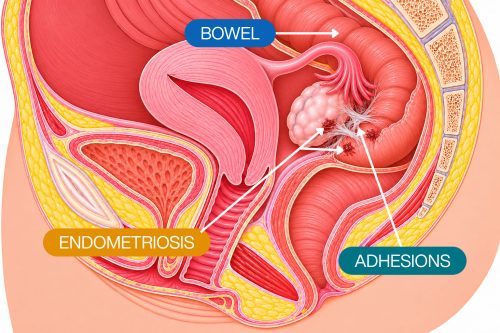
Endometriosis doesn’t always look the way people expect. Early lesions can be clear, white or red instead of dark. They can sit under scar tissue or in places that are hard to reach, like behind the uterus or up on the diaphragm. Several studies have looked at how often surgeons get it right by sight alone, and the numbers are humbling.
- In a study of 1,439 biopsies from 431 patients, the surgeon’s visual call was correct in only 49.7% of the earliest stage (stage I) disease. Deep lesions were about two and a half times more likely to be identified correctly than superficial ones.
- In another study of 2,005 tissue samples, tissue that the surgeon judged not to be endometriosis turned out to be endometriosis 24.3% of the time when the lab looked at it.
- A 2026 study of 1,309 women having surgery for pelvic pain found that what the surgeon saw and what the pathologist reported disagreed 56% of the time. Of the cases called negative by sight alone, 85% had no biopsy taken.
None of this means your surgery was done badly. It means that “we didn’t see endometriosis” and “there is no endometriosis” aren’t the same statement.
A CAREFUL WORD ABOUT ONE STUDY
One small study took biopsies of normal-looking tissue in 142 women with pelvic pain and found endometriosis under the microscope in 39% of them. It’s a striking number, but it comes from a single retrospective series, and microscopic endometriosis has also been found in women who have no pain at all. So a positive biopsy of normal-looking tissue doesn’t automatically explain someone’s symptoms. We include it because it shows how much the eye can miss. It doesn’t prove anything about any one person’s case.
Experience changes what gets found
The 2026 study also asked who did the surgery. A negative laparoscopy was about two and a half times as likely when the surgeon didn’t have fellowship training in endometriosis surgery. That isn’t a criticism of anyone. Recognizing subtle endometriosis is a skill, and it gets sharper with every case. It’s the reason the UK’s national guideline (NICE) says a diagnostic laparoscopy should be done by “a gynaecologist with training and skills in laparoscopic surgery for endometriosis” who performs “a systematic inspection of the pelvis.”
The guidelines themselves show the tension. NICE says that if a full, systematic laparoscopy is normal, a woman can be told she doesn’t have endometriosis. The European guideline (ESHRE, 2022) adds that “negative histology does not entirely rule out the disease.” We think both are right. The word doing the work in the NICE sentence is “full.”
It may not be endometriosis, and that matters too
Sometimes the laparoscopy was thorough and the cause of the pain is somewhere else. Pelvic floor muscle problems, nerve pain, bladder pain and bowel conditions can all cause symptoms that overlap with endometriosis.
In one older study of women who still had pain after a negative laparoscopy, a hidden musculoskeletal cause (most often myofascial pain in the muscles of the abdominal wall and pelvis) was found in 47%, and about three quarters of those women improved or recovered with treatment. A negative result can still point you toward the right answer, as long as someone keeps looking.
What you can do now
- Ask for two documents: your operative report and your pathology report. They show which areas were inspected, whether photos were taken, and whether any tissue was sent to the lab. You’re entitled to both.
- Keep a simple symptom record for two or three cycles. Note when the pain comes, how bad it is, and what it affects (bowel movements, urination, sex, work). Pain that tracks your cycle is one of the most useful clues there is.
- Don’t assume the next step is another operation. Ultrasound or MRI done with endometriosis in mind can often show deeper disease and help plan care before anyone goes back to the operating room.
- Get an opinion from someone who treats endometriosis every week, and bring your two documents with you.
Do I have endometriosis? Find out in 3 minutes
We built a free checker called “Do I Have Endometriosis?” to help women put their symptoms into words and get a sense of how likely endometriosis is before they see a doctor. It now has a section just for women who’ve had a negative laparoscopy.
You’ll be asked three quick questions about that surgery: who did it (a general gynecologist or an endometriosis specialist), whether biopsies were sent to the lab, and how long ago it was. The checker weighs those answers alongside your symptoms. A specialist’s surgery with negative biopsies lowers the estimate more than a surgery where no tissue was taken, and an operation from several years ago counts for less than a recent one. It never stops the calculation just because a laparoscopy was negative.
At the end you get an estimate and a one-page summary you can print or save and bring to your appointment. It’s private: nothing you enter is sent anywhere or stored. It isn’t a diagnosis, and it can be wrong in either direction, but it’s a good way to start a more useful conversation.
If you’re still in pain
You don’t have to choose between accepting “normal” and starting over from scratch. Bring us your reports and your symptom notes and we’ll go through them with you, including what was looked at, what may have been missed, and what else could be going on.
Call us at 631-533-9733 or email info@nygse.com. Our office is at 325 West Main St., Bldg 1, Ste 2A, Babylon, NY 11702.
This article is for general education and isn’t medical advice for any individual. If you have sudden severe pelvic pain, heavy bleeding, fever or fainting, seek urgent care.
Referencias
- Reliability of visual diagnosis of endometriosis. J Minim Invasive Gynecol. 2013. PMID 24183270.
- Laparoscopic excision of lesions suggestive of endometriosis or otherwise atypical in appearance. J Minim Invasive Gynecol. 2008. PMID 18262141.
- Int J Gynaecol Obstet. 2020. PMID 32644227 (occult microscopic endometriosis in normal-appearing peritoneum, n = 142).
- Aust N Z J Obstet Gynaecol. 2026. PMID 42104671 (negative laparoscopy, surgeon training and histology, n = 1,309).
- J Reprod Med. 1991. PMID 1830102 (somatic causes of pain after negative laparoscopy).
- National Institute for Health and Care Excellence. Endometriosis: diagnosis and management (NG73), section 1.5.
- ESHRE guideline: endometriosis. Hum Reprod Open. 2022. PMID 35350465.