During an ultrasound, MRI, or endometriosis surgery, some patients may be told that they have an “obliterated cul-de-sac”.
An obliterated cul-de-sac occurs when adhesions cause the normally open space between the uterus and rectum to become partially or completely closed. In patients with endometriosis, this can occur when inflammation and scar-like tissue cause pelvic organs to stick together. [2]
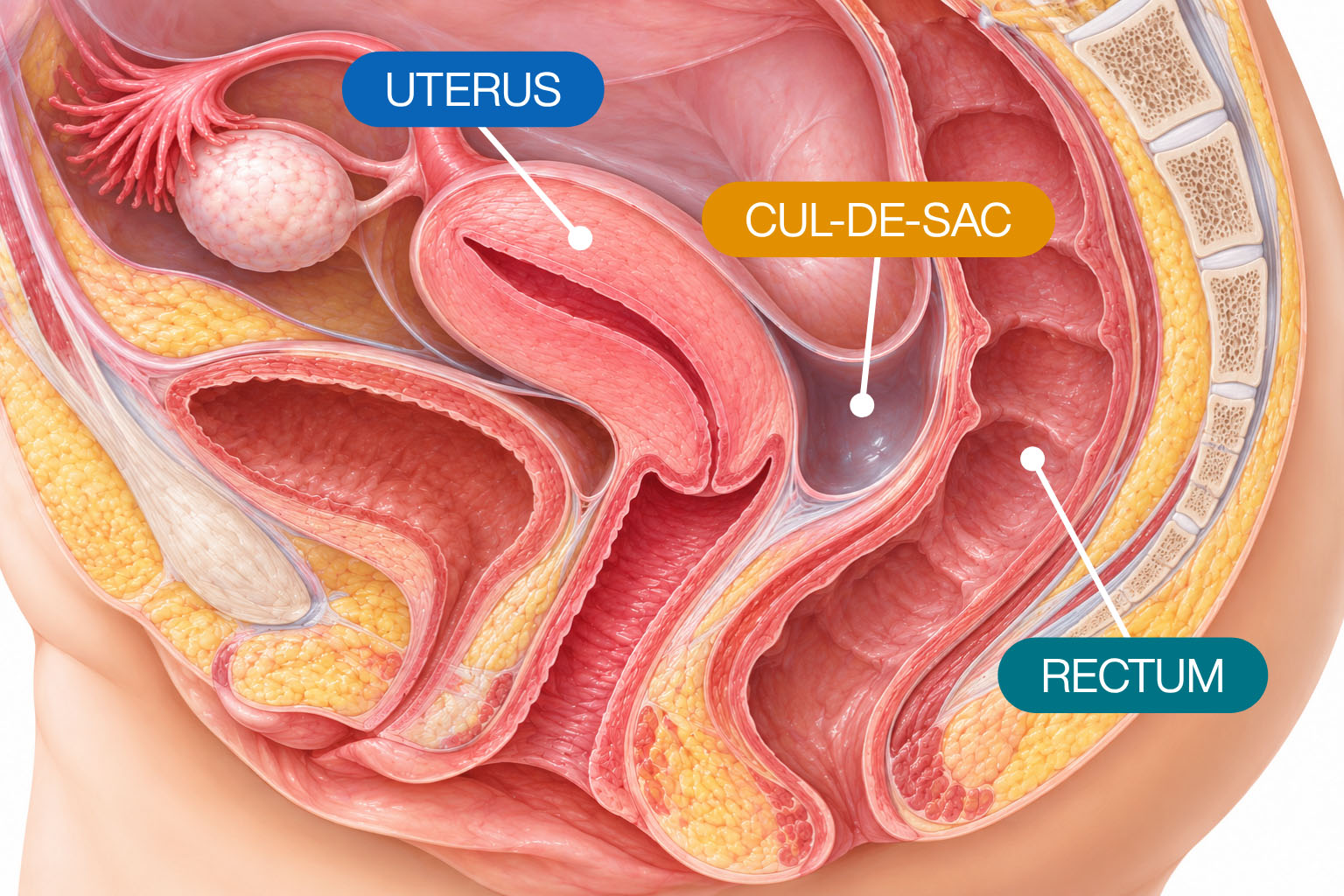
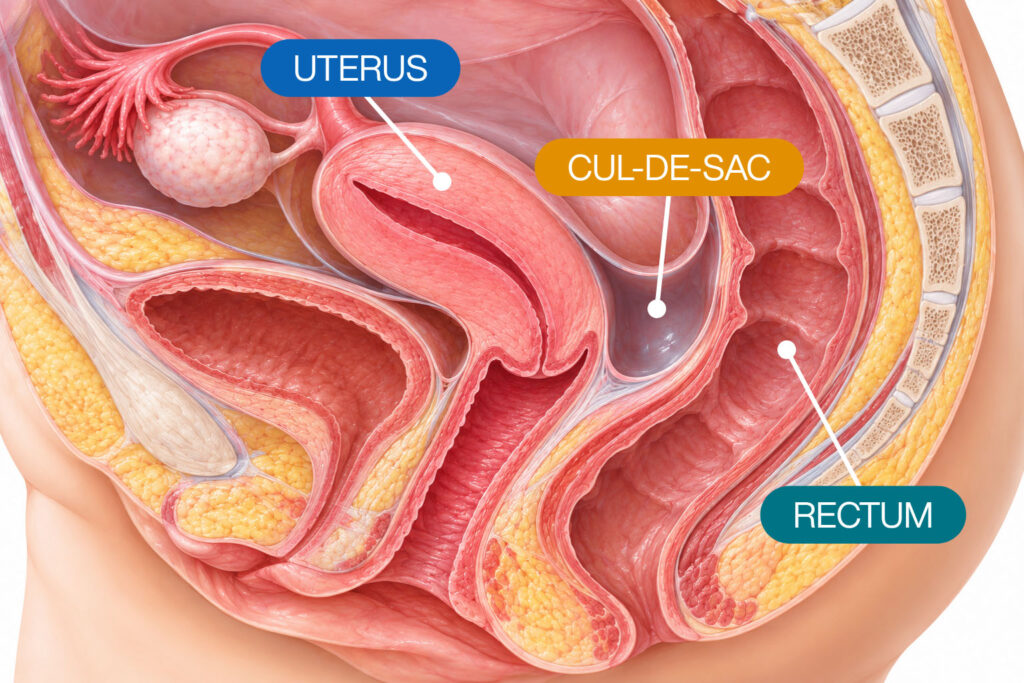
Medical illustration showing the uterus, rectum, and cul-de-sac (pouch of Douglas), the space located between the uterus and rectum.
What Is the Cul-de-Sac?
The posterior cul-de-sac is the space located behind the uterus and in front of the rectum.
Normally, these structures remain separate and have some mobility relative to one another. When endometriosis and adhesions develop in this area, the normal tissue planes can become distorted. [2]
What Does “Obliterated” Mean?
An obliterated cul-de-sac does not mean that an organ has disappeared.
Instead, it means that the normal space has become partially or completely closed by adhesions, fibrosis, or endometriosis-related disease. In more extensive cases, the posterior uterus or cervix may become densely adherent to the rectum or sigmoid colon. [2]
Endometriosis Can Distort the Normal Pelvic Anatomy
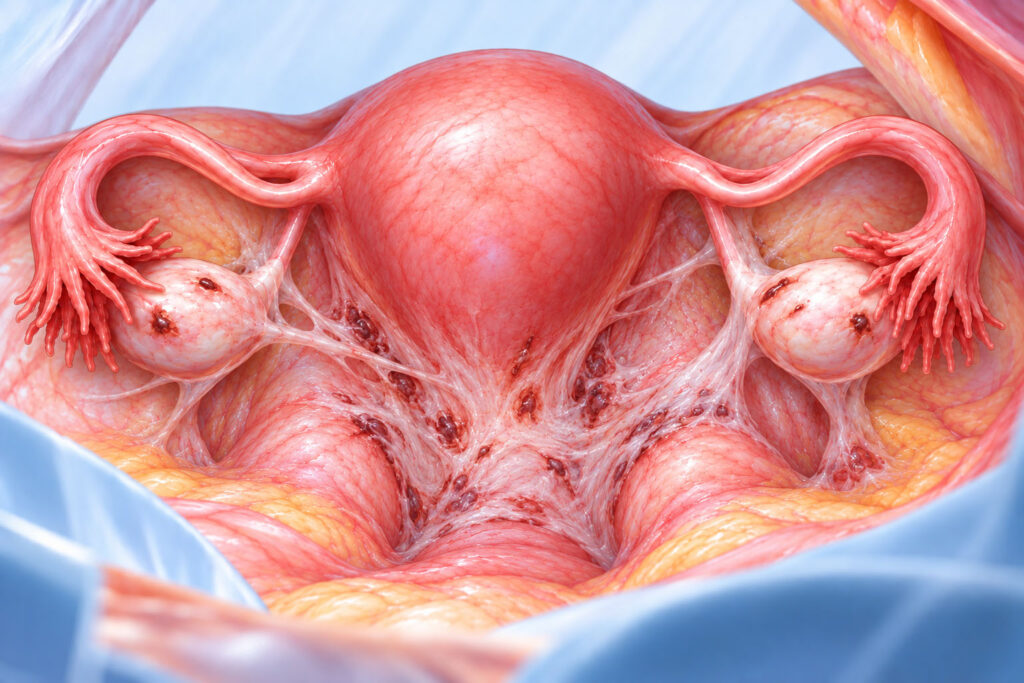
Endometriosis can cause inflammation, fibrosis, and adhesions that bring normally separate pelvic structures together. [1]
When this occurs behind the uterus, the normal cul-de-sac may gradually become obliterated. This finding can occur with deep endometriosis and may be associated with disease involving nearby structures. [2]
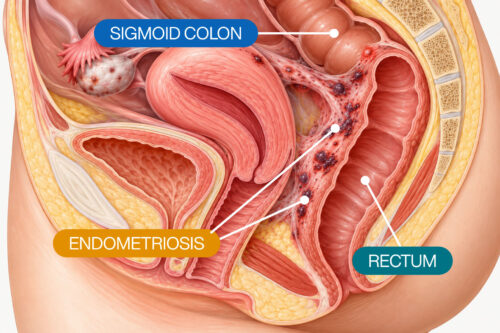
Medical illustration showing an obliterated cul-de-sac, where adhesions associated with endometriosis have caused the space between the uterus and rectum to become partially or completely closed.
Is an Obliterated Cul-de-Sac the Same as a Frozen Pelvis?
Not exactly.
An obliterated cul-de-sac specifically describes loss of the normal space behind the uterus.
A frozen pelvis is a broader description of extensive adhesions that severely restrict the mobility of multiple pelvic organs. Cul-de-sac obliteration can therefore be part of a frozen pelvis, but the terms are not interchangeable.
What Symptoms Can Cul-de-Sac Endometriosis Cause?
Symptoms vary depending on the location and extent of disease. Some people may experience:
These symptoms are not specific to cul-de-sac obliteration. ESHRE recommends considering endometriosis in people with symptoms including dysmenorrhea, deep dyspareunia, dyschezia, urinary symptoms, fatigue, and infertility. [1]
Ultrasound and MRI Can Help Evaluate the Cul-de-Sac
Specialized pelvic ultrasound and MRI can help identify signs of deep endometriosis and changes in pelvic anatomy.
MRI findings associated with posterior cul-de-sac obliteration can include tethering of the rectum toward the uterus, fibrotic tissue, adhesions, and changes involving the posterior uterus and surrounding structures. In one study of women with histologically confirmed endometriosis, MRI had a mean accuracy of 71.9% for diagnosing posterior cul-de-sac obliteration. [2]
Imaging can provide valuable information for diagnosis and surgical planning, although imaging findings must be interpreted within the patient’s overall clinical picture. ESHRE recommends ultrasound or MRI as part of the diagnostic work-up for suspected endometriosis. [1]
Treatment Depends on Symptoms and Disease Extent
An obliterated cul-de-sac does not automatically mean that surgery is necessary.
Treatment depends on symptoms, fertility goals, imaging findings, previous treatment, and the extent of endometriosis.
When surgery is appropriate, restoring normal anatomy can be technically complex because the rectum, ureters, pelvic nerves, and other structures may be close to the disease. ESHRE recommends that patients with deep endometriosis be referred to a center with appropriate expertise and counseled about the potential benefits and risks of surgery. [1]
An Obliterated Cul-de-Sac Can Be an Important Sign of Deep Endometriosis
An obliterated cul-de-sac describes a significant change in the normal anatomy behind the uterus. Endometriosis-related adhesions and fibrosis are one possible cause, particularly when deep endometriosis is present.
At New York Gynecology Surgery & Endometriosis (NYGSE), Dr. Pankaj Singhal and Dr. Elizabeth McLean evaluate suspected deep endometriosis based on symptoms, imaging findings, pelvic anatomy, and each patient’s individual treatment goals.
If imaging suggests an obliterated cul-de-sac or deep endometriosis, evaluation with an endometriosis specialist can help determine an appropriate next step.
Becker, C. M., Bokor, A., Heikinheimo, O., Horne, A., Jansen, F., Kiesel, L., King, K., Kvaskoff, M., Nap, A., Petersen, K., Saridogan, E., Tomassetti, C., van Hanegem, N., Vulliemoz, N., & Vermeulen, N. (2022). ESHRE guideline: Endometriosis. Human Reproduction Open, 2022(2), hoac009. https://doi.org/10.1093/hropen/hoac009
Kataoka, M. L., Togashi, K., Yamaoka, T., Koyama, T., Ueda, H., Kobayashi, H., Rahman, M., Higuchi, T., & Fujii, S. (2005). Posterior cul-de-sac obliteration associated with endometriosis: MR imaging evaluation. Radiology, 234(3), 815–823. https://doi.org/10.1148/radiol.2343031366
Tanaka, Y., Higami, S., Shiraishi, M., & Shiki, Y. (2023). Total laparoscopic hysterectomy when there is posterior cul-de-sac obliteration: A step-by-step nerve-sparing technique. American Journal of Obstetrics and Gynecology, 229(2), 178–180. https://doi.org/10.1016/j.ajog.2023.03.033