

Right-sided abdominal pain often raises concern about the appendix. Acute appendicitis is an important cause, but for some patients, endometriosis can also affect the appendix and produce symptoms that resemble appendicitis.
This condition, known as appendiceal endometriosis, may cause right lower abdominal pain, chronic or cyclical symptoms, or sometimes no obvious appendix-specific symptoms at all. Published reports have documented appendiceal endometriosis presenting as suspected acute appendicitis as well as being discovered unexpectedly during gynecologic surgery [1].
Understanding the difference is important because right-sided pain alone cannot determine whether the cause is appendicitis, endometriosis, or another condition.
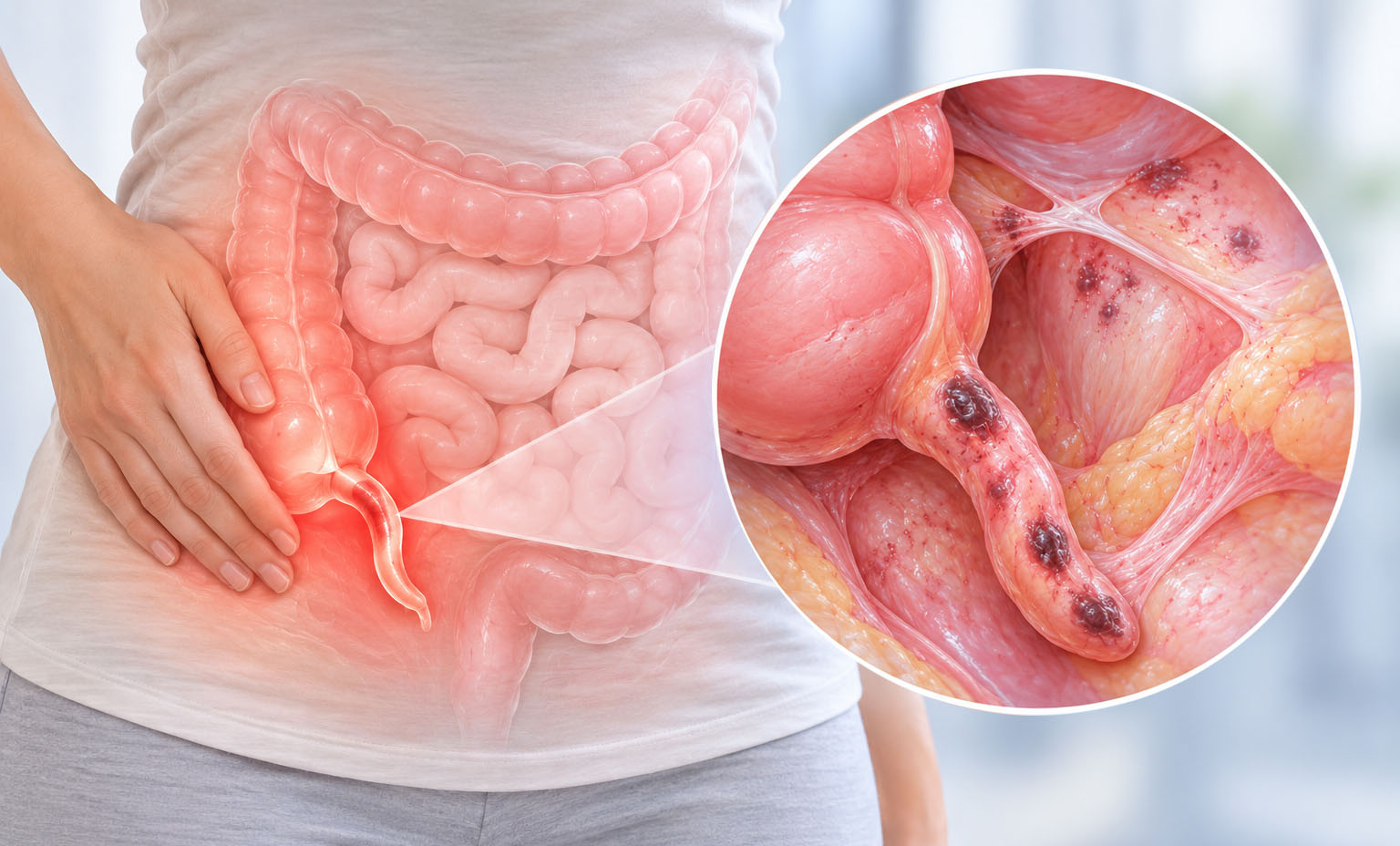
Medical illustration showing the location of the appendix in the right lower abdomen with a close-up of possible endometriosis involving the appendix.
Can Endometriosis Affect the Appendix?
Yes. Endometriosis can involve the gastrointestinal tract, including the appendix.
A comprehensive review of 75 studies found that appendiceal endometriosis has been reported both in patients presenting with symptoms resembling appendicitis and as an incidental finding during surgery for endometriosis or pelvic pain. The reported frequency varies considerably depending on the population being studied and is higher in some groups with deep endometriosis [1].
Because of this variability, having endometriosis does not mean that the appendix is necessarily involved.
What Are the Symptoms of Appendix Endometriosis?
Appendix endometriosis symptoms can vary considerably.
Some patients have no symptoms that clearly point to the appendix. Others may experience:
- right lower abdominal or pelvic pain
- chronic or recurring right-sided pain
- pain that appears to follow the menstrual cycle
- abdominal discomfort
- symptoms resembling acute or chronic appendicitis
Appendiceal endometriosis has been associated with acute and chronic appendicitis-like symptoms as well as cyclic and chronic right lower quadrant pain [1].
More broadly, endometriosis should be considered in patients experiencing certain cyclical or non-cyclical symptoms, including pelvic pain and bowel-related symptoms such as dyschezia [2].
These symptoms are not specific to endometriosis, however. Right-sided abdominal pain has many possible causes.
Appendicitis vs. Endometriosis: How Can the Symptoms Overlap?
The distinction can sometimes be difficult because both conditions may produce pain in the right lower abdomen.
Acute appendicitis commonly causes abdominal pain that may begin near the belly button and move toward the lower right abdomen. The pain may begin suddenly and worsen within hours. Other symptoms can include loss of appetite, nausea, vomiting, fever, and abdominal swelling [3].
Appendiceal endometriosis can sometimes resemble this presentation. In a comprehensive review, numerous published cases involved patients with appendiceal endometriosis who presented with right-sided lower abdominal pain and clinical features suggestive of acute appendicitis [1].
One potentially important clue is whether pain repeatedly occurs around menstruation, particularly when right-sided pain accompanies other symptoms associated with endometriosis. However, a cyclical pattern alone cannot reliably distinguish appendiceal endometriosis from other causes of abdominal pain.
Right-Sided Abdominal Pain and Endometriosis
Right-sided pain can occur in patients with endometriosis even when the appendix is not involved.
Endometriosis can occur at different locations within and outside the pelvis, and symptoms do not always reliably identify the precise location of disease. ESHRE recommends considering endometriosis in patients with a range of cyclical and non-cyclical symptoms, including dysmenorrhea, deep dyspareunia, dyschezia, dysuria, painful rectal bleeding, and other characteristic symptoms [2].
Therefore:
Right-sided abdominal pain does not automatically mean appendix endometriosis.
The location, timing, severity, menstrual pattern, associated symptoms, previous surgery, imaging, and other clinical findings all matter.
What Does Endometriosis on the Appendix Look Like?
The appearance of appendiceal endometriosis can vary. During surgery, an appendix affected by endometriosis may show abnormalities such as adhesions, rigidity, hyperemia, congestion, induration, or visible implants. Importantly, not every abnormal-looking appendix proves to contain endometriosis [1].
In some cases, surgeons may notice dark or benign-appearing spots on the appendix during pelvic surgery. These findings can raise suspicion for endometriosis, particularly when disease is present elsewhere in the pelvis, but appearance alone cannot confirm the diagnosis.
If suspicious tissue or the appendix is removed, histopathologic examination can determine whether endometriosis is actually present [1].
How Is Appendix Endometriosis Diagnosed?
Diagnosing appendiceal endometriosis before surgery can be challenging.
Symptoms may overlap with other causes of abdominal and pelvic pain, and appendiceal involvement may sometimes be discovered incidentally during surgery. When the appendix is removed, histopathologic examination can establish whether endometriosis is present in the tissue [1].
This distinction is particularly important because symptoms and visual appearance alone may not reveal exactly what is affecting the appendix.
When Endometriosis and Appendix Symptoms Overlap
Appendiceal endometriosis illustrates why abdominal and pelvic pain can sometimes be difficult to interpret.
For one patient, right-sided pain may be caused by appendicitis. For another, endometriosis may involve the appendix. In others, endometriosis elsewhere in the pelvis or an entirely different condition may be responsible.
At New York Gynecology Surgery & Endometriosis (NYGSE), our endometriosis specialists evaluate the complete pattern of symptoms, imaging, previous treatments, surgical history, and other clinical findings when determining whether endometriosis may be contributing to persistent or complex pelvic pain.
References
- Allahqoli, L., Mazidimoradi, A., Momenimovahed, Z., Günther, V., Ackermann, J., Salehiniya, H., & Alkatout, I. (2023). Appendiceal endometriosis: A comprehensive review of the literature. Diagnostics, 13(11), 1827. https://doi.org/10.3390/diagnostics13111827
- Becker, C. M., Bokor, A., Heikinheimo, O., Horne, A., Jansen, F., Kiesel, L., King, K., Kvaskoff, M., Nap, A., Petersen, K., Saridogan, E., Tomassetti, C., van Hanegem, N., Vulliemoz, N., & Vermeulen, N. (2022). ESHRE guideline: Endometriosis. Human Reproduction Open, 2022(2), hoac009. https://doi.org/10.1093/hropen/hoac009
- National Institute of Diabetes and Digestive and Kidney Diseases. (2021, July). Appendicitis. U.S. Department of Health and Human Services. https://www.niddk.nih.gov/health-information/digestive-diseases/appendicitis