

November 13, 2026
by NYGSE
Endometriosis Fertility & Reproductive Health Symptoms & Diagnosis Treatment & Surgery
Endometriosis can cause painful periods, chronic pelvic pain, bowel and bladder symptoms, and difficulty becoming pregnant. However, diagnosis may be delayed when symptoms are overlooked or imaging findings appear normal.
The National Institute for Health and Care Excellence (NICE) provides evidence-based recommendations for diagnosing and managing endometriosis. Its Endometriosis: Diagnosis and Management guideline (NG73), updated in 2024, addresses diagnosis, medical treatment, and surgery, while the 2026 fertility guideline (NG257) provides additional guidance for patients trying to conceive.
Here are 16 key recommendations summarized from NICE guidance, covering the most important aspects of endometriosis care.
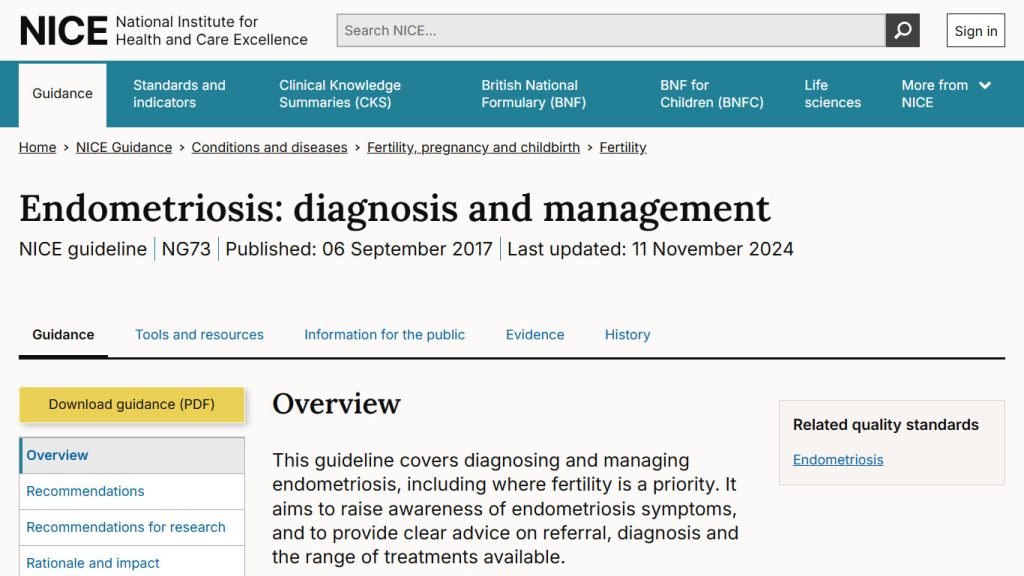
Screenshot of the official NICE NG73 guideline webpage, covering the diagnosis and management of endometriosis. Featured in NYGSE’s summary of 16 clinical recommendations.
Recognizing and Diagnosing Endometriosis
1. Recognize the Symptoms of Endometriosis
Consider endometriosis in patients with chronic pelvic pain, painful periods affecting daily activities, deep pain during intercourse, cyclical bowel or urinary symptoms, or infertility associated with these symptoms.
2. Consider Family History
Having a first-degree relative, such as a mother, sister, or daughter, with endometriosis increases the likelihood of having the condition.
3. Offer Pelvic Ultrasound
Offer transvaginal ultrasound to patients with suspected endometriosis, even when abdominal or pelvic examination findings are normal. If transvaginal ultrasound is unsuitable or declined, consider transabdominal ultrasound.
4. Do Not Exclude Endometriosis Based on Normal Imaging
Normal pelvic examination or ultrasound findings do not exclude endometriosis, particularly superficial peritoneal disease. Diagnostic laparoscopy may still be considered when endometriosis is suspected, even if ultrasound or MRI findings are normal.
5. Do Not Use CA-125 to Diagnose Endometriosis
Do not use serum CA-125 to diagnose endometriosis because it lacks sufficient diagnostic accuracy. A normal CA-125 result cannot reliably exclude the condition.
6. Refer Patients With Persistent or Complex Symptoms
Refer patients for gynecologic evaluation when symptoms persist, recur, interfere with daily activities, or do not respond adequately to initial treatment. Suspected or confirmed ovarian endometriomas, deep endometriosis involving the bowel, bladder, or ureter, or endometriosis outside the pelvis warrant referral to a specialist endometriosis service.
7. Consider Diagnostic Laparoscopy
Consider diagnostic laparoscopy when endometriosis is suspected, even if ultrasound or MRI findings are normal. NICE recommends systematic pelvic inspection by a gynecologist trained in endometriosis surgery, with findings documented using intraoperative imaging.
8. Interpret Biopsy Results Carefully
Consider biopsy of suspected endometriotic lesions, recognizing that negative histology does not necessarily exclude endometriosis. However, when a properly performed and documented systematic laparoscopy identifies no endometriosis, NICE recommends informing the patient that the condition is unlikely.
Managing Endometriosis and Surgical Treatment
9. Offer Appropriate Pain Management
Consider suitable analgesics, such as paracetamol or nonsteroidal anti-inflammatory drugs (NSAIDs), and offer hormonal treatment, including combined hormonal contraceptives or progestogens, for endometriosis-associated pain. Hormonal treatment may reduce symptoms but does not establish that endometriotic lesions have disappeared.
10. Treat the Patient, Not Just the Disease Stage
Base treatment decisions on symptoms, patient preferences, and individual priorities rather than endometriosis stage alone.
11. Prefer Laparoscopic Surgery When Appropriate
Perform endometriosis surgery laparoscopically unless contraindications exist. The choice of surgical technique should consider lesion location, disease complexity, fertility goals, and potential complications.
12. Refer Deep Endometriosis to Specialist Services
Refer patients with suspected or confirmed deep endometriosis involving the bowel, bladder, or ureter to a specialist endometriosis service. Complex disease may require specialist imaging and multidisciplinary surgical planning.
13. Remove Visible Endometriosis During Hysterectomy
When hysterectomy is indicated, excise all visible endometriotic lesions during the same operation. Hysterectomy does not necessarily eliminate endometriosis elsewhere in the pelvis and should not be presented as a guaranteed cure for endometriosis-associated pain.
Endometriosis and Fertility
14. Consider Fertility Goals Before Surgery
When spontaneous pregnancy is a priority, NICE recommends offering excision or ablation with adhesiolysis for endometriosis not involving the bowel, bladder, or ureter. For ovarian endometriomas, NICE recommends offering laparoscopic ovarian cystectomy or drainage with ablation, while considering the potential impact on ovarian reserve.
15. Do Not Use Hormonal Suppression to Improve Spontaneous Pregnancy
NICE recommends against offering hormonal treatment, either alone or combined with surgery, to patients with endometriosis who are trying to conceive because it does not improve spontaneous pregnancy rates. Hormonal treatment may reduce endometriosis-associated pain, but symptom management and fertility treatment have different goals.
16. Individualize Fertility Treatment
NICE recommends discussing expectant management for up to two years, including time already spent trying to conceive, or appropriate surgical treatment. If these approaches are unsuccessful or unsuitable, clinicians should consider up to four cycles of intrauterine insemination (IUI) with gonadotrophin ovarian stimulation when appropriate, or offer in vitro fertilization (IVF) according to eligibility criteria. The two-year period is not mandatory for every patient, and IUI is not required before IVF.
Can the NYGSE Endometriosis Likelihood Index Help Assess Your Symptoms?
For individuals who are uncertain whether their symptoms may be associated with endometriosis, the NYGSE Endometriosis Likelihood Index (ELI) offers a preliminary, symptom-based assessment.
ELI is not a diagnostic tool; it only estimates the likelihood of having endometriosis and should not replace clinical evaluation, imaging, or specialist consultation.

What Patients Should Remember
The NICE guidelines emphasize that endometriosis should not be excluded solely because routine examination or imaging findings are normal.
Persistent symptoms may require further investigation, specialist evaluation, or consideration of laparoscopy. Medical and surgical treatment should reflect symptoms, disease characteristics, fertility goals, and individual patient preferences.
At New York Gynecology Surgery & Endometriosis (NYGSE), patients with suspected or confirmed endometriosis can seek specialized evaluation and discuss appropriate diagnostic and treatment options.
This article is for general education and isn’t medical advice for any individual. If you have sudden severe pelvic pain, heavy bleeding, fever or fainting, seek urgent care.
References
- National Institute for Health and Care Excellence. (2024). Endometriosis: Diagnosis and management (NICE Guideline No. NG73). https://www.nice.org.uk/guidance/ng73
- National Institute for Health and Care Excellence. (2026). Fertility problems: Assessment and treatment (NICE Guideline No. NG257). https://www.nice.org.uk/guidance/ng257