Endometriosis can affect fertility in several ways, including changes to the normal relationship between the ovaries and fallopian tubes.
In some patients, endometriosis-related adhesions and scarring can affect the fallopian tubes, potentially contributing to tubal blockage or impaired function. However, finding a blocked fallopian tube does not automatically mean that endometriosis is the cause.
How Can Endometriosis Affect the Fallopian Tubes?
The fallopian tubes play an important role in reproduction. The fimbriae at the end of each tube help capture an egg released from the ovary, and fertilization normally occurs within the tube.
Endometriosis can contribute to adhesions and distortion of normal pelvic anatomy. When adhesions involve the ovaries or fallopian tubes, they may restrict movement, alter the relationship between the tube and ovary, or interfere with egg pickup and transport. [1]
Importantly, endometriosis does not have to be growing inside a fallopian tube to affect its function. Disease and adhesions surrounding the tube or ovary may also interfere with reproductive anatomy.
Can a Blocked Fallopian Tube Affect Fertility?
Yes. Fallopian tube blockage can affect fertility because fertilization normally occurs within the fallopian tube. If endometriosis-related adhesions or scarring interfere with the tube or fimbriae, the egg and sperm may have difficulty meeting.
If one fallopian tube remains open and functional, natural pregnancy may still be possible. However, fertility also depends on factors such as age, ovarian reserve, ovulation, sperm factors, and the condition of the remaining tube and ovary.
If both fallopian tubes are truly blocked, natural conception becomes much more difficult because the egg and sperm may not be able to meet.
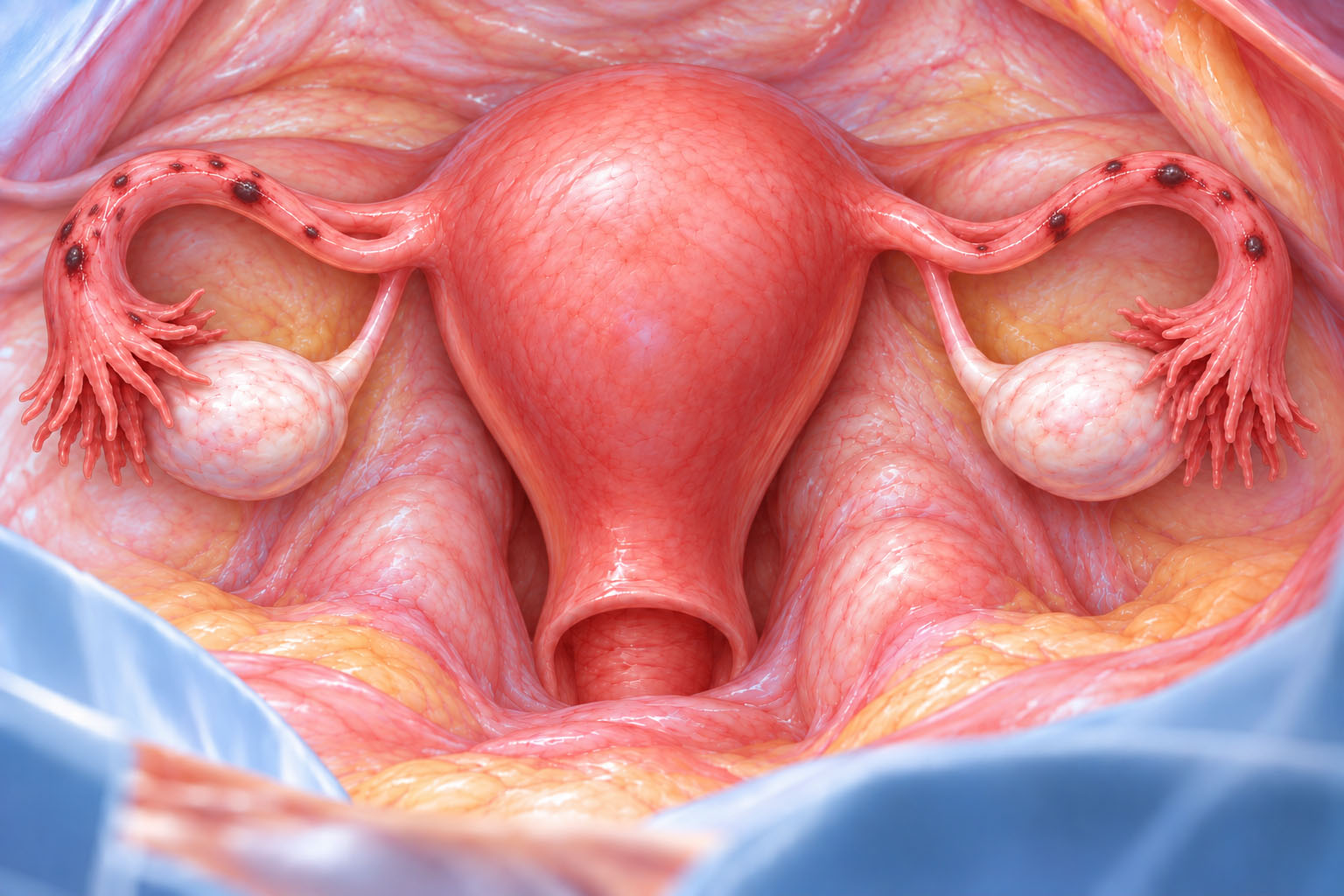
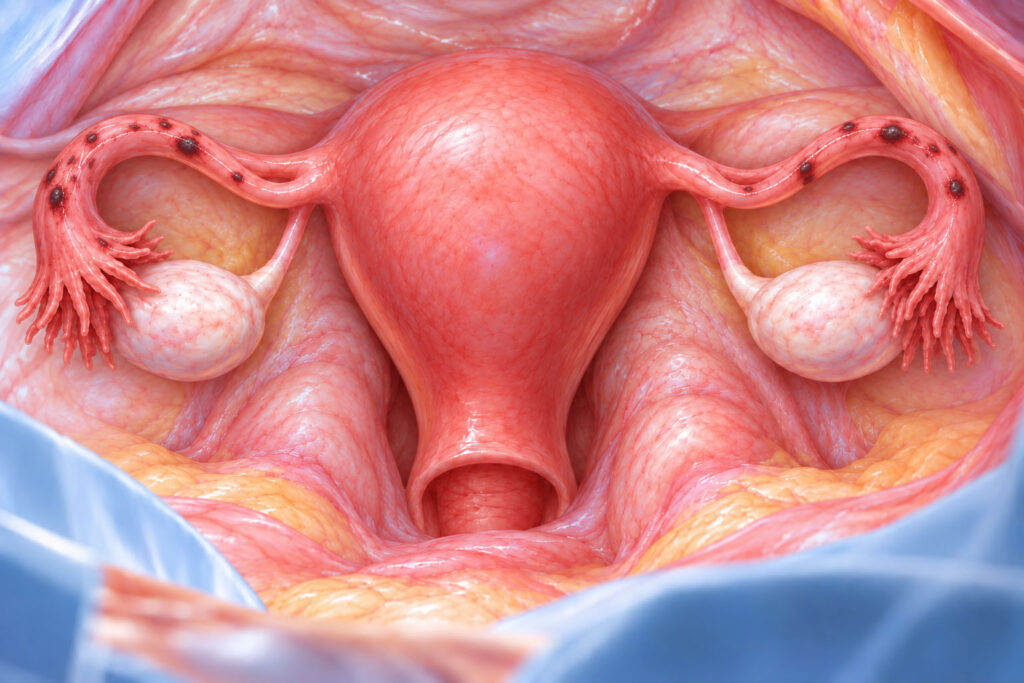
Medical illustration showing healthy ovaries with endometriosis lesions concentrated around the fallopian tubes, illustrating how endometriosis may contribute to tubal blockage and affect fertility.
How Is Fallopian Tube Blockage Diagnosed?
A hysterosalpingogram (HSG) is commonly used to evaluate whether the fallopian tubes are open.
During an HSG, contrast material is introduced through the uterus while X-ray imaging is used to determine whether the contrast passes through the fallopian tubes. HSG can help identify proximal or distal tubal obstruction. [2]
An apparent blockage does not always mean that a tube is permanently closed. In particular, apparent proximal blockage may sometimes result from temporary contractions or technical factors and may require further evaluation.
Can Endometriosis Surgery Improve Tubal Function?
In some patients, surgery may release adhesions and improve the anatomical relationship between the ovaries, fallopian tubes, and surrounding structures.
However, not every blocked or damaged fallopian tube can or should be surgically reopened.
Management depends on the location and severity of the blockage, condition of the tube, extent of endometriosis, age, ovarian reserve, other fertility factors, and the patient’s reproductive goals. Assisted reproductive technology such as IVF may also be considered in some circumstances. [1]
Fallopian Tubes and the Endometriosis Fertility Index
For patients who undergo endometriosis surgery, the condition of the fallopian tubes can also contribute to the Endometriosis Fertility Index (EFI).
An important component of the EFI is the Least Function Score, which evaluates the functional condition of the fallopian tubes, fimbriae, and ovaries at the conclusion of surgery.
The EFI combines these surgical findings with fertility history to help estimate the likelihood of pregnancy without assisted reproductive technology after endometriosis surgery.
Understanding Fallopian Tube Blockage and Endometriosis
A blocked fallopian tube is a finding, not a diagnosis of endometriosis. Tubal blockage can have different causes, and endometriosis is only one possibility.
When fallopian tube problems occur alongside infertility, painful periods, chronic pelvic pain, pain during or after sex, ovarian endometriomas, or pelvic adhesions, endometriosis may be one condition considered during evaluation.
At New York Gynecology Surgery & Endometriosis (NYGSE), our endometriosis specialists consider reproductive anatomy, surgical findings, fertility history, symptoms, and each patient’s individual goals when evaluating endometriosis and fertility concerns.
Becker, C. M., Bokor, A., Heikinheimo, O., Horne, A., Jansen, F., Kiesel, L., King, K., Kvaskoff, M., Nap, A., Petersen, K., Saridogan, E., Tomassetti, C., van Hanegem, N., Vulliemoz, N., & Vermeulen, N. (2022). ESHRE guideline: Endometriosis. Human Reproduction Open, 2022(2), hoac009. https://doi.org/10.1093/hropen/hoac009
Practice Committee of the American Society for Reproductive Medicine. (2021). Fertility evaluation of infertile women: A committee opinion. Fertility and Sterility, 116(5), 1255–1265. https://doi.org/10.1016/j.fertnstert.2021.08.038