Removing endometriosis is an important goal of surgery. But when deep endometriosis develops close to the nerves that help control the bladder, bowel, and other pelvic functions, surgeons must also consider what lies around the disease.
Nerve-sparing endometriosis surgery is an anatomy-focused surgical approach designed to identify and, when possible, preserve important pelvic nerves while treating endometriosis.
The goal is not simply to remove disease. It is to treat endometriosis while protecting normal pelvic function whenever safely possible.
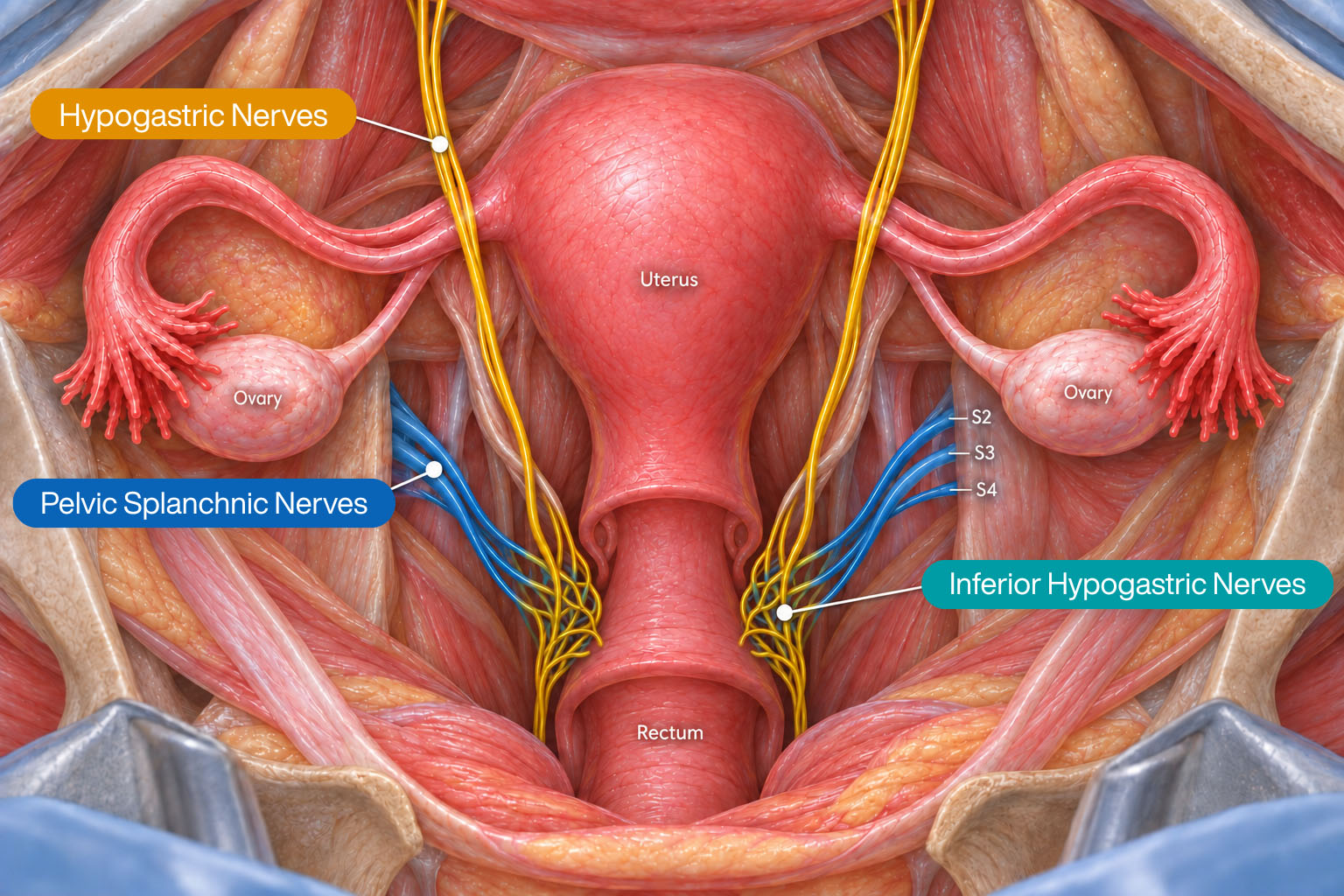
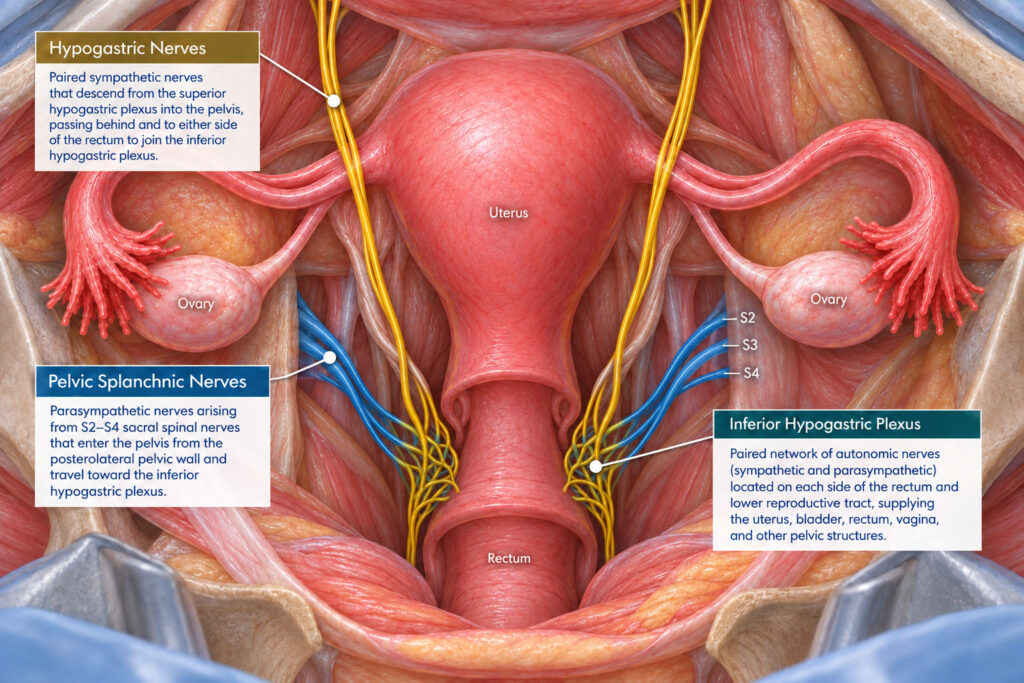
Medical Illustration: The hypogastric nerves, pelvic splanchnic nerves, and inferior hypogastric plexus are important pelvic nerves that help control the bladder, bowel, and reproductive organs.
Why Do Pelvic Nerves Matter During Endometriosis Surgery?
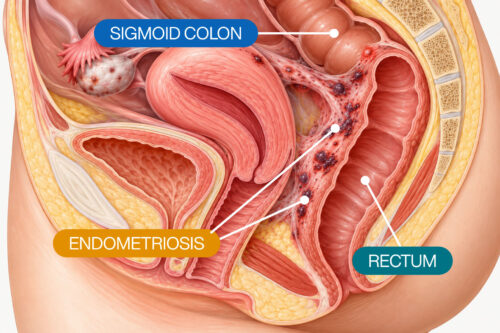
Deep endometriosis can involve areas of the pelvis close to the autonomic nerves.
These nerves help regulate functions that normally happen without conscious control, including aspects of bladder emptying and bowel function. Important structures include the hypogastric nerves, pelvic splanchnic nerves, and inferior hypogastric plexus. [3]
When endometriosis or surrounding fibrosis develops near these structures, surgical dissection may become more complex.
This makes a detailed understanding of pelvic neuroanatomy particularly important during surgery for deep endometriosis.
Key Pelvic Nerves in Endometriosis Surgery
Several autonomic nerve structures are particularly important during surgery for deep endometriosis. These include the hypogastric nerves, pelvic splanchnic nerves, and inferior hypogastric plexus. [3]
Hypogastric Nerves
Paired sympathetic nerves that descend from the superior hypogastric plexus into the pelvis, passing behind and to either side of the rectum to join the inferior hypogastric plexus.
Pelvic Splanchnic Nerves
Parasympathetic nerves arising from S2–S4 sacral spinal nerves that enter the pelvis from the posterolateral pelvic wall and travel toward the inferior hypogastric plexus.
Inferior Hypogastric Plexus
A paired network of autonomic nerves located on each side of the rectum and lower reproductive tract.
What Is Nerve-Sparing Endometriosis Surgery?
Nerve-sparing surgery does not mean leaving endometriosis untreated simply because it is near a nerve.
Instead, the surgeon identifies relevant nerve pathways and carefully separates disease from surrounding anatomy when this can be accomplished safely.
Improved laparoscopic visualization and a better understanding of pelvic neuroanatomy have contributed to techniques that allow surgeons to recognize and preserve these structures during complex pelvic surgery. [3]
The exact approach depends on where the endometriosis is located, how deeply it infiltrates surrounding tissues, and which organs or structures are involved.
Can Endometriosis Surgery Affect Bladder or Bowel Function?
It can.
Surgery for deep endometriosis may involve areas close to nerves supplying the bladder and bowel. Injury to these autonomic nerves can contribute to postoperative problems such as difficulty emptying the bladder. [2]
Research comparing nerve-sparing and conventional approaches has suggested that nerve-sparing techniques may reduce certain postoperative urinary complications. A systematic review and meta-analysis, for example, found a lower risk of persistent urinary retention after nerve-sparing surgery, although the available evidence was limited and additional controlled studies were recommended. [2]
Another study of surgery for posterior deep infiltrating endometriosis found improved immediate postoperative urinary outcomes with systematic nerve sparing, including a reduced need for self-catheterization. [4]
Is Nerve-Sparing Surgery Better for Every Patient?
No necesariamente.
Endometriosis surgery must be individualized. Disease location and extent can vary considerably from one patient to another, and preservation of a nerve may not always be technically possible or appropriate.
Importantly, the European Society of Human Reproduction and Embryology (ESHRE) does not currently recommend one particular surgical technique for treating pain associated with deep endometriosis because studies differ substantially in their patient populations, surgical approaches, and techniques. [1]
ESHRE does recommend that patients with deep endometriosis be referred to a center with appropriate expertise and that patients considering surgery be informed about potential risks, benefits, and long-term effects on quality of life. [1]
Treating Endometriosis While Preserving Pelvic Function
Endometriosis surgery is about more than removing visible disease. In complex cases, surgeons must also consider how endometriosis relates to surrounding structures, particularly the bowel, bladder, ureters, blood vessels, and pelvic nerves.
A careful surgical approach considers both treatment of the disease and preservation of normal function whenever possible.
En New York Gynecology Surgery & Endometriosis (NYGSE), Dr. Pankaj Singhal and Dr. Elizabeth McLean evaluate each patient individually, considering symptoms, disease location, pelvic anatomy, and treatment goals when planning endometriosis surgery.
If you have deep endometriosis or are considering surgery, an evaluation with an NYGSE endometriosis specialist can help determine an appropriate approach for your individual case.
Becker, C. M., Bokor, A., Heikinheimo, O., Horne, A., Jansen, F., Kiesel, L., King, K., Kvaskoff, M., Nap, A., Petersen, K., Saridogan, E., Tomassetti, C., van Hanegem, N., Vulliemoz, N., y Vermeulen, N. (2022). ESHRE guideline: Endometriosis. Human Reproduction Open, 2022(2), hoac009. https://doi.org/10.1093/hropen/hoac009
2. de Resende Júnior, J. A. D., Cavalini, L. T., Crispi, C. P., & Fonseca, M. F. (2017). Risk of urinary retention after nerve-sparing surgery for deep infiltrating endometriosis: A systematic review and meta-analysis. Neurourology and Urodynamics, 36(1), 57–61. https://doi.org/10.1002/nau.22915
3. Ribeiro-Julio, G. S., Pereira, J. A., Ribeiro, E., Gallo, C. M., & Favorito, L. A. (2023). Anatomy of the lower hypogastric plexus applied to endometriosis: A narrative review. International Brazilian Journal of Urology, 49(3), 299–306. https://doi.org/10.1590/S1677-5538.IBJU.2022.9980
4. Soares, M., Mimouni, M., Oppenheimer, A., Nyangoh Timoh, K., du Cheyron, J., & Fauconnier, A. (2021). Systematic nerve sparing during surgery for deep-infiltrating posterior endometriosis improves immediate postoperative urinary outcomes. Journal of Minimally Invasive Gynecology, 28(6), 1194–1202. https://doi.org/10.1016/j.jmig.2020.10.016