

Menstrual cramps usually result from contractions of the uterus during menstruation. Endometriosis, however, can cause pain through inflammation, fibrosis, adherencias, and irritation of surrounding tissues and nerves.
Both conditions can cause lower abdominal pain, back discomfort, and symptoms that worsen during menstruation, making them difficult to distinguish based on pain alone.
The distinction is not simply how severe the pain feels. Its timing, location, associated symptoms, and response to treatment can provide important clues about the underlying cause.
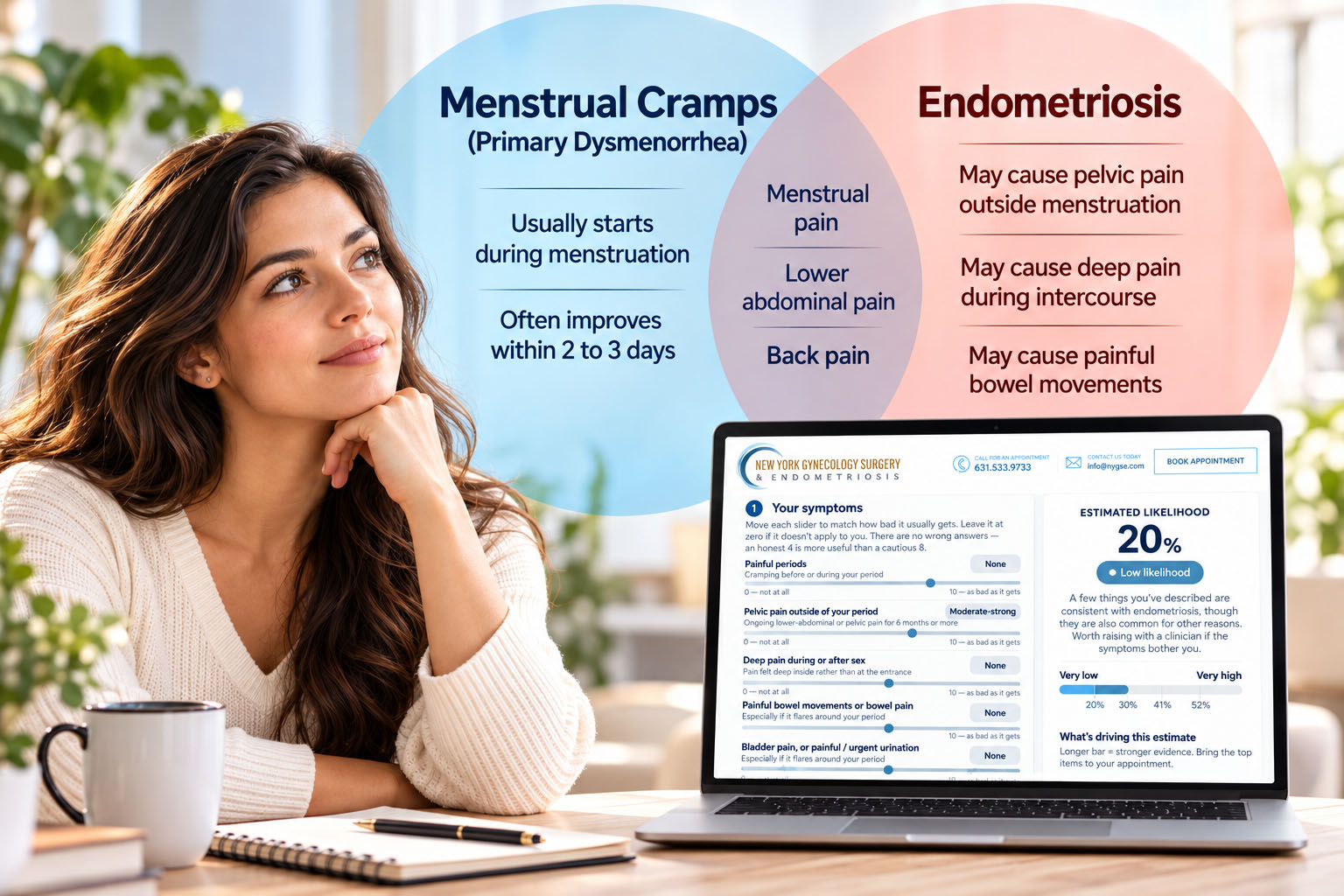
An illustration comparing menstrual cramps and endometriosis, highlighting shared symptoms, differences in pain patterns, and the NYGSE Endometriosis Symptom Checker.
Normal Menstrual Cramps Begin With Uterine Contractions
During menstruation, the uterus sheds its inner lining, called the endometrium. Chemicals known as prostaglandins stimulate contractions of the uterine muscle, helping expel menstrual blood and tissue. [4]
Strong contractions can temporarily reduce blood flow within the uterine muscle, producing cramps. Menstrual pain that occurs without an identifiable underlying pelvic disorder is called primary dysmenorrhea.
Primary dysmenorrhea typically begins shortly before or at the start of menstrual bleeding. Pain is often strongest during the first 24 hours and gradually improves over the next two to three days. [4]
Although this type of pain does not require an underlying disease, it can still be severe enough to interfere with daily activities.
Endometriosis Pain Can Originate Outside the Uterus
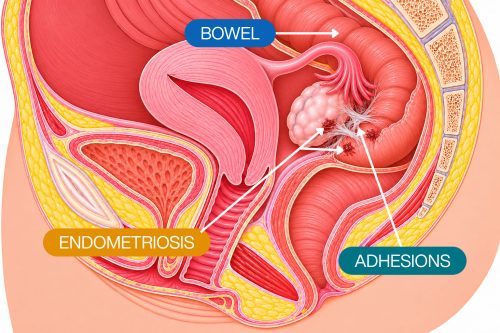
Endometriosis occurs when tissue resembling the uterine lining develops outside the uterus. These growths, called endometriosis lesions, may affect the pelvic lining, ovaries, ligamentos uterosacros, bowel, bladder, and other structures. [3]
Unlike primary dysmenorrhea, which primarily involves uterine contractions, endometriosis-related pain can arise from affected tissues elsewhere in the pelvis.
Endometriosis lesions and their surrounding environment may produce inflammatory substances that increase the sensitivity of nearby nerves. [3]
Some lesions are also associated with fibrosis, a process in which tissues become thickened or scarred. Adhesions may develop between pelvic organs, restricting their normal movement.
These changes can contribute to pain during menstruation, intercourse, bowel movements, or certain physical activities.
However, not every lesion or adhesion causes pain. The relationship between visible disease and symptoms varies considerably between patients.
Period Pain and Endometriosis Have Different Patterns
Although symptoms frequently overlap, several characteristics may help distinguish primary dysmenorrhea from possible endometriosis. [2][4]
| Característica | Primary Dysmenorrhea | Endometriosis-Related Pain |
|---|---|---|
| Timing | Usually begins shortly before or during menstruation | May occur during or outside menstruation |
| Duration | Often improves within 2–3 days | May continue beyond menstrual bleeding |
| Ubicación | Lower abdomen, back, or thighs | Pelvis, lower back, or areas involving affected structures |
| Associated Symptoms | Nausea, diarrhea, or headache | Painful intercourse, bowel or urinary symptoms, fertility difficulties |
| Underlying Mechanism | Prostaglandin-driven uterine contractions | Inflammation, nerve sensitization, fibrosis, and other mechanisms |
| Treatment Response | Often improves with anti-inflammatory medication or hormonal treatment | May respond to similar treatments, but symptoms can persist |
These are general patterns rather than diagnostic rules.
Endometriosis may cause pain only during menstruation, while primary dysmenorrhea can produce intense cramps. Both conditions may also occur together.
Use the NYGSE Endometriosis Symptom Checker to Examine Pain Patterns
Menstrual pain is not always easy to classify. Two patients may experience equally severe cramps, yet one may have primary dysmenorrhea while the other has endometriosis.
El NYGSE Endometriosis Symptom Checker allows patients to assess painful periods alongside other symptoms, including pelvic pain outside menstruation. [2]
Considering these symptoms together may help patients recognize patterns that deserve further medical evaluation, rather than focusing only on the intensity of menstrual cramps.
The checker provides an educational likelihood estimate, not a diagnosis or a clinically validated individual probability. Its results can help organize symptoms for discussion with a healthcare professional.

An illustration showing a woman using the NYGSE Endometriosis Symptom Checker to review her symptoms and receive an educational likelihood estimate.
Pain During Bowel Movements or Intercourse May Provide Additional Clues
The uterus sits close to the rectum, bladder, pelvic muscles, and connective tissues supporting the reproductive organs.
Endometriosis affecting the posterior pelvis, including areas near the rectum, may contribute to pain during bowel movements, particularly around menstruation. Similarly, deep endometriosis involving the uterosacral ligaments or nearby tissues may be associated with pain during intercourse. [2][5]
These symptoms can suggest that structures beyond the uterine muscle are involved.
However, bowel disorders, bladder conditions, and pelvic floor dysfunction can produce similar symptoms. Their presence does not automatically establish an endometriosis diagnosis.
Severe Pain Does Not Always Mean Severe Endometriosis
It may seem reasonable to assume that more extensive endometriosis causes more severe pain. In practice, the relationship is not that straightforward. Some patients with limited visible disease experience debilitating pain, while others with extensive lesions or adhesions report relatively mild symptoms. [2]
Pain depends on several factors, including lesion location, inflammation, nerve sensitivity, and coexisting pelvic conditions.
Consequently, pain severity cannot reliably determine whether endometriosis is present or establish its stage.
Persistent Menstrual Pain Deserves Clinical Evaluation
Period pain that repeatedly interferes with work, school, sleep, or everyday activities deserves medical attention, particularly when symptoms are worsening or do not respond adequately to treatment. [5]
A clinician may review the timing and location of pain, associated symptoms, medical history, and response to medications.
Ultrasound can identify ovarian endometriomas and certain forms of deep endometriosis. However, superficial lesions may not be visible, meaning a normal ultrasound cannot rule out the condition. [1][5]
A clinical diagnosis of suspected endometriosis may be made without immediate surgery. Further investigation and treatment decisions depend on individual findings, symptoms, and reproductive goals. [1]
Understanding the Cause of Pain Helps Guide Treatment
Ordinary menstrual cramps and endometriosis-related pain can feel similar because both may worsen during menstruation.
The important difference lies in their possible origins. Primary dysmenorrhea mainly involves uterine contractions, while endometriosis can affect tissues outside the uterus through inflammation, fibrosis, and adhesions.
En New York Gynecology Surgery & Endometriosis (NYGSE), evaluating pelvic anatomy alongside each patient’s symptoms and treatment goals helps guide individualized care.
Menstrual pain should not be judged by intensity alone. Understanding its pattern and possible underlying mechanisms is an important step toward identifying the cause and choosing appropriate treatment.
Referencias
- American College of Obstetricians and Gynecologists. (2026). ACOG clinical practice guideline No. 11: Diagnosis of endometriosis. Obstetrics & Gynecology, 147(3), 432–448. https://doi.org/10.1097/AOG.0000000000006181
- Becker, C. M., Bokor, A., Heikinheimo, O., Horne, A., Jansen, F., Kiesel, L., King, K., Kvaskoff, M., Nap, A., Petersen, K., Saridogan, E., Tomassetti, C., van Hanegem, N., Vulliemoz, N., y Vermeulen, N. (2022). ESHRE guideline: Endometriosis. Human Reproduction Open, 2022(2), hoac009. https://doi.org/10.1093/hropen/hoac009
- Bulun, S. E., Yilmaz, B. D., Sison, C., Miyazaki, K., Bernardi, L., Liu, S., Kohlmeier, A., Yin, P., Milad, M., & Wei, J. (2019). Endometriosis. Endocrine Reviews, 40(4), 1048–1079. https://doi.org/10.1210/er.2018-00242
- Iacovides, S., Avidon, I., & Baker, F. C. (2015). What we know about primary dysmenorrhea today: A critical review. Human Reproduction Update, 21(6), 762–778. https://doi.org/10.1093/humupd/dmv039
- National Institute for Health and Care Excellence. (2024). Endometriosis: Diagnosis and management (NICE Guideline NG73). https://www.nice.org.uk/guidance/ng73