

An endometrioma ovárico, commonly known as a chocolate cyst, is usually benign. However, research has established an association between endometriosis involving the ovary and certain types of ovarian cancer.
This connection raises an important question: Can an ovarian endometrioma become cancerous?
Although malignant transformation has been documented, it is uncommon. Most women with ovarian endometriomas will never develop ovarian cancer. [2][3]
The important distinction is between an increased statistical risk and an actual cancer diagnosis. The presence of an endometrioma alone does not establish malignancy.
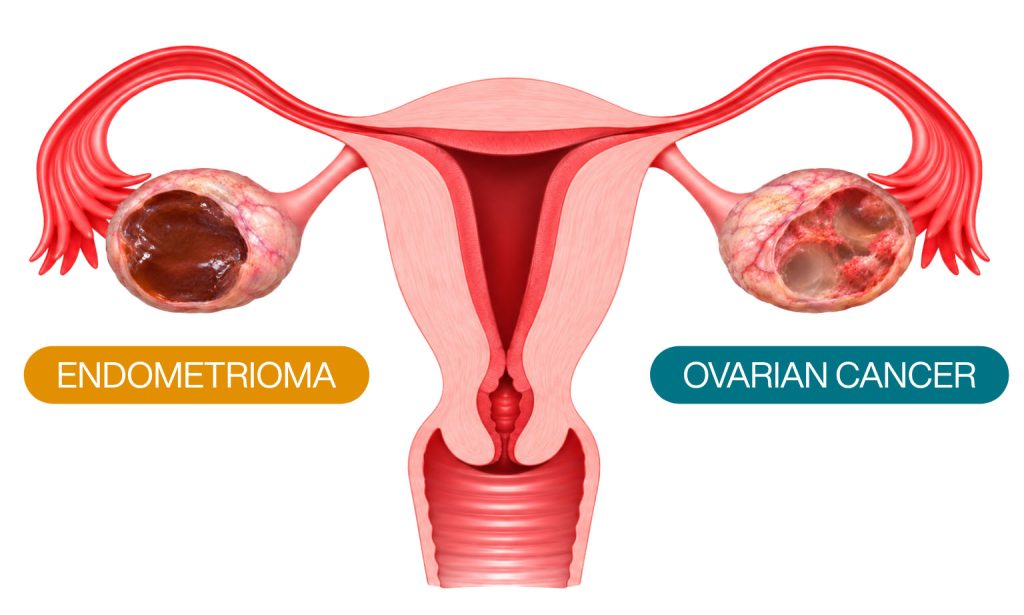
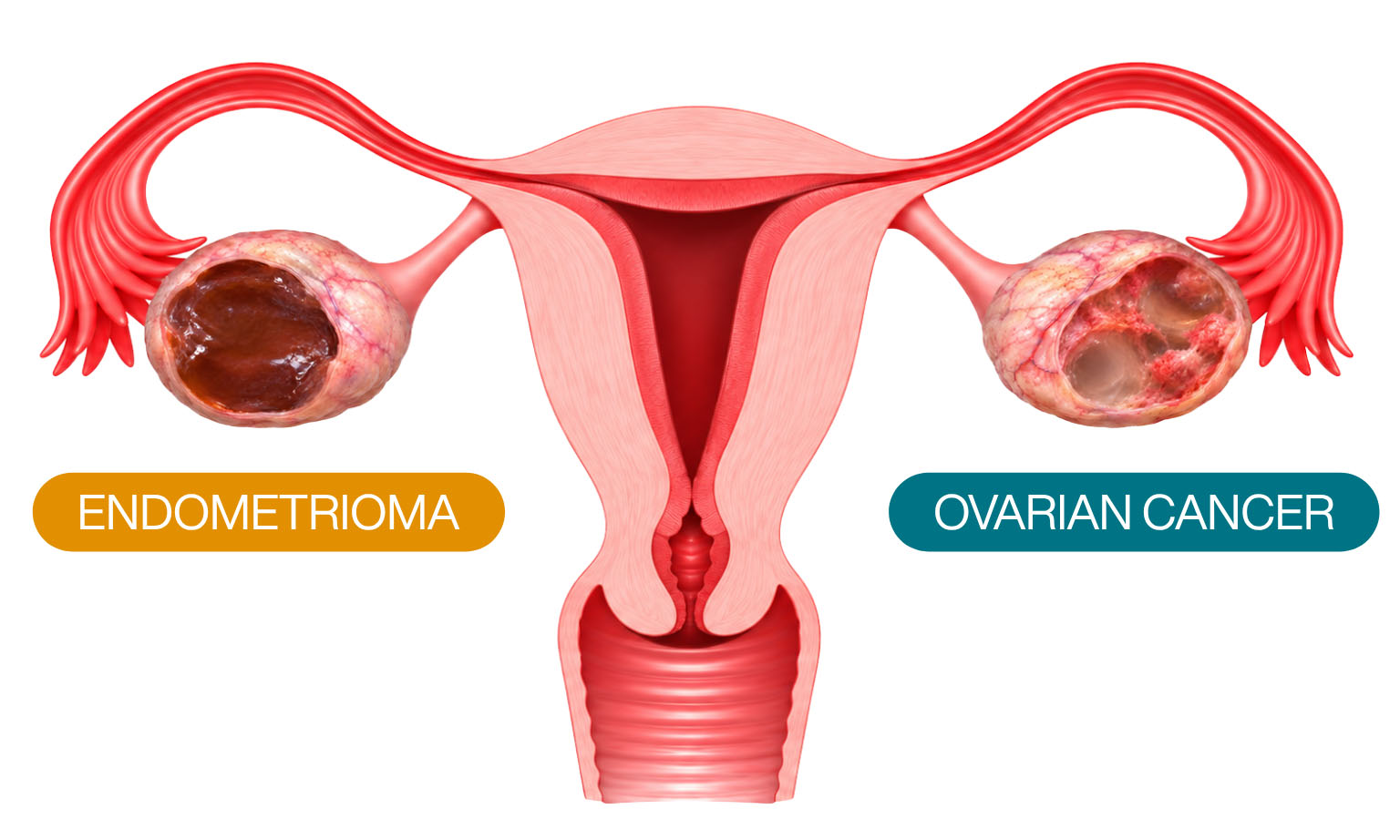
Comparison of a benign ovarian endometrioma (left) and an illustrative ovarian cancerous mass (right), highlighting differences in their internal appearance.
Most Ovarian Endometriomas Are Benign
An endometrioma is an ovarian cyst associated with endometriosis. It contains old blood and inflammatory material, often producing the dark brown appearance responsible for the term chocolate cyst.
Endometriomas may cause pelvic pain, painful menstruation, or fertility difficulties. Others produce few symptoms and are discovered during imaging examinations. [3]
An endometrioma is not itself ovarian cancer. Nevertheless, a diagnosis of endometriosis should not lead to the assumption that every ovarian mass is harmless.
The appearance of the cyst, the patient’s clinical history, and any changes over time remain important in determining whether further evaluation is necessary.
Can an Ovarian Endometrioma Become Cancerous?
Malignant transformation has been documented in some endometriosis-associated ovarian lesions. However, this is uncommon, and most ovarian endometriomas remain benign. [3][6]
Researchers have identified several possible biological mechanisms involving chronic inflammation, oxidative stress, and repeated exposure to iron released from blood within an endometrioma.
Genetic alterations involving ARID1A and PIK3CA have also been identified in some endometriosis-associated ovarian cancers. [6][7]
These findings provide biological evidence for a possible connection between endometriosis and ovarian malignancy. However, they do not establish that an individual endometrioma is progressing toward cancer.
Importantly, ovarian cancer discovered in a woman with endometriosis does not necessarily prove that the cancer originated from a preexisting endometrioma.
Ovarian Cancer Risk Is Higher in Certain Endometriosis Subtypes
In a 2024 population-based study, Barnard and colleagues examined the association between different forms of endometriosis and epithelial ovarian cancer.
Women diagnosed with endometriosis had approximately 4.2 times the adjusted hazard of epithelial ovarian cancer compared with women without a recorded endometriosis diagnosis.
The association was stronger among women with ovarian endometriomas and/or deep infiltrating endometriosis, with an estimated 9.7-fold higher adjusted hazard.
However, the 9.7-fold estimate applies to a combined disease category, not specifically to isolated ovarian endometriomas. [2]
Because this was an observational study, the findings establish an association rather than proving that endometriosis directly causes ovarian cancer.
The Absolute Risk of Ovarian Cancer Remains Relatively Low
Relative risk must be interpreted alongside absolute risk.
The European Society of Human Reproduction and Embryology (ESHRE) reports the following estimated lifetime risks:
| Population | Estimated Lifetime Ovarian Cancer Risk |
|---|---|
| Women without endometriosis | 1.3% |
| Women with endometriosis | 2.5% |
Source: ESHRE guideline (2022). Estimates apply to endometriosis overall, not specifically to ovarian endometriomas. [3]
These figures apply to endometriosis overall rather than specifically to ovarian endometriomas. [3]
The difference between these estimates is approximately 1.2 percentage points.
Although the relative risk is elevated, most women with endometriosis will not develop ovarian cancer.
Two Ovarian Cancer Types Are Particularly Associated With Endometriosis
Ovarian Clear Cell Carcinomaometriosis
Ovarian clear cell carcinoma is an epithelial ovarian cancer subtype with a recognized association with endometriosis.
Molecular research has identified genetic alterations in some tumors that may help explain how endometriosis-associated tissue can participate in cancer development. [6][7]
However, the presence of an endometrioma does not mean that clear cell carcinoma is developing.
Endometrioid Ovarian Carcinoma
Endometrioid ovarian carcinoma is another epithelial ovarian cancer subtype associated with endometriosis. [2][6]
These cancers are distinct from benign ovarian endometriomas. A definitive diagnosis generally requires histopathological examination, in which a pathologist examines tissue under a microscope.
Neither cancer subtype can be diagnosed simply because an ovarian endometrioma is present.
Ultrasound Findings Can Help Identify Suspicious Ovarian Changes
Transvaginal ultrasound is commonly used to evaluate ovarian cysts.
A typical endometrioma often demonstrates relatively uniform, low-level internal echoes, producing what radiologists describe as a ground-glass appearance. [1]
However, the term chocolate cyst describes the cyst’s contents, not a definitive pathological diagnosis.
An ovarian cyst may require further evaluation when ultrasound identifies:
- Solid components within the cyst
- Papillary projections or irregular internal structures
- Vascularity within suspicious solid tissue
- Significant changes in appearance over time
- A new or changing ovarian mass after menopause
These findings must be interpreted using standardized imaging criteria, such as the American College of Radiology’s O-RADS system. They do not automatically indicate cancer, because blood clots and other benign structures can sometimes resemble suspicious tissue. [1]
Depending on the findings, MRI or evaluation by a specialist experienced in ovarian mass assessment may be appropriate.

CA-125 Alone Cannot Diagnose Ovarian Cancer
CA-125 is a blood tumor marker that may be measured as part of the evaluation of an ovarian mass, particularly when ovarian cancer is suspected.
However, CA-125 can be elevated in benign conditions, including endometriosis. Conversely, some ovarian cancers do not produce markedly elevated CA-125 levels, particularly in earlier stages. [5]
Therefore, an elevated CA-125 does not confirm ovarian cancer, and a normal result cannot exclude it.
Physicians must interpret the result alongside imaging findings, symptoms, age, menopausal status, and other clinical factors.
Can the NYGSE Endometriosis Likelihood Index Help?
Women with an ovarian endometrioma may also experience symptoms associated with endometriosis. The free Predictor de Riesgo de Endometriosis de NYGSE estimates the likelihood of endometriosis using reported symptoms and other relevant clinical information, including CA-125 results when available. This may help patients better understand their symptoms and whether further medical evaluation is appropriate.
The ELI is not a diagnostic tool and cannot determine whether an ovarian cyst is benign or cancerous. Although CA-125 is included in the assessment, elevated levels can occur in benign endometriosis and other conditions. The ELI does not assess ovarian cancer risk or replace ultrasound, specialist evaluation, or other diagnostic testing.
GRATIS · 3 MINUTOS · PRIVADO
Realice la evaluación de 3 minutos

Persistent Changes Should Not Automatically Be Attributed to Endometriosis
Pelvic pain and abdominal discomfort are common among women with endometriosis. However, an existing diagnosis should not become the explanation for every new symptom.
Medical evaluation is important when a woman develops:
- Persistent or progressively worsening abdominal bloating
- Increasing abdominal size
- Feeling full unusually quickly
- Unexplained weight loss
- New urinary urgency or frequency
- New or worsening pelvic or abdominal pain
These symptoms are not specific to ovarian cancer and may have several benign explanations.
Nevertheless, persistent or unexplained changes warrant attention, particularly when an ovarian mass has already been identified. [4]
Does an Endometrioma Require Regular Ovarian Cancer Screening?
Having an ovarian endometrioma does not automatically mean that a woman requires routine ovarian cancer screening.
Current evidence does not support systematic ovarian cancer screening beyond existing population-based recommendations solely because a woman has endometriosis. [3]
However, screening for cancer and monitoring an existing ovarian cyst are different clinical decisions.
An endometrioma may require individualized imaging follow-up depending on its appearance, the patient’s age, menopausal status, symptoms, and other risk factors.
Women with additional risk factors, including a significant family history or inherited cancer predisposition, may require a different evaluation strategy.
Surgery Is Not Automatically Necessary for Every Endometrioma
The presence of an endometrioma does not, by itself, justify surgical removal.
Management depends on symptoms, imaging characteristics, age, fertility plans, ovarian reserve, and any concern about malignancy.
When surgery is indicated for a benign endometrioma, ovarian cystectomy is generally preferred over simple drainage and coagulation to reduce recurrence of endometrioma and associated pain. [3]
However, removing an endometrioma can also damage healthy ovarian tissue and reduce ovarian reserve, particularly in women who wish to preserve fertility. [3]
For women with a suspicious ovarian mass, the priority is appropriate evaluation and surgical planning rather than automatically treating the lesion as routine endometriosis.
When ovarian cancer is suspected, consultation with a gynecologic oncologist before surgery is important.
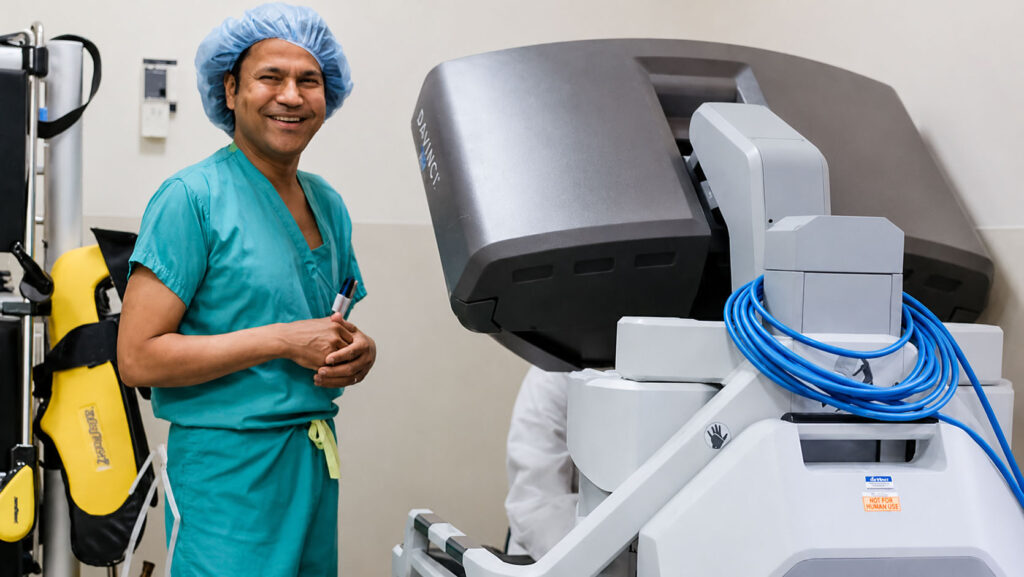
At NYGSE, Dr. Pankaj Singhal is double board-certified in obstetrics and gynecology and gynecologic oncology. With experience performing more than 12,000 surgeries, including over 6,000 robotic procedures, and recognition as a Master Robotic Surgeon, he brings extensive surgical experience to the evaluation and treatment of complex gynecologic conditions.
Accurate Diagnosis Should Guide Treatment Decisions
An ovarian endometrioma is usually benign, but its diagnosis should be based on appropriate clinical assessment rather than assumptions.
The association between endometriosis and ovarian cancer is supported by epidemiological and molecular research. Yet this association does not justify treating every endometrioma as a precancerous lesion. [2][3][6]
En New York Gynecology Surgery & Endometriosis (NYGSE), evaluation of ovarian endometriomas involves considering the extent of endometriosis, imaging findings, symptoms, and reproductive goals.
When findings raise concern for malignancy, further investigation and coordinated specialist care are essential.
The objective is to distinguish benign disease from suspicious pathology while avoiding both unnecessary surgery and delayed diagnosis.
Este artículo tiene fines educativos generales y no constituye asesoramiento médico individualizado. Si presenta dolor pélvico intenso y repentino, sangrado abundante, fiebre o desmayos, busque atención médica urgente.
Referencias
- American College of Radiology. (2022). O-RADS US risk stratification and management system (v2022). https://www.acr.org/Clinical-Resources/Clinical-Tools-and-Reference/Reporting-and-Data-Systems/O-RADS
- Barnard, M. E., Farland, L. V., Yan, B., et al. (2024). Endometriosis typology and ovarian cancer risk. JAMA, 332(6), 482–489. https://doi.org/10.1001/jama.2024.9210
- Becker, C. M., Bokor, A., Heikinheimo, O., et al. (2022). ESHRE guideline: Endometriosis. Human Reproduction Open, 2022(2), hoac009. https://doi.org/10.1093/hropen/hoac009
- National Cancer Institute. (n.d.). Ovarian epithelial, fallopian tube, and primary peritoneal cancer treatment (PDQ®)–Health professional version. https://www.cancer.gov/types/ovarian/hp/ovarian-epithelial-treatment-pdq
- Shinmura, H., Yoneyama, K., Harigane, E., Tsunoda, Y., Fukami, T., Matsushima, T., & Takeshita, T. (2020). Use of tumor markers to distinguish endometriosis-related ovarian neoplasms from ovarian endometrioma. International Journal of Gynecological Cancer, 30(6), 831–836. https://doi.org/10.1136/ijgc-2020-001210
- Wiegand, K. C., Shah, S. P., Al-Agha, O. M., et al. (2010). ARID1A mutations in endometriosis-associated ovarian carcinomas. The New England Journal of Medicine, 363(16), 1532–1543. https://doi.org/10.1056/NEJMoa1008433
- Yamamoto, S., Tsuda, H., Takano, M., Iwaya, K., Tamai, S., & Matsubara, O. (2011). PIK3CA mutation is an early event in the development of endometriosis-associated ovarian clear cell adenocarcinoma. The Journal of Pathology, 225(2), 189–194. https://doi.org/10.1002/path.2940