

noviembre 25, 2026
por NYGSE
Endometriosis avanzada Endometriosis Síntomas y diagnóstico Tratamiento y cirugía
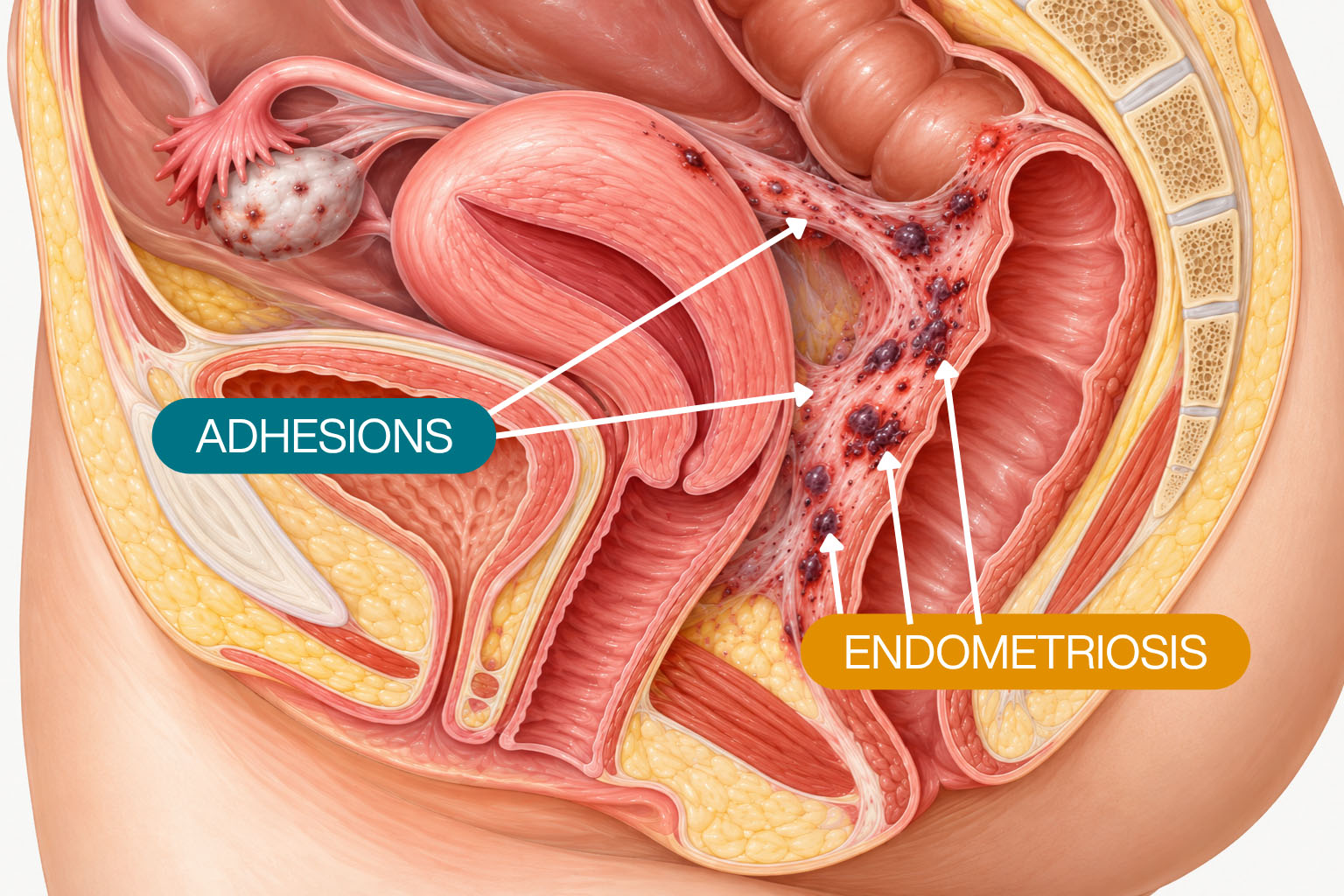
No, pelvic adhesions do not necessarily mean you have endometriosis. Although endometriosis is a recognized cause of pelvic adhesions, adhesions can also develop following surgery, infection, or other inflammatory conditions.
Research suggests that the likelihood of endometriosis varies depending on the location of the adhesions, whether the ovaries are fixed, and whether deeper pelvic structures are affected. [1][3][5]
In one surgical study, 21.5% of patients with pelvic or abdominal adhesions also had endometriosis. However, another study found that a fixed ovary on ultrasound had an 87.9% positive predictive value for endometriosis in a selected group of women undergoing laparoscopy for pelvic pain or infertility. [3][4]
These findings raise an important question: Does the location of pelvic adhesions provide more information about the likelihood of endometriosis than the presence of adhesions alone?
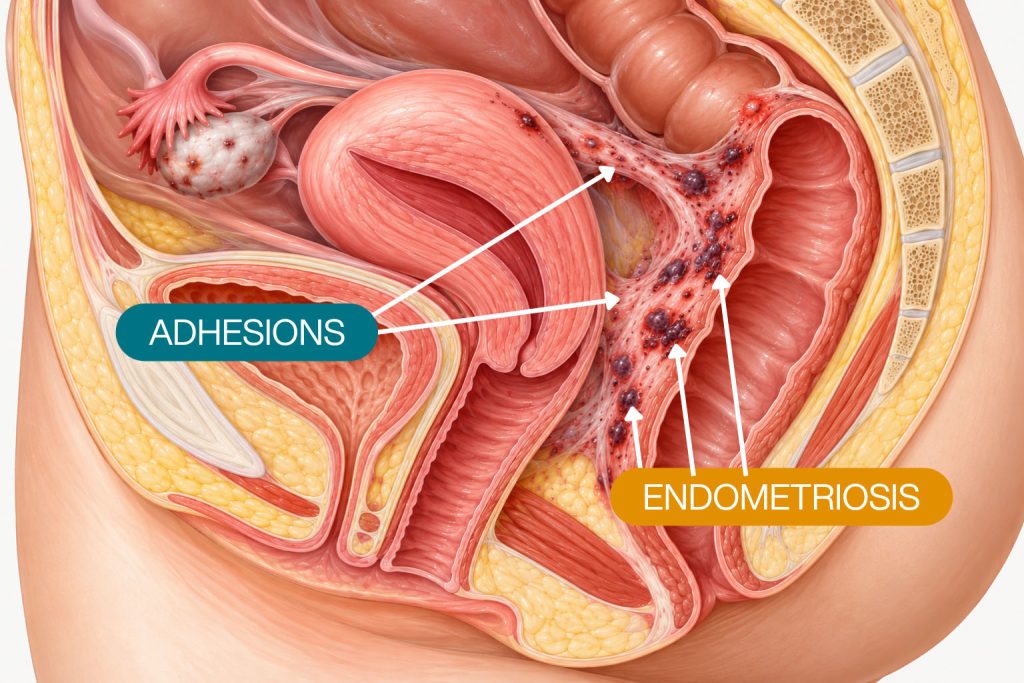
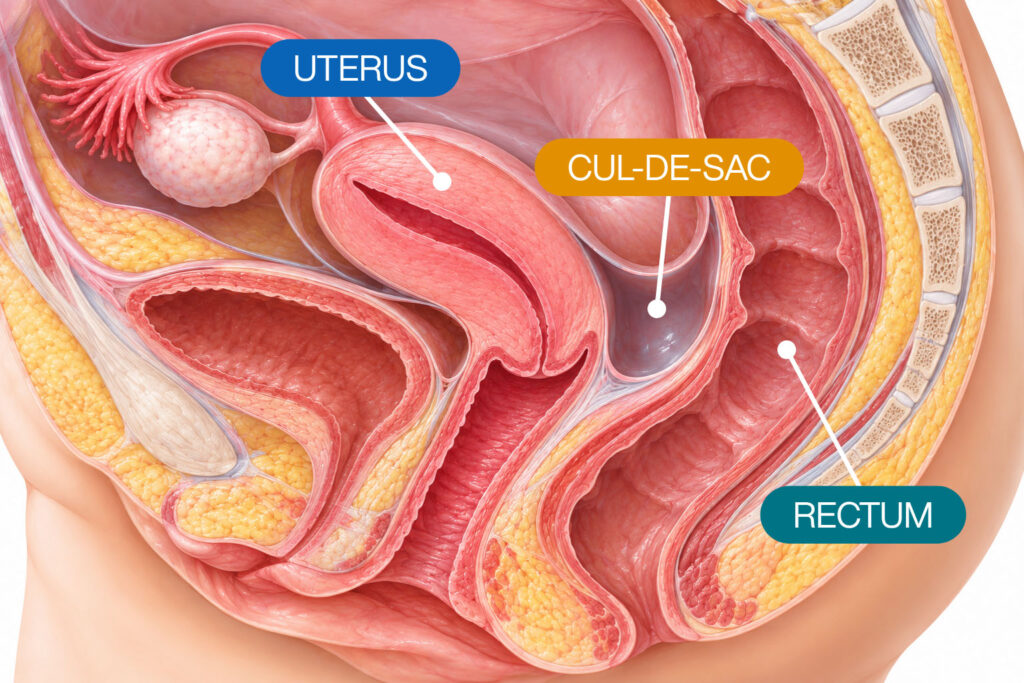
Illustration showing pelvic adhesions and endometriosis lesions in the posterior pelvic compartment, between the uterus and rectum.
Not All Pelvic Adhesions Are Caused by Endometriosis
Pelvic adhesions are bands of fibrous scar-like tissue that form between organs or structures that would normally move independently. They may connect the uterus, ovaries, fallopian tubes, bowel, or pelvic sidewall, sometimes restricting normal movement. [4]
Endometriosis can produce chronic inflammation and fibrosis, contributing to adhesion formation. Over time, an ovary may become attached to the uterus, the bowel may become adherent to nearby structures, or the space behind the uterus may become partially or completely obliterated.
However, adhesions are not specific to endometriosis. Other possible causes include previous abdominal or pelvic surgery, pelvic inflammatory disease, prior infection, and inflammatory conditions involving the abdomen or pelvis. [4]
Some adhesions cause pain or interfere with fertility, while others produce no noticeable symptoms. Their presence alone cannot establish the underlying cause. [4]
What Percentage of Patients With Pelvic Adhesions Have Endometriosis?
A retrospective study by Mettler and Alhujeily (2007), conducted at the Kiel School of Gynecological Endoscopy in Germany, examined 462 laparoscopic procedures. [4]
Researchers identified pelvic or abdominal adhesions in 275 patients. Among those patients, 59 also had endometriosis. [4]
| Research finding | Result |
|---|---|
| Patients with pelvic or abdominal adhesions | 275 |
| Patients with coexisting endometriosis | 59 |
| Percentage with endometriosis | 21.5% |
Source: Mettler & Alhujeily (2007). Among 275 patients with pelvic or abdominal adhesions,
59 had coexisting endometriosis (21.5%). This finding comes from a selected surgical population
and should not be generalized to all patients with pelvic adhesions.
Importantly, 70.2% of patients with adhesions had undergone previous surgery, a recognized contributor to adhesion formation. [4]
Therefore, 21.5% is not the general probability of endometriosis for every patient with pelvic adhesions. The study included both abdominal and pelvic adhesions in a selected surgical population. The proportion may differ among patients without previous surgery, those with chronic pelvic pain, or those with adhesions involving specific reproductive organs. [4]
Ovarian Fixation Is Strongly Associated With Endometriosis
An ovary is normally able to move to some degree relative to nearby pelvic structures. When an ovary becomes attached to the uterus or pelvic sidewall, this restriction is called ovarian fixation or ovarian immobility. [3]
In a prospective study published in 2014, Marasinghe and colleagues evaluated 106 women scheduled for laparoscopy because of infertility or chronic pelvic pain. [3]
Before surgery, researchers used transvaginal ultrasound to assess ovarian mobility. A fixed ovary was defined as an ovary adherent to either the uterus medially or the pelvic sidewall laterally. [3]
The researchers reported the following diagnostic findings for fixed ovaries on ultrasound:
| Measure | Result | Meaning |
|---|---|---|
| Sensitivity | 78.4% | Among women with endometriosis, 78.4% had ovarian fixation detected on ultrasound. |
| Specificity | 94.2% | Among women without endometriosis, 94.2% had no ovarian fixation detected on ultrasound. |
| Positive predictive value | 87.9% | Among women with fixed ovaries on ultrasound, 87.9% had endometriosis. |
| Negative predictive value | 89.0% | Among women without ovarian fixation on ultrasound, 89.0% did not have endometriosis. |
The positive predictive value means that, within this selected population of women undergoing laparoscopy for infertility or chronic pelvic pain, approximately 88% of those with a fixed ovary detected on ultrasound had endometriosis at laparoscopy. [3]
However, the researchers did not report a separate probability for ovaries attached specifically to the uterus. Furthermore, positive predictive values depend on the prevalence of disease in the population being examined. [3]
An ovary stuck to the uterus should therefore raise suspicion for endometriosis, but it does not confirm the diagnosis. The reported 87.9% should not be interpreted as the probability of endometriosis among all patients with ovarian fixation. [3]
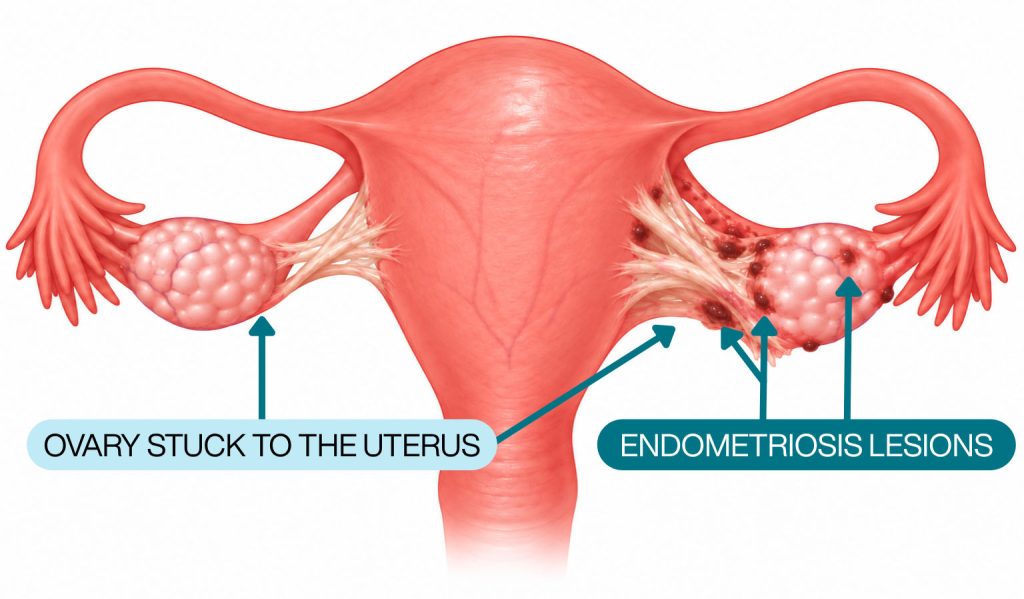
Medical illustration showing ovaries stuck to the uterus by pelvic adhesions, with endometriosis lesions on the right side.
The Location of Pelvic Adhesions May Be More Informative Than Their Presence Alone
Not all pelvic adhesions involve the same organs or carry the same clinical significance.
Adhesions affecting the ovaries, posterior uterus, rectum, or pouch of Douglas may be particularly relevant when evaluating suspected endometriosis. [1][5]
A prospective study by Chaggar and colleagues (2023) examined 1,026 women attending a general gynecology clinic. Researchers found ultrasound evidence of deep and/or ovarian endometriosis in 194 patients, representing 18.9% of the study population. [1]
After adjusting for other measured variables, pelvic adhesions were strongly associated with deep and/or ovarian endometriosis, with an adjusted odds ratio of 25.7. [1]
This represents a strong statistical association, not a 25.7-fold probability or a direct estimate of an individual patient’s risk. The study primarily assessed sonographically detected disease rather than systematically obtaining surgical confirmation in every participant. [1]
Pouch of Douglas Obliteration Is Associated With Deep Endometriosis
El pouch of Douglas, also called the posterior cul-de-sac, is the space between the uterus and rectum.
Endometriosis-associated fibrosis and adhesions may restrict movement in this area or cause partial or complete obliteration of the space. [5]
In a 2026 prospective study, Morales and colleagues evaluated 202 patients undergoing laparoscopy for benign gynecological conditions. [5]
Of the 17 patients with pouch of Douglas obliteration, 11 had deep pelvic endometriosis. [5]
| Study finding | With obliteration | Without obliteration |
|---|---|---|
| Patients with deep endometriosis | 11 of 17 | 11 of 185 |
| Percentage | 64.7% | 5.9% |
Source: Morales et al. (2026).
Findings from 202 patients undergoing benign gynecologic laparoscopy.
Only 17 patients had pouch of Douglas obliteration.
The absence of obliteration does not exclude deep endometriosis.
Pouch of Douglas obliteration was also statistically associated with chronic pelvic pain and infertility in this study. [5]
Although the association with deep endometriosis was statistically significant, only 17 patients had pouch of Douglas obliteration, making this a relatively small subgroup. This limits the precision and generalizability of the 64.7% finding. [5]
Nevertheless, the results support the clinical importance of evaluating the posterior pelvic compartment when deep endometriosis is suspected. The findings should not be interpreted as establishing a universal probability of endometriosis among patients with pouch of Douglas obliteration. [5]
Research Findings: Pelvic Adhesions and Endometriosis
The following studies illustrate why one percentage cannot describe every patient with pelvic adhesions.
| Pelvic finding | Research finding | Estudio |
|---|---|---|
| Pelvic or abdominal adhesions | 21.5% had coexisting endometriosis | Mettler & Alhujeily (2007) |
| Fixed ovary on ultrasound | 87.9% positive predictive value | Marasinghe et al. (2014) |
| Pelvic adhesions on ultrasound | Adjusted odds ratio 25.7 | Chaggar et al. (2023) |
| Pouch of Douglas obliteration | 64.7% had deep endometriosis | Morales et al. (2026) |
Note: These studies involve different patient populations and measure different outcomes. Their results should not be directly compared or combined to estimate an individual patient’s probability of endometriosis.
Can Ultrasound or MRI Identify Pelvic Adhesions?
Transvaginal ultrasound can provide information about the movement of pelvic organs, particularly when performed by a clinician experienced in assessing endometriosis. [1]
During dynamic ultrasound, the examiner evaluates whether an ovary moves freely or appears fixed to nearby structures. The examination may also include the sliding sign, which assesses movement between pelvic structures, particularly the uterus, cervix, rectum, and surrounding tissues. [3][5]
A negative sliding sign may suggest restricted movement and possible pouch of Douglas obliteration. However, it cannot independently establish the cause of adhesions, confirm endometriosis, or determine the complete extent of pelvic disease.
MRI can help evaluate deep endometriosis and its anatomical distribution, although it may not identify every adhesion or superficial lesion. [2][6]
The National Institute for Health and Care Excellence (NICE) recommends transvaginal ultrasound for suspected endometriosis and specialist ultrasound or MRI when evaluating deep disease. [6]
Importantly, normal imaging does not exclude endometriosis, particularly superficial peritoneal disease. [2][6]
Adhesions Can Affect Fertility Without Confirming Endometriosis
Pelvic adhesions may interfere with fertility by changing the normal anatomical relationship between the ovaries and fallopian tubes.
For example, adhesions may restrict ovarian mobility, distort tubal anatomy, or interfere with the fallopian tube’s ability to capture an egg following ovulation.
However, the presence of adhesions does not automatically mean that a patient is infertile. Fertility depends on several additional factors, including age, ovarian function, tubal patency, sperm parameters, and other reproductive conditions. [2][6]
When fertility is a priority, evaluation should consider the overall reproductive picture rather than adhesions alone. Treatment decisions should account for the location and extent of pelvic disease, the patient’s reproductive goals, and the potential benefits and risks of intervention. [2][6]
Surgery Is Not Automatically Necessary for Every Patient With Pelvic Adhesions
Laparoscopy allows direct visualization of pelvic adhesions and may permit their surgical separation, known as adhesiolysis, alongside treatment of endometriosis when indicated. [2][6]
However, surgery is not automatically necessary when adhesions are suspected. Adhesiolysis carries risks, including organ injury and new adhesion formation, and does not guarantee pain relief.
ESHRE (2022) and NICE (2024) support individualized assessment based on symptoms, imaging findings, treatment response, fertility goals, and surgical risks. [2][6]
Can the NYGSE Endometriosis Likelihood Index Help?
El Predictor de Riesgo de Endometriosis de NYGSE estimates the likelihood of endometriosis using available patient information. Research on pelvic adhesions and ovarian fixation may inform future risk assessment, but these studies do not independently validate the ELI.
The ELI is not diagnostic and cannot confirm or exclude endometriosis. Results should be considered alongside medical history, imaging findings, and specialist evaluation.

FREE · 5 to 10 MINUTES · PRIVATE
Take the 5 to 10 minutes check
Lo que las pacientes deben recordar
Pelvic adhesions do not automatically mean that a patient has endometriosis. Although endometriosis is one possible cause, adhesions may also result from previous surgery, infection, or other inflammatory conditions.
The location of the adhesions and associated findings, such as ovarian fixation or pouch of Douglas obliteration, may provide additional information about the likelihood of endometriosis.
En New York Gynecology Surgery & Endometriosis (NYGSE), patients with suspected or confirmed endometriosis can seek specialized evaluation to better understand their symptoms, imaging findings, and available diagnostic and treatment options.
The goal is not simply to identify an adhesion, but to determine why it developed, whether endometriosis may be involved, and what findings are clinically important for the patient.
Referencias
- Chaggar, P., Tellum, T., Thanatsis, N., De Braud, L. V., Setty, T., & Jurkovic, D. (2023). Prevalence of deep and ovarian endometriosis in women attending a general gynecology clinic: Prospective cohort study. Ultrasound in Obstetrics & Gynecology, 61(5), 632–641. https://doi.org/10.1002/uog.26175
- European Society of Human Reproduction and Embryology. (2022). Endometriosis: Guideline of the European Society of Human Reproduction and Embryology. https://www.eshre.eu/guideline/endometriosis
- Marasinghe, J. P., Senanayake, H., Saravanabhava, N., Arambepola, C., Condous, G., & Greenwood, P. (2014). History, pelvic examination findings and mobility of ovaries as a sonographic marker to detect pelvic adhesions with fixed ovaries. Journal of Obstetrics and Gynaecology Research, 40(3), 785–790. https://doi.org/10.1111/jog.12234
- Mettler, L., & Alhujeily, M. (2007). Role of laparoscopy in identifying the clinical significance and cause of adhesions and chronic pelvic pain: A retrospective review at the Kiel School of Gynecological Endoscopy. JSLS, 11(3), 303–308. https://pmc.ncbi.nlm.nih.gov/articles/PMC3015826/
- Morales, C., Crovo, E., Morales, S., Borquez, V., Hinojosa, C., Assar, R., & Alcázar, J. L. (2026). Diagnostic accuracy of transvaginal ultrasound for detecting pelvic adhesions and predicting surgical time in benign gynecologic surgery. Journal of Ultrasound in Medicine, 45(9), 1941–1947. https://doi.org/10.1002/jum.70250
- National Institute for Health and Care Excellence. (2024). Endometriosis: Diagnosis and management (NICE Guideline No. NG73). https://www.nice.org.uk/guidance/ng73
Este artículo tiene fines educativos generales y no constituye asesoramiento médico individualizado. Si presenta dolor pélvico intenso y repentino, sangrado abundante, fiebre o desmayos, busque atención médica urgente.