Deep endometriosis can invade the bowel, bladder, ureters and diaphragm. The skills used in gynecologic cancer surgery are the skills these operations require.
By Pankaj Singhal, MD, MS, MHCM, FACOG, and Virginia McLean, MD New York Gynecology Surgery & Endometriosis, Babylon, NY
Dr. Singhal is double board certified in obstetrics and gynecology and in gynecologic oncology, with more than 18 years in practice and more than 12,000 surgeries.
Endometriosis is not cancer. In some ways, though, deep endometriosis behaves like one. It grows into neighboring organs, it creates dense scar tissue, and it distorts the normal layout of the pelvis. Removing it completely and safely calls for the same skills a gynecologic oncologist uses every week.
What deep endometriosis can involve
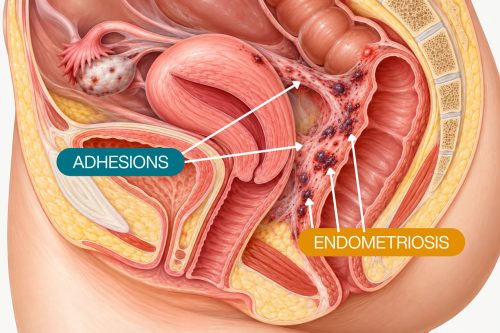
Deep endometriosis is disease that grows more than about 5 millimeters below the surface. It commonly affects the ligaments behind the uterus and the space between the rectum and the vagina, and it can extend into the wall of the sigmoid colon and rectum, the bladder, and the ureters, the tubes that carry urine from the kidneys to the bladder. It can also reach the diaphragm and, less often, the surface of the liver and other upper-abdominal organs. [1]
Ureteral endometriosis deserves special mention because it is often silent. It can slowly block the flow of urine from a kidney without causing obvious symptoms, and if the diagnosis is delayed, the kidney can lose function.[2]
Oncologic principles applied to endometriosis
Dr. Singhal is double board certified in obstetrics and gynecology and in gynecologic oncology. In cancer surgery, the goal is to remove all visible disease with a margin of normal tissue, while protecting the nerves, blood vessels and organs around it.
We apply the same principles to endometriosis. We excise each lesion with a margin, so that disease extending beyond what the eye can see comes out with it, and we work in the deep spaces of the pelvis where the bowel, ureters and pelvic nerves run close together.
Everything between the diaphragm and the pelvis
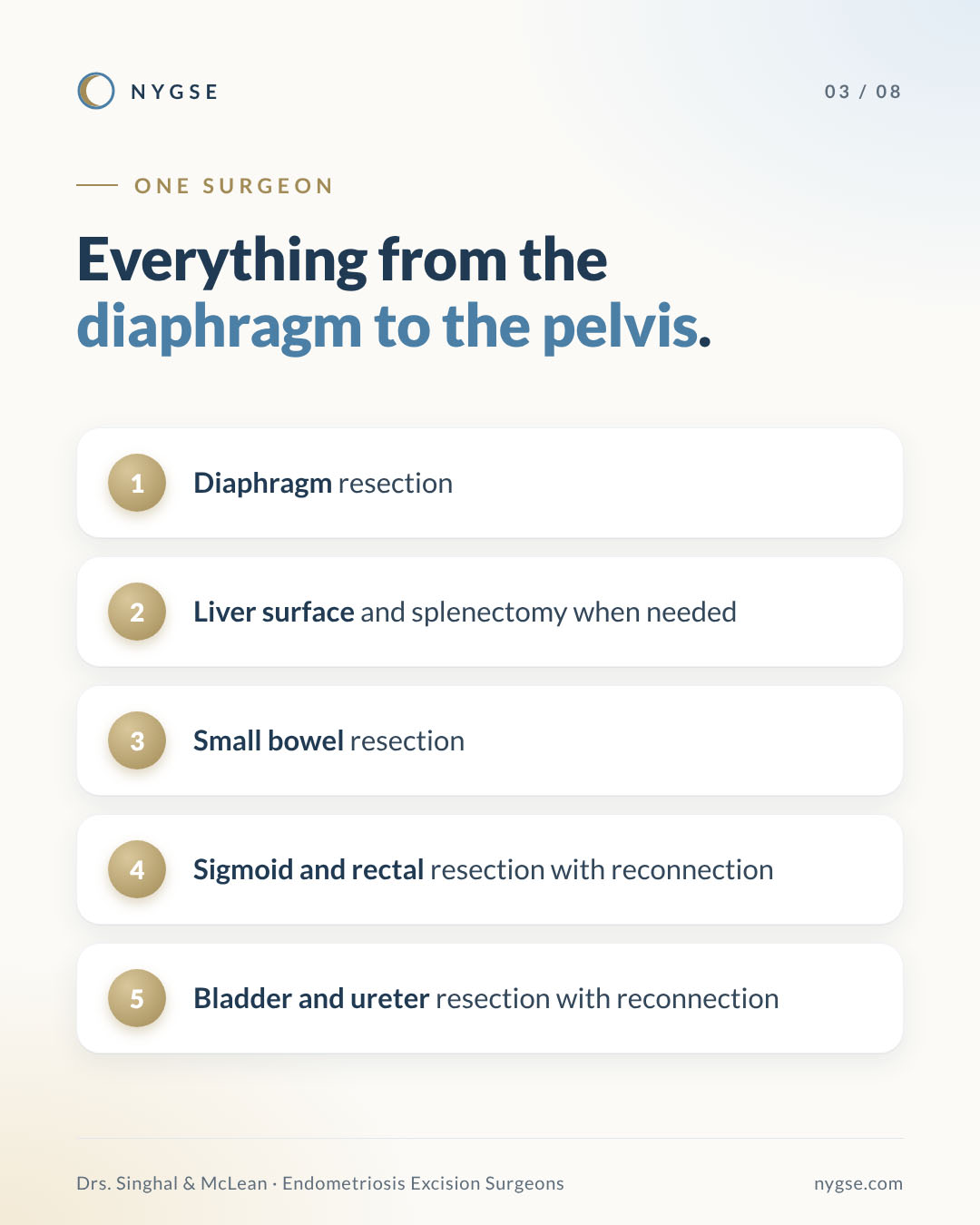
Because of this training, Dr. Singhal performs the colorectal, general and urologic portions of the operation himself. That includes diaphragm resection, removal of endometriosis from the surface of the liver, splenectomy when it is needed, small bowel resection, sigmoid colon resection with reconnection of the bowel, excision of endometriosis from the rectum, and resection of the bladder and ureters with reconnection when needed.
Figure 1.Sites of deep endometriosis that Dr. Singhal treats within a single operation.
Choosing the right bowel operation
When endometriosis involves the rectum, there are three main options: shaving the disease off the bowel wall, removing a small disc of the wall, or removing a short segment of bowel and reconnecting the ends.
A 2023 analysis of 2,861 patients found that segmental resection had a lower recurrence rate than shaving, with similar rates of leaks and other complications, while shaving had the lowest rate of stoma formation. [3]
The right choice depends on the depth and width of the disease, and a surgeon comfortable with all three can choose based on the disease rather than on what is available. We plan each bowel operation to remove the disease completely while keeping the need for an ostomy, a bag on the abdomen to collect stool, as low as possible.
Ureters and bladder
Most ureteral endometriosis can be treated by freeing the ureter from the surrounding disease and scar tissue. In a review of 1,337 patients, about 21% needed the ureter reimplanted into the bladder and 6% needed a segment removed and reconnected.[4]
These are procedures we perform ourselves when they are needed.
Signs that endometriosis may be deep
Pain with bowel movements, especially around your period
Blood in the stool or urine during your period
Deep pain with sex
Right shoulder or chest pain around your period
Pain that persisted after an earlier operation
The takeaway
Deep endometriosis does not stay within the borders of one surgical specialty. A surgeon trained in cancer surgery can remove it from the bowel, bladder, ureters and diaphragm in a single operation, using the same principles that guide cancer care.
Key terms
Term
Plain-language meaning
Deep endometriosis
Endometriosis that grows more than about 5 millimeters below the surface.
Ureter
The tube that carries urine from a kidney to the bladder.
Anastomosis
Reconnecting two ends of bowel or ureter after a segment is removed.
Ostomy
An opening on the abdomen that diverts stool into a bag.
About the authors. Pankaj Singhal, MD, MS, MHCM, FACOG, and Virginia McLean, MD, are endometriosis excision surgeons at New York Gynecology Surgery & Endometriosis in Babylon, NY.
Dr. Singhal is double board certified in obstetrics and gynecology and in gynecologic oncology, has performed more than 12,000 surgeries, more than 6,000 of them robotic, and holds a national designation as a master robotic surgeon.
Andres MP, Arcoverde FVL, Souza CCC, et al. Extrapelvic endometriosis: a systematic review. J Minim Invasive Gynecol. 2020;27(2):373-389. doi:10.1016/j.jmig.2019.10.004
Barra F, Scala C, Biscaldi E, et al. Ureteral endometriosis: a systematic review of epidemiology, pathogenesis, diagnosis, treatment, risk of malignant transformation and fertility. Hum Reprod Update. 2018;24(6):710-730. doi:10.1093/humupd/dmy027
O’Brien L, Morarasu S, Morarasu BC, et al. Conservative surgery versus colorectal resection for endometriosis with rectal involvement: a systematic review and meta-analysis of surgical and long-term outcomes. Int J Colorectal Dis. 2023;38(1):55. doi:10.1007/s00384-023-04352-6
da Cunha FL, Arcoverde FVL, Andres MP, et al. Laparoscopic treatment of ureteral endometriosis: a systematic review. J Minim Invasive Gynecol. 2021;28(4):779-787. doi:10.1016/j.jmig.2020.11.022
Educational content only. It is not a substitute for individual medical advice. Please speak with your own physician about your symptoms and treatment.