

November 23, 2026
by NYGSE
Advanced Endometriosis Fertility & Reproductive Health Treatment & Surgery

Can you still have a baby after a hysterectomy? The answer depends on whether you mean carrying a pregnancy yourself or having a genetically related child through assisted reproduction.
A hysterectomy removes the uterus, permanently eliminating the ability to carry a pregnancy. However, if the ovaries remain functional, having a genetically related child through in vitro fertilization (IVF) and a gestational carrier may still be possible. [1][5]
For women who have only been advised to undergo hysterectomy, another question deserves attention:
Can the underlying medical condition be treated without removing the uterus?
The answer depends on the diagnosis, available treatments, surgical risks, and future reproductive goals.

Hysterectomy Permanently Ends the Ability to Carry a Pregnancy
A hysterectomy is an operation to remove the uterus, the organ where a pregnancy normally develops.
The main types include:
- Total hysterectomy: Removes the uterus and cervix.
- Partial or supracervical hysterectomy: Removes the upper uterus while preserving the cervix.
- Radical hysterectomy: Removes the uterus, cervix, and additional surrounding tissues, usually to treat certain cancers.
Regardless of the type, a woman can no longer carry a normal pregnancy after hysterectomy. Preserving the cervix does not preserve the ability to carry a baby. [1]
The ovaries, however, are separate organs and may remain functional after the uterus is removed.
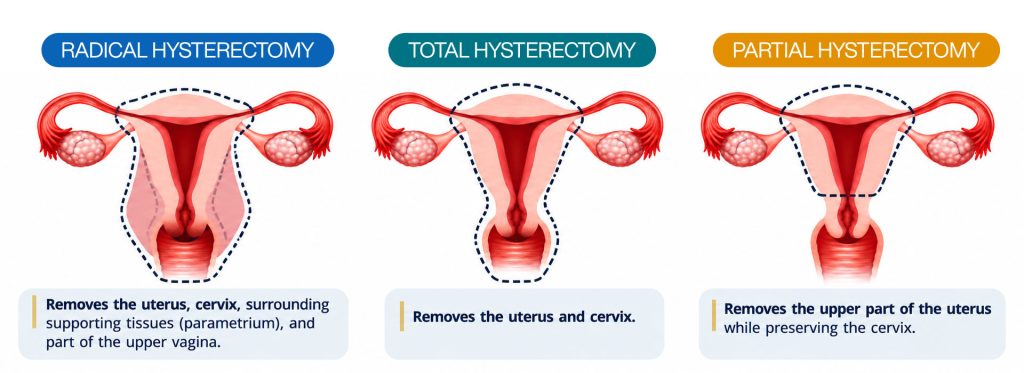
Note: The fallopian tubes and ovaries may be removed during any of these procedures, depending on the medical indication (such as endometriosis, ovarian disease, or cancer).
Can You Have a Biological Child After Hysterectomy?
If one or both ovaries remain functional, they may continue producing eggs.
In selected circumstances, eggs may be retrieved and fertilized through IVF. The resulting embryo can then be transferred into the uterus of a gestational carrier, who carries the pregnancy on behalf of the intended parent or parents. [5]
This approach requires reproductive evaluation, medical screening, and legal counseling.
Preserving ovarian function does not guarantee successful IVF or a live birth. Age, egg quality, ovarian reserve, and other reproductive factors influence the outcome.
Women considering hysterectomy, particularly when ovarian removal or damage is possible, may benefit from discussing egg or embryo freezing with a reproductive endocrinologist before surgery. [4]
A Hysterectomy Recommendation Does Not Always Mean There Are No Alternatives
For women who have not yet undergone hysterectomy, the possibility of preserving the uterus depends on the condition requiring treatment.
Some benign gynecologic conditions can be managed with medication or uterus-preserving procedures. In other situations, hysterectomy may provide the most appropriate treatment. [1]
The decision should consider disease severity, previous treatments, surgical risks, and whether future pregnancy remains a priority.
Preserving the uterus is not necessarily the same as preserving fertility. A treatment may leave the uterus intact without guaranteeing that a pregnancy will be possible or safe.
This distinction is particularly important in endometriosis, adenomyosis, and uterine fibroids.
Endometriosis Can Often Be Treated Without Hysterectomy
Endometriosis occurs when tissue resembling the uterine lining grows outside the uterus. It may affect the ovaries, pelvic peritoneum, bowel, bladder, and other structures.
Removing the uterus does not automatically remove endometriosis elsewhere in the pelvis.
The European Society of Human Reproduction and Embryology (ESHRE) states that hysterectomy may be considered for women who no longer wish to conceive and whose symptoms have not responded to more conservative treatments. [2]
The guideline also emphasizes that hysterectomy does not necessarily cure endometriosis or its symptoms. [2]
For women who wish to preserve the possibility of pregnancy, treatment may include symptom-directed medical therapy, surgical excision of endometriosis lesions, or fertility-focused care.
These approaches serve different purposes.
Hormonal treatments may help control pain but generally do not improve fertility during ovarian suppression. Excision surgery removes identified endometriosis lesions and may be appropriate for selected patients, although its reproductive benefits depend on the extent of disease, ovarian reserve, previous operations, and other fertility factors. [2]
Surgery involving ovarian endometriomas can also reduce ovarian reserve, making individualized treatment planning especially important. [2]
Preserving reproductive organs does not guarantee pregnancy. The objective is to address the disease while considering symptoms, surgical risks, and fertility goals.
Preserving the Ovaries Is Different From Preserving the Uterus
The ovaries produce eggs and reproductive hormones, while the uterus supports a developing pregnancy.
If the uterus is removed but the ovaries remain, egg development and hormone production may continue. However, the woman can no longer carry a normal pregnancy. [1]
Although the ovaries may continue functioning after hysterectomy, some research has found an increased risk of earlier ovarian failure, even when both ovaries are preserved. This association does not establish that hysterectomy itself caused the decline. [3]
If both ovaries are removed before natural menopause, natural egg production stops and surgical menopause occurs. [1]
Patients should therefore understand which reproductive organs their surgeon plans to remove and how the operation may affect future family-building options.
What Does Research Show About Hysterectomy and Endometriosis?
Published research provides additional insight into ovarian function and persistent symptoms following hysterectomy.
| Study | Study Findings | What Patients Should Know |
|---|---|---|
| Moorman et al. (2011) | 14.8% of women who underwent hysterectomy without removal of both ovaries were estimated to experience ovarian failure within four years, compared with 8.0% of women who had not undergone hysterectomy. | Retaining the ovaries does not guarantee that ovarian function will remain unchanged. |
| Vercellini et al. (2009) | Approximately 15% of patients experienced persistent symptoms after hysterectomy for endometriosis, while 3–5% experienced worsening pain, according to historical estimates summarized in the review. | Hysterectomy does not guarantee complete relief from endometriosis-associated symptoms. |
Note: These studies examined different outcomes and patient populations. Moorman et al. reported modeled four-year estimates from an observational study, while Vercellini et al. summarized historical research. The percentages should not be interpreted as individual risk predictions or as outcomes specific to contemporary specialist surgery.
A Second Surgical Opinion Can Help Clarify Your Options
When future pregnancy matters, seeking a second surgical opinion may help patients understand their options before undergoing hysterectomy.
A second opinion does not necessarily mean the first physician was wrong. Another surgeon can review the patient’s condition and determine whether uterus-preserving treatment may be appropriate.
For complex endometriosis, a surgeon’s experience with the disease is particularly important. [2]
Questions to Ask Before Agreeing to a Hysterectomy
If you still hope to have children, consider asking your surgeon:
- What is the medical reason for recommending hysterectomy?
- Can my condition be treated without removing my uterus?
- What are the risks and benefits of uterus-preserving surgery?
- If I want to become pregnant, would postponing hysterectomy be medically safe in my situation?
- Will my ovaries also need to be removed?
- Could the proposed treatment affect my ovarian reserve?
- Should I consult a fertility specialist before surgery?
- Would another surgical opinion help clarify my options?
These questions support informed decision-making without assuming that the original recommendation was inappropriate.
When Hysterectomy May Still Be Necessary
For women with endometriosis, hysterectomy may be considered when symptoms persist despite conservative treatments and future pregnancy is no longer desired. However, hysterectomy does not necessarily cure endometriosis, particularly when disease remains outside the uterus. [2]
Other serious gynecologic conditions may also require hysterectomy.
The goal is not to avoid hysterectomy at all costs, but to identify the most appropriate treatment while considering future fertility.
A Patient Story About Exploring Another Surgical Option
For more than a decade, Jessica lived with a serious medical condition while her father, Leonard, watched her search for answers.
According to Leonard’s public account, Jessica had been told that she needed a hysterectomy and would never have children.
She subsequently received surgical care from Dr. Pankaj Singhal at New York Gynecology Surgery & Endometriosis (NYGSE).
Leonard later shared a photograph of Dr. Singhal holding Jessica’s son during a follow-up visit.
Her family’s experience illustrates why understanding available surgical options can matter before making an irreversible decision.
Related patient story: She Was Told She Needed a Hysterectomy. Years Later, She Returned With Her Son.
Jessica’s specific diagnosis and surgical details were not disclosed in her father’s account. Individual treatment and reproductive outcomes vary.
Understanding Your Options Before Hysterectomy
For women who have already undergone hysterectomy, reproductive medicine may offer options for having a genetically related child, depending on ovarian function and other circumstances. [4][5]
For women who have only received a recommendation, the decision may be more complex.
Is hysterectomy necessary? Could another treatment address the condition? And would preserving the uterus be medically appropriate?
These questions deserve careful consideration, particularly when future pregnancy remains a priority.
At New York Gynecology Surgery & Endometriosis, individualized surgical evaluation helps patients understand their diagnosis, available treatment options, and the potential consequences of surgery.
A hysterectomy cannot be reversed. Understanding the options beforehand can help patients make an informed decision.
References
- American College of Obstetricians and Gynecologists. (2024). Hysterectomy. https://www.acog.org/womens-health/faqs/hysterectomy
- European Society of Human Reproduction and Embryology. (2022). Endometriosis: Guideline. https://www.eshre.eu/guideline/endometriosis
- Moorman, P. G., Myers, E. R., Schildkraut, J. M., Iversen, E. S., Wang, F., & Warren, N. (2011). Effect of hysterectomy with ovarian preservation on ovarian function. Obstetrics & Gynecology, 118(6), 1271–1279. https://doi.org/10.1097/AOG.0b013e318236fd12
- Practice Committee of the American Society for Reproductive Medicine. (2026). Fertility preservation in patients with medical indications: A committee opinion. Fertility and Sterility, 125(2), 247–259. https://doi.org/10.1016/j.fertnstert.2025.12.001
- Practice Committee of the American Society for Reproductive Medicine & Practice Committee of the Society for Assisted Reproductive Technology. (2022). Recommendations for practices using gestational carriers: A committee opinion. Fertility and Sterility, 118(1), 65–74. https://doi.org/10.1016/j.fertnstert.2022.05.001
- Vercellini, P., Barbara, G., Abbiati, A., Somigliana, E., Viganò, P., & Fedele, L. (2009). Repetitive surgery for recurrent symptomatic endometriosis: What to do? European Journal of Obstetrics & Gynecology and Reproductive Biology, 146(1), 15–21. https://doi.org/10.1016/j.ejogrb.2009.05.007
This article is for general education and isn’t medical advice for any individual. If you have sudden severe pelvic pain, heavy bleeding, fever or fainting, seek urgent care.