Finding out that you have an endometrioma can raise questions about pain, ovarian health, fertility, and treatment. When endometriomas are found in both ovaries, they are called bilateral endometriomas. [2]
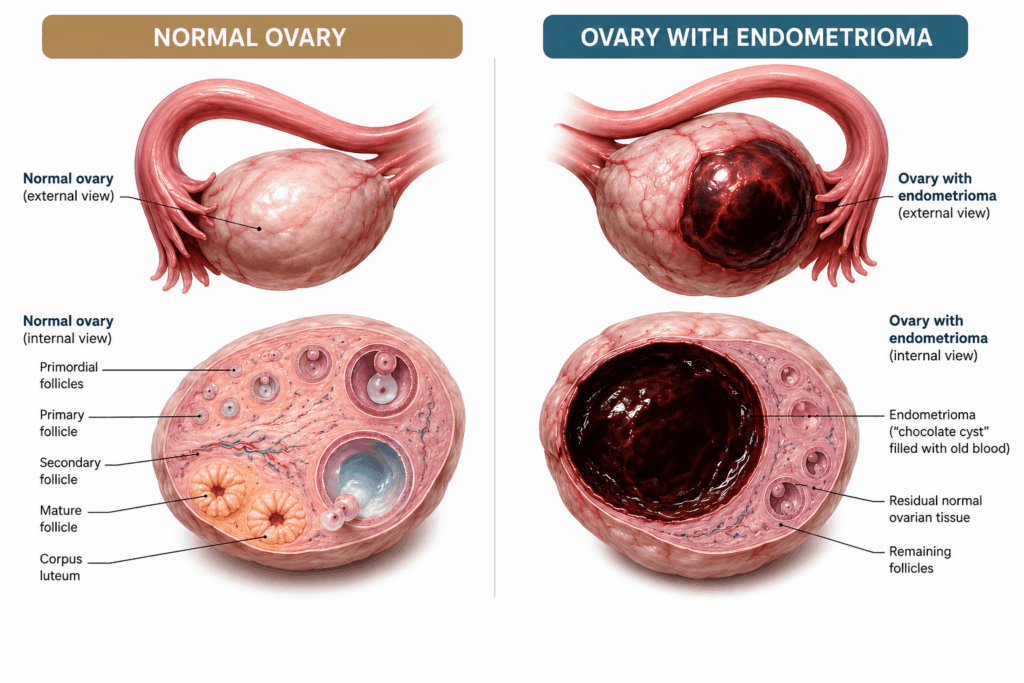
Endometriomas are ovarian cysts associated with endometriosis. They typically contain old blood and are sometimes called “chocolate cysts” because of their appearance.
When both ovaries are affected, careful evaluation is particularly important. Bilateral endometriomas do not automatically mean infertility or that surgery is necessary, but they can influence decisions about ovarian reserve, fertility, and treatment. [2][4]
Medical illustration comparing a normal ovary with an ovarian endometrioma
Understanding Bilateral Endometriomas
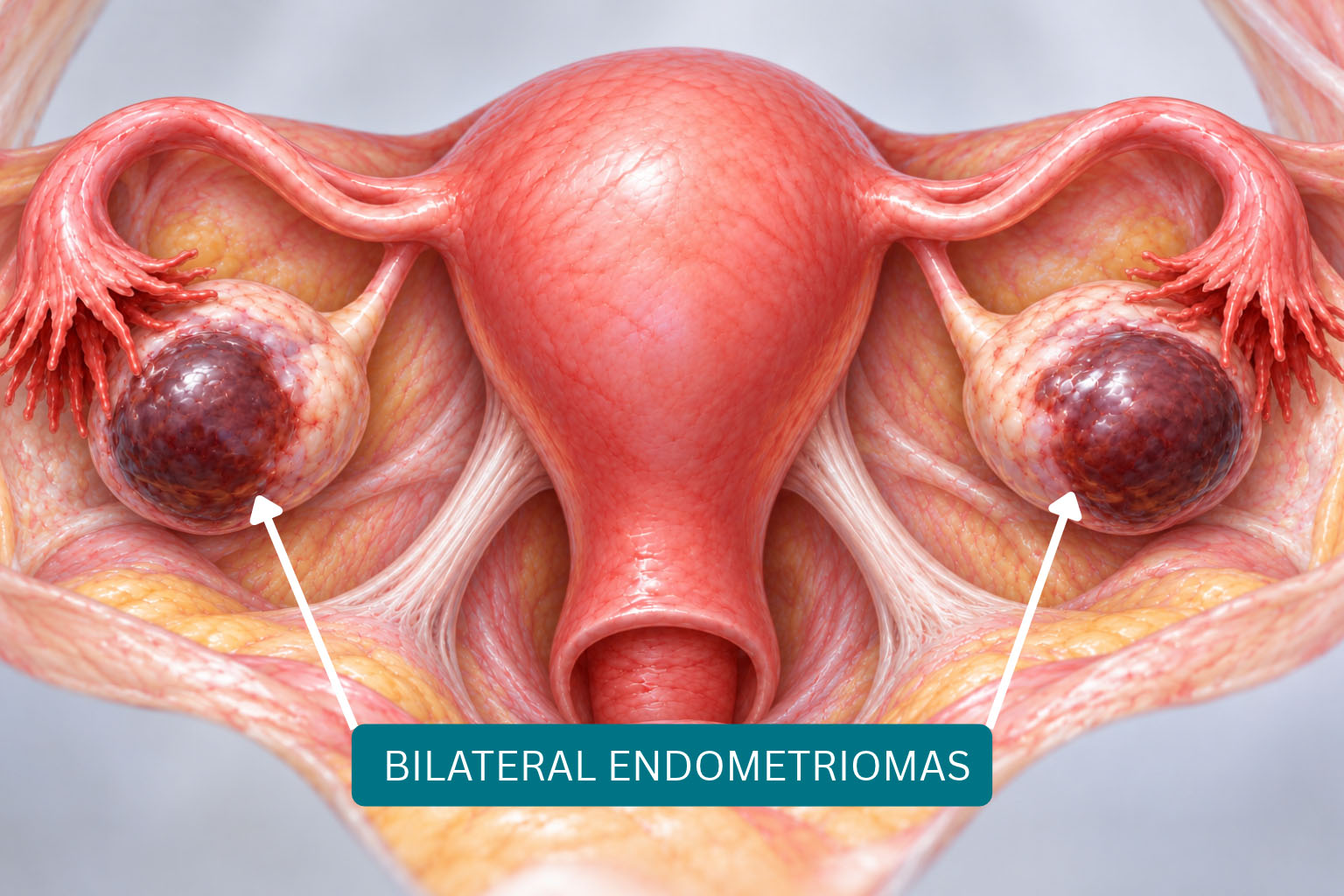
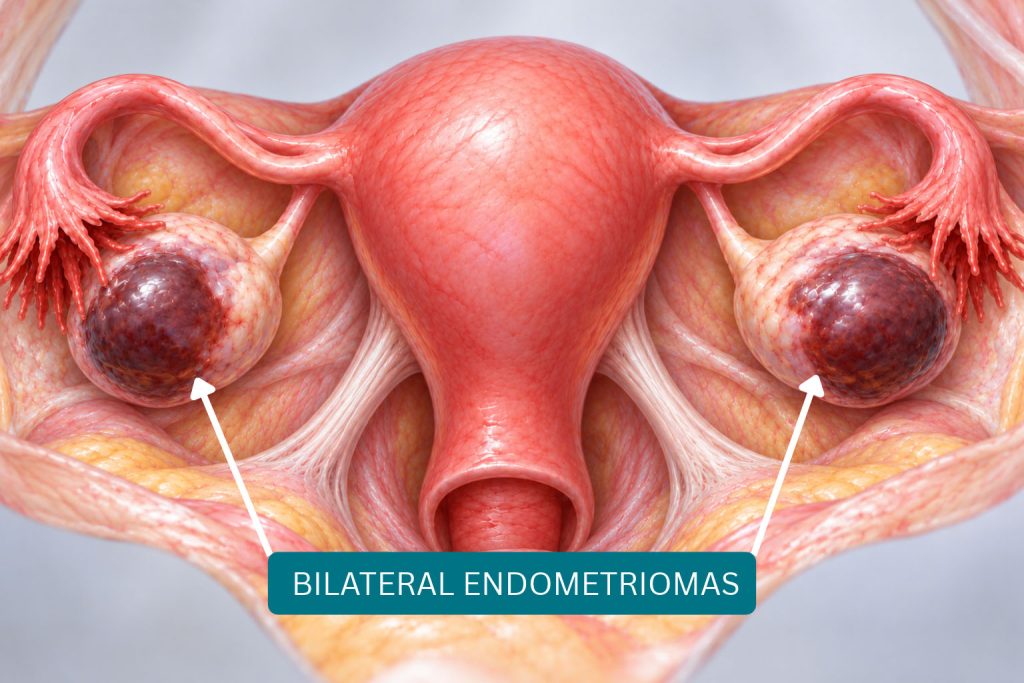
A bilateral endometrioma means that endometriomas are present in both ovaries, one affecting the right ovary and another affecting the left.
The endometriomas may be different sizes. For example, one ovary may contain a larger endometrioma while the other has a smaller one.
Because endometriomas are associated with endometriosis, finding them in both ovaries may also prompt evaluation for endometriosis elsewhere in the pelvis.
Medical illustration of bilateral ovarian endometriomas
What Do Bilateral Endometriomas Look Like on Ultrasound?
Transvaginal ultrasound is commonly used to evaluate suspected ovarian endometriomas.
Endometriomas can have a characteristic appearance, often containing relatively uniform, low-level internal echoes described as “ground-glass” echogenicity. [3]
Ultrasound can help determine the size and location of each cyst, assess the ovaries, and identify other findings that may suggest endometriosis or pelvic adhesions.
MRI may provide additional information when ultrasound findings are uncertain or when more extensive endometriosis is suspected.
Bilateral Endometriomas and Ovarian Reserve
One of the most important considerations with bilateral endometriomas is ovarian reserve, which refers to the remaining supply of eggs within the ovaries.
Endometriomas have been associated with reduced ovarian reserve, although their effect varies from patient to patient. Age, the size and number of endometriomas, previous ovarian surgery, and other individual factors may also influence ovarian function. [2][4]
When both ovaries are affected, preserving healthy ovarian tissue can become especially important, particularly for patients who hope to become pregnant in the future. [1][2]
For patients who undergo endometriosis surgery, the Endometriosis Fertility Index (EFI) is a scoring system used to help assess fertility prognosis after surgery.
Can You Get Pregnant With Bilateral Endometriomas?
Yes. Having bilateral endometriomas does not automatically mean that you cannot become pregnant.
Fertility depends on much more than the presence of ovarian cysts. Doctors may consider age, ovarian reserve, fallopian tube function, pelvic adhesions, other areas of endometriosis, previous surgery, and sperm factors.
Some patients with endometriomas conceive naturally, while others may benefit from fertility treatment. The appropriate approach depends on the complete fertility picture. [2]
When Surgery May Be Considered
Not every endometrioma needs to be surgically removed.
Treatment decisions may consider pain, cyst size and appearance, fertility goals, ovarian reserve, previous treatment, and whether there are other areas of endometriosis.
This decision deserves particular care when both ovaries are affected. Surgery for an endometrioma can sometimes affect healthy ovarian tissue and may reduce ovarian reserve. [1][2]
The potential benefit of removing an endometrioma therefore needs to be weighed against the potential effect of surgery on ovarian function. [1][2]
What If Both Endometriomas Are Large?
Cyst size is an important consideration, but size alone does not determine whether surgery is necessary. [2]
Doctors may also consider whether an endometrioma is causing significant symptoms, changing over time, has unusual imaging characteristics, affects fertility treatment, or occurs alongside other forms of endometriosis. [2]
For this reason, two patients with similarly sized bilateral endometriomas may receive different treatment recommendations based on their individual circumstances.
Bilateral Endometriomas and More Extensive Endometriosis
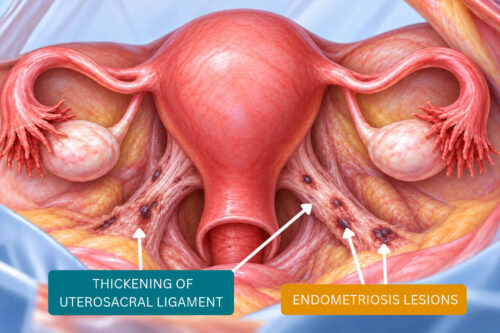
Endometriomas can occur alongside pelvic adhesions and deep endometriosis. [3]
Adhesions may restrict normal ovarian movement or cause the ovaries to become attached to surrounding structures. In some patients, both ovaries are pulled toward the center of the pelvis and positioned next to one another behind the uterus. This imaging finding is sometimes called kissing ovaries. [3]
Looking at the position and mobility of the ovaries, as well as the surrounding pelvic anatomy, can therefore provide information beyond the endometriomas themselves.
Planning Treatment for Bilateral Endometriomas
Bilateral endometriomas are an important finding in ovarian endometriosis, but the cysts alone do not determine what treatment a patient needs.
Further evaluation may be particularly important for patients experiencing pelvic pain, painful periods, fertility concerns, changes in cyst size, or other symptoms associated with endometriosis.
At New York Gynecology Surgery & Endometriosis (NYGSE), we consider the size and appearance of the endometriomas, symptoms, ovarian reserve, fertility goals, previous treatments, and other evidence of endometriosis to determine what further evaluation or treatment may be appropriate.
Alborzi, S., Keramati, P., Younesi, M., Samsami, A., & Dadras, N. (2014). The impact of laparoscopic cystectomy on ovarian reserve in patients with unilateral and bilateral endometriomas. Fertility and Sterility, 101(2), 427–434. https://doi.org/10.1016/j.fertnstert.2013.10.019
Becker, C. M., Bokor, A., Heikinheimo, O., Horne, A., Jansen, F., Kiesel, L., King, K., Kvaskoff, M., Nap, A., Petersen, K., Saridogan, E., Tomassetti, C., van Hanegem, N., Vulliemoz, N., & Vermeulen, N. (2022). ESHRE guideline: Endometriosis. Human Reproduction Open, 2022(2), hoac009. https://doi.org/10.1093/hropen/hoac009
Guerriero, S., et al. (2016). Systematic approach to sonographic evaluation of the pelvis in women with suspected endometriosis, including terms, definitions and measurements: A consensus opinion from the International Deep Endometriosis Analysis (IDEA) group. Ultrasound in Obstetrics & Gynecology, 48(3), 318–332. https://doi.org/10.1002/uog.15955
Karadağ, C., Yoldemir, T., Karadağ, S. D., & Turgut, A. (2020). The effects of endometrioma size and bilaterality on ovarian reserve. Journal of Obstetrics and Gynaecology, 40(4), 531–536. https://doi.org/10.1080/01443615.2019.1633518