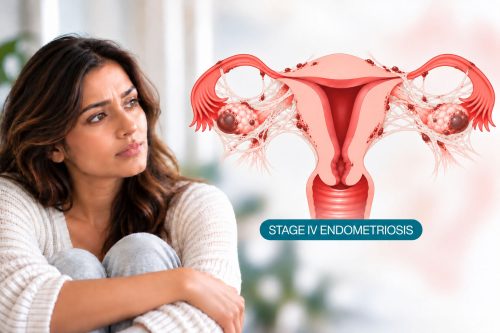


Painful periods, chronic pelvic pain, heavy menstrual bleeding, and pain during sex can occur with several gynecologic conditions. Two conditions that can produce many of these symptoms are adenomyosis and endometriosis.
Although their symptoms can overlap, adenomyosis and endometriosis are different conditions that affect different areas of the body. They can also occur together, which may make it more difficult to determine what is contributing to a patient’s symptoms.
Understanding where each condition develops and recognizing the clues that may distinguish them can help guide appropriate evaluation and treatment.
Adenomyosis and Endometriosis Develop in Different Places
One of the most important differences between adenomyosis and endometriosis is where the abnormal tissue is located.
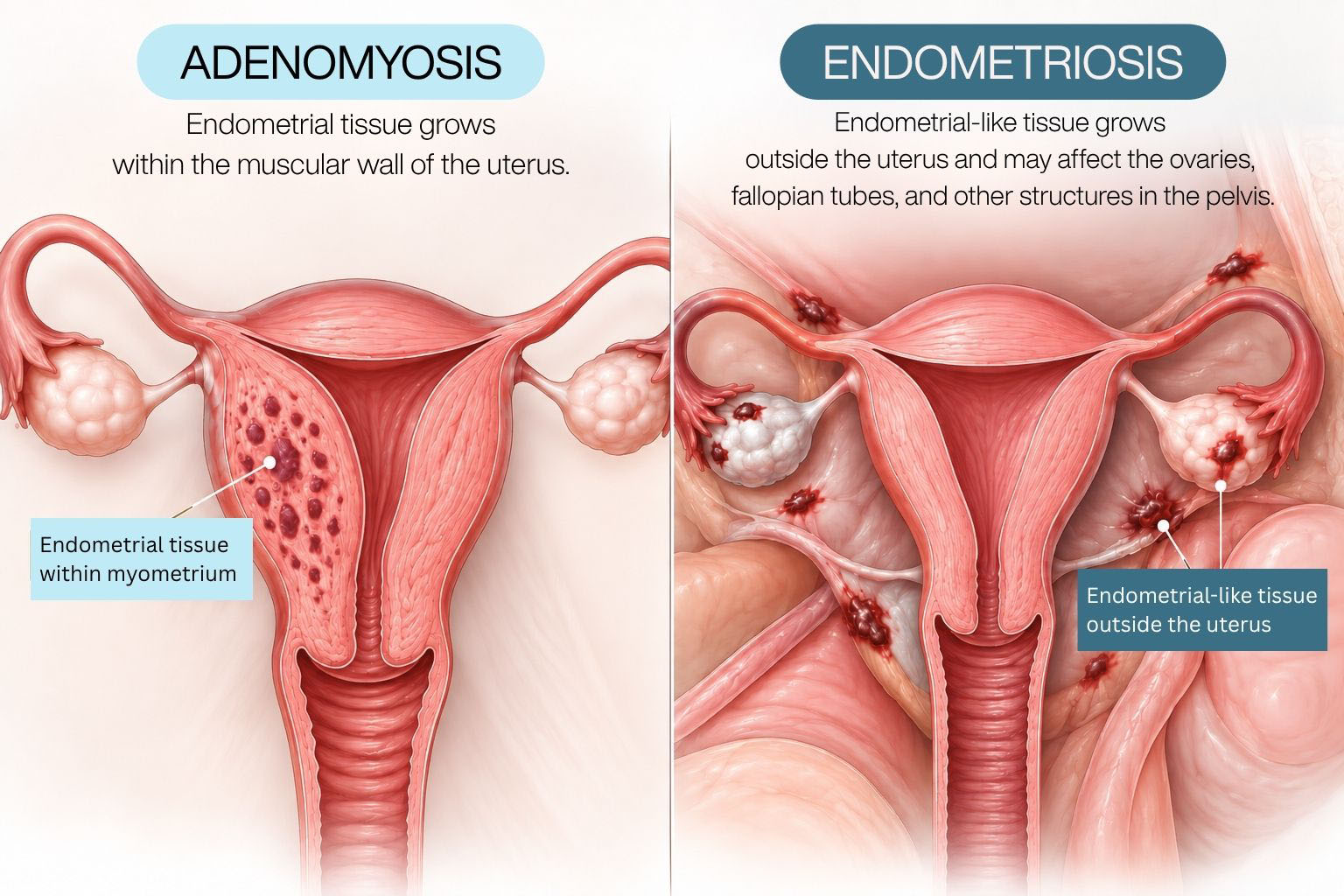
In adenomyosis, endometrial glands and stroma are found within the myometrium, the muscular wall of the uterus.
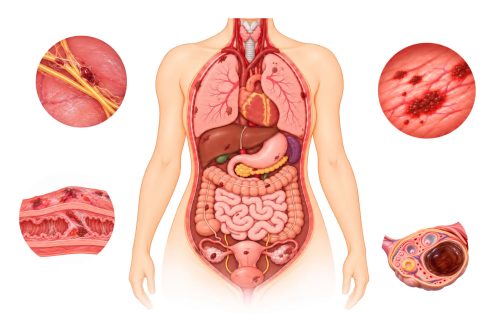
In endometriosis, endometrial-like tissue develops outside the uterus. Endometriosis may affect areas such as the ovaries, pelvic peritoneum, tissues behind the uterus, bowel, bladder, and other pelvic structures.
This anatomical difference is important. Adenomyosis primarily affects the uterus itself, while endometriosis can involve different locations throughout the pelvis and, less commonly, outside it.
Where Do Adenomyosis and Endometriosis Symptoms Overlap?
Despite developing in different places, the two conditions can produce similar symptoms.
| Symptom | Adenomyosis | Endometriosis |
|---|---|---|
| Painful periods | Common | Common |
| Chronic pelvic pain | Can occur | Common |
| Heavy menstrual bleeding | Common | Can occur |
| Pain during sex | Can occur | Can occur |
| Infertility | Can occur | Can occur |
| Painful bowel movements | Less characteristic | Can occur |
| Bloating or pelvic fullness | Can occur | Can occur |
| Enlarged or tender uterus | More characteristic | Not typical |
No single symptom can reliably determine which condition is present. The overall pattern of symptoms, physical examination, imaging findings, and medical history all contribute to the evaluation.
Heavy Menstrual Bleeding May Be an Important Clue
Heavy menstrual bleeding is particularly associated with adenomyosis.
Adenomyosis can affect the structure and function of the uterine muscle and is commonly associated with heavy menstrual bleeding and painful periods. Some patients may also experience chronic pelvic pain, pain during sex, or a feeling of pelvic pressure or fullness.
Endometriosis can also occur in patients who experience abnormal bleeding, but heavy menstrual bleeding is generally more characteristic of adenomyosis.
This does not mean that heavy periods automatically indicate adenomyosis. Fibroids and other gynecologic conditions can also cause heavy menstrual bleeding, which is why appropriate evaluation is important.
Pain Alone May Not Tell the Conditions Apart
Painful periods are strongly associated with both adenomyosis and endometriosis.
Likewise, chronic pelvic pain and pain during sex may occur with either condition. This means that the location or intensity of pain alone may not always distinguish adenomyosis from endometriosis.
Other symptoms may provide additional clues.
For example, painful bowel movements, urinary symptoms, or pain associated with disease involving structures outside the uterus may raise greater suspicion for endometriosis. European Society of Human Reproduction and Embryology (ESHRE) guidelines recommend considering endometriosis in patients with symptoms including painful periods, deep pain during sex, painful bowel movements, painful urination, fatigue, and infertility (Becker et al., 2022).
Adenomyosis and Endometriosis Can Occur Together
For some patients, the diagnosis is not simply adenomyosis or endometriosis.
Both conditions can be present at the same time.
This is important because treating or identifying one condition does not necessarily explain every symptom a patient experiences. Someone with known endometriosis who continues to experience significant heavy menstrual bleeding or uterine pain, for example, may need evaluation for other possible causes, including adenomyosis.
Similarly, finding adenomyosis on imaging does not automatically rule out endometriosis elsewhere in the pelvis.
Recognizing the possibility of coexisting disease can therefore be an important part of evaluating persistent or complex pelvic symptoms.
How Is Adenomyosis Diagnosed?
Historically, adenomyosis was definitively identified through examination of the uterus after hysterectomy. Advances in imaging have significantly changed how the condition is evaluated.
Today, transvaginal ultrasound is generally the first-line imaging method when adenomyosis is suspected (Harada et al., 2023).
During ultrasound, physicians may look for characteristic changes in the uterine muscle, including differences in the thickness or appearance of the myometrium, myometrial cysts, a globular uterine shape, or other features associated with adenomyosis.
Magnetic resonance imaging (MRI) may be considered when ultrasound findings are inconclusive or when additional information about the uterus and surrounding pelvic structures is needed (Harada et al., 2023).
How Is Endometriosis Evaluated?
The evaluation of endometriosis also begins with a detailed medical history, including the type, location, timing, and severity of symptoms.
An endometriosis specialist may ask about painful periods, chronic pelvic pain, painful sex, painful bowel movements, urinary symptoms, infertility, and whether symptoms change during the menstrual cycle.
Ultrasound and MRI can help identify certain forms of endometriosis, particularly ovarian endometriomas and some forms of deep endometriosis.
However, normal imaging does not completely rule out endometriosis, particularly superficial disease that may not be visible on ultrasound or MRI (Becker et al., 2022).
This is one reason why symptoms, examination findings, imaging, previous treatments, and the patient’s overall clinical picture need to be considered together.
Why Distinguishing Adenomyosis From Endometriosis Matters
Because the symptoms overlap, it can be tempting to think of adenomyosis and endometriosis as variations of the same condition. They are not.
Their different locations can influence how they are evaluated and how treatment options are discussed.
Adenomyosis involves disease within the muscular wall of the uterus, while endometriosis can involve structures outside the uterus. Treatment decisions may therefore depend on which condition is present, the severity of symptoms, the location and extent of disease, previous treatments, and whether a patient wishes to preserve fertility.
For patients who have both conditions, treatment planning may need to consider both sources of symptoms rather than focusing on only one diagnosis.
Getting the Right Diagnosis Matters
Adenomyosis and endometriosis can cause similar symptoms, but understanding their differences is important when evaluating persistent pelvic pain, painful periods, heavy menstrual bleeding, painful sex, or fertility concerns. Some patients may have one condition, while others may have both.
At New York Gynecology Surgery & Endometriosis (NYGSE), evaluation and treatment are individualized based on each patient’s symptoms, medical history, imaging, examination findings, and personal goals. A comprehensive evaluation can help determine whether adenomyosis, endometriosis, or another condition may be contributing to symptoms and guide the next steps in care.
References
Becker, C. M., Bokor, A., Heikinheimo, O., Horne, A., Jansen, F., Kiesel, L., King, K., Kvaskoff, M., Nap, A., Petersen, K., Saridogan, E., Tomassetti, C., van Hanegem, N., Vulliemoz, N., & Vermeulen, N. (2022). ESHRE guideline: Endometriosis. Human Reproduction Open, 2022(2), hoac009. https://doi.org/10.1093/hropen/hoac009
Harada, T., Taniguchi, F., Guo, S.-W., Choi, Y. M., Biberoglu, K. O., Tsai, S.-J. S., Alborzi, S., Al-Jefout, M., Chalermchokcharoenkit, A., Sison-Aguilar, A. G., Fong, Y.-F., Senanayake, H., Popov, A., Hestiantoro, A., & Kaufman, Y. (2023). The Asian Society of Endometriosis and Adenomyosis guidelines for managing adenomyosis. Reproductive Medicine and Biology, 22(1), e12535. https://doi.org/10.1002/rmb2.12535