

Endometriosis can cause years of pelvic pain, painful menstruation, infertility, and other symptoms before a diagnosis is established. For many patients, a simple blood test seems like an appealing alternative to diagnostic laparoscopy or repeated imaging examinations. But can endometriosis actually be detected through blood testing?
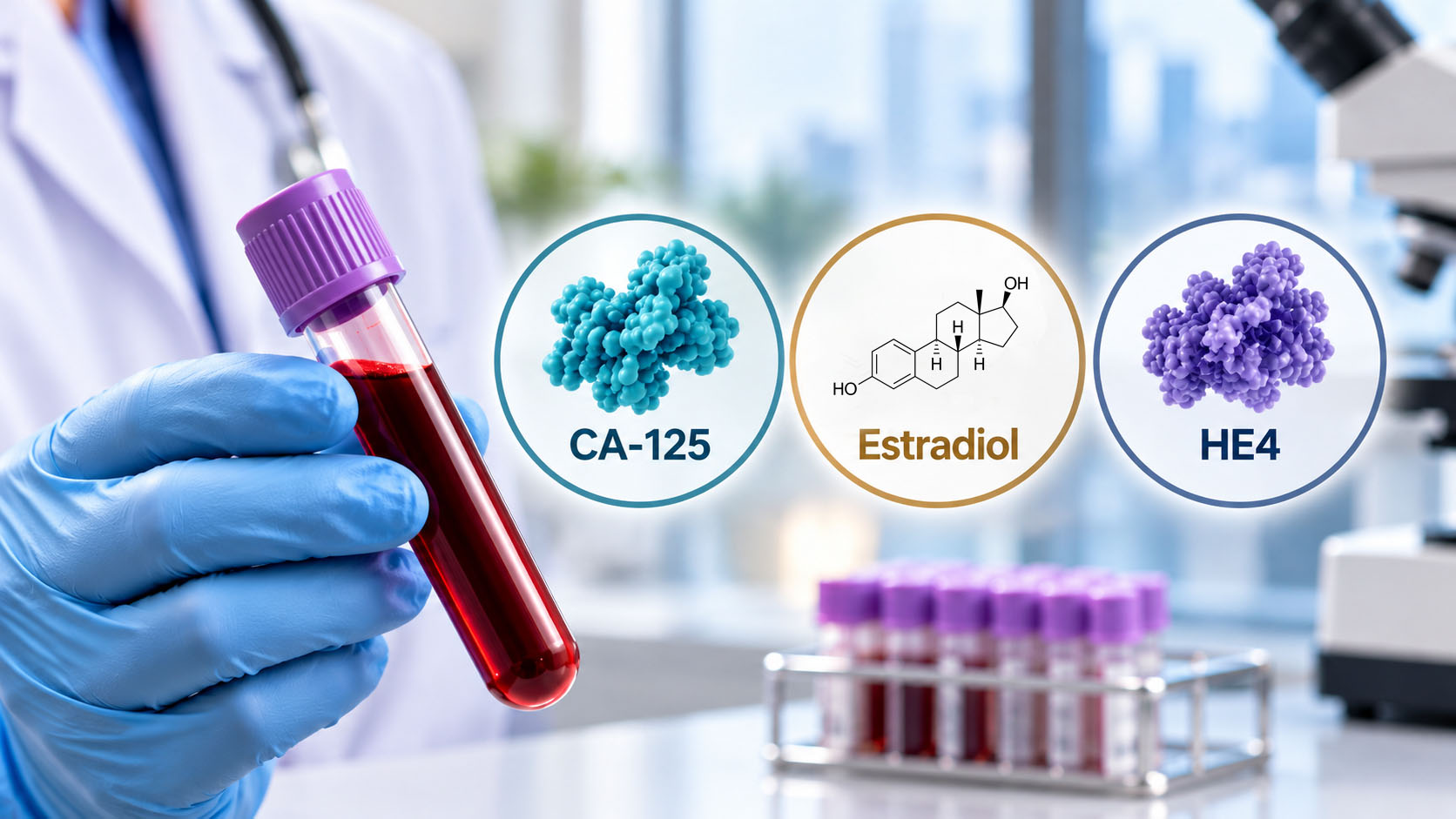
Researchers have investigated several blood biomarkers, including cancer antigen 125 (CA-125), human epididymis protein 4 (HE4), and estradiol. Although these substances provide information about certain biological processes, none can independently confirm or rule out endometriosis. [1][5]
CA-125, HE4, and estradiol are blood biomarkers, but none can independently diagnose endometriosis.
Why Endometriosis Is Difficult to Diagnose With a Blood Test
Endometriosis occurs when tissue resembling the uterine lining grows outside the uterus. Lesions may develop on the ovaries, pelvic peritoneum, uterosacral ligaments, bowel, bladder, and other structures.
Unlike conditions associated with a consistent laboratory abnormality, no single blood biomarker is currently established for reliably diagnosing endometriosis in routine clinical practice.
Some patients have superficial lesions with severe pain, while others have extensive disease with few symptoms. The extent of disease does not consistently correspond to pain severity or biomarker concentrations. [1][3][5]
Normal Blood Tests Do Not Rule Out Endometriosis
Patients may have normal CA-125, HE4, and estradiol results despite having endometriosis.
Persistent menstrual pain, painful intercourse, bowel symptoms, or infertility may warrant further evaluation even when laboratory findings are normal. [1][5]
CA-125 Can Be Elevated in Patients With Endometriosis
Cancer antigen 125 (CA-125) is a protein commonly measured when evaluating certain ovarian masses.
Although frequently associated with ovarian cancer, CA-125 can also increase in benign conditions, including endometriosis, fibroids, and pelvic inflammation.
Patients with ovarian endometriomas or extensive endometriosis may have elevated CA-125 concentrations. However, many patients with confirmed disease have normal results. [5][7]
What Is a Normal CA-125 Level?
Many laboratories use approximately 35 U/mL as the upper reference limit, although laboratory ranges vary.
An elevated result does not establish endometriosis, while a normal result cannot exclude it. Menstruation, pregnancy, and other gynecologic conditions may also influence concentrations. [7]
| CA-125 Level | General Interpretation | Relevance to Endometriosis |
|---|---|---|
| 0.0–38.1 U/mL | Within Labcorp's published reference interval. | Endometriosis may still be present despite a normal result. |
| Above 38.1 U/mL | Above Labcorp's reference interval; further clinical evaluation may be appropriate. | May occur with endometriosis or other benign and malignant conditions, but is not diagnostic. |
Note: CA-125 reference interval based on Labcorp’s Cancer Antigen (CA) 125, Test 002303 (0.0–38.1 U/mL). Reference intervals vary by laboratory and testing method.
CA-125 levels vary with age, menstrual cycle, pregnancy, and several benign or malignant conditions. A normal result does not exclude endometriosis, while an elevated result does not confirm it. The ranges above are intended for general education rather than diagnosis.
Can CA-125 Detect Early Endometriosis?
CA-125 has limited sensitivity, particularly for superficial or less extensive disease.
A Cochrane systematic review by Nisenblat and colleagues (2016) found that CA-125 had approximately 40% sensitivity at thresholds around 35–36 U/mL, meaning it failed to detect approximately 60% of endometriosis cases in the studies analyzed at those thresholds.
These findings demonstrate why CA-125 is unsuitable as a standalone diagnostic test. [5]
HE4 May Help Evaluate Ovarian Masses but Cannot Diagnose Endometriosis
Human epididymis protein 4 (HE4) is a biomarker used in selected evaluations of ovarian malignancy risk.
Unlike CA-125, HE4 is often not substantially elevated in benign endometriosis. Researchers have investigated whether this difference helps distinguish ovarian endometriomas from certain malignant tumors.
However, HE4 does not reliably identify endometriotic lesions and is not recommended as a routine diagnostic test for endometriosis. [1][2]
| Patient Group | Commonly Cited HE4 Reference Limit | Relevance to Endometriosis |
|---|---|---|
| Premenopausal women | Below 70 pmol/L with certain laboratory testing methods. | HE4 is not a validated diagnostic test for endometriosis. |
| Postmenopausal women | Below 140 pmol/L with certain laboratory testing methods. | HE4 cannot confirm or exclude endometriosis. |
The HE4 reference limits shown are based on the Abbott ARCHITECT HE4 assay, as documented in the FDA decision summary (K093957). Reference intervals vary by laboratory and testing method.
HE4 is primarily used in selected clinical settings involving ovarian masses and ovarian cancer monitoring, rather than endometriosis diagnosis. Unlike CA-125, HE4 is often not substantially elevated in benign endometriosis, although results vary. Neither a normal nor an elevated HE4 level can independently establish whether endometriosis is present.
Can CA-125 and HE4 Be Used Together?
Both markers may be incorporated into ovarian malignancy risk assessment.
The Risk of Ovarian Malignancy Algorithm (ROMA) combines CA-125, HE4, and menopausal status to help assess malignancy risk in selected adults with an adnexal mass for which surgery is planned.
ROMA must be interpreted alongside clinical and imaging findings. It is not intended for routine screening, determining whether surgery is necessary, or diagnosing endometriosis. [2][6]
Estradiol Influences Endometriosis but Cannot Establish a Diagnosis
Estradiol is a major form of estrogen produced primarily by the ovaries during reproductive years.
Endometriosis is an estrogen-dependent condition. Estrogen influences biological processes associated with lesion persistence and inflammation.
However, circulating estradiol levels do not reliably reflect the presence or extent of endometriosis. [1][3]
Why Normal Estradiol Does Not Exclude Endometriosis
Estradiol naturally fluctuates throughout the menstrual cycle and is influenced by age, ovarian function, and hormonal medications.
A single measurement reflects circulating estrogen at one point in time, not whether endometriotic lesions exist. [1][3]
| Menstrual Phase or Status | Estradiol Reference Range | Relevance to Endometriosis |
|---|---|---|
| Follicular phase | 12.5–166 pg/mL | Normal levels do not exclude endometriosis. |
| Ovulatory phase | 85.8–498 pg/mL | A natural estrogen rise around ovulation does not establish endometriosis. |
| Luteal phase | 43.8–211 pg/mL | Estradiol levels cannot confirm or exclude endometriosis. |
| Postmenopausal | Up to 54.7 pg/mL | Low circulating estradiol does not independently exclude endometriosis. |
Note: Reference intervals are based on Labcorp’s published estradiol testing information and are not universal.
Estradiol levels naturally fluctuate throughout the menstrual cycle and vary according to menopausal status, medications, and laboratory testing methods. Although endometriosis is an estrogen-dependent disease, a normal or elevated estradiol blood level cannot independently confirm or exclude endometriosis.
Does High Estrogen Mean Endometriosis?
No. Elevated estradiol does not establish endometriosis, and patients with confirmed disease may have normal circulating estrogen concentrations.
The relationship between estrogen and endometriosis involves complex hormonal and tissue-level processes, not simply an abnormally high blood result. [3]
Comparing CA-125, HE4, and Estradiol Blood Tests
These biomarkers have different clinical purposes, but none is sufficiently accurate to diagnose endometriosis independently.
| Blood Test | Clinical Relevance to Endometriosis | Can It Reliably Diagnose Endometriosis? |
|---|---|---|
| CA-125 | May be elevated in some patients with endometriosis, but normal levels do not exclude the disease. | No |
| HE4 | Has been studied as a biomarker, but is not validated for diagnosing endometriosis. | No |
| Estradiol (E2) | Endometriosis is estrogen-dependent, but blood estradiol levels cannot confirm or exclude the disease. | No |
None of these blood tests can independently confirm or rule out endometriosis. Diagnosis requires consideration of symptoms, clinical findings, imaging, and, when appropriate, surgical evaluation. [1][2][3][5]
Medical Guidelines Do Not Recommend Blood Biomarkers for Diagnosis
The European Society of Human Reproduction and Embryology (ESHRE) recommends against using biomarkers from blood or other biological samples to diagnose endometriosis.
The National Institute for Health and Care Excellence (NICE) specifically advises against using serum CA-125 for this purpose.
These recommendations reflect insufficient diagnostic accuracy, despite the biological associations between certain biomarkers and endometriosis. [1][4]
How Is Endometriosis Diagnosed When Blood Tests Are Normal?
Evaluation begins with clinical history, symptom assessment, physical examination when appropriate, and imaging.
Transvaginal ultrasound can identify ovarian endometriomas and certain forms of deep endometriosis. Specialist MRI may help evaluate disease affecting the bowel, bladder, or surrounding pelvic structures.
However, normal imaging does not exclude endometriosis, particularly superficial peritoneal disease. [1][4]
When Should Laparoscopy Be Considered?
Laparoscopy allows direct examination of the pelvis and, when appropriate, biopsy or removal of suspicious lesions for histological assessment.
Although a negative biopsy does not always exclude endometriosis, a properly performed and documented systematic laparoscopy with normal findings makes the diagnosis unlikely.
Laparoscopy may be considered when imaging is negative but clinical suspicion remains, medical treatment is unsuccessful or inappropriate, or surgery is otherwise clinically indicated.
Not every patient requires surgery. Decisions should consider symptoms, fertility goals, treatment preferences, and potential surgical risks. [1][4]
Can the NYGSE Endometriosis Likelihood Index (ELI) Help?
Because blood tests alone cannot reliably diagnose endometriosis, evaluating symptoms alongside other clinical factors may provide a more complete picture. The NYGSE Endometriosis Likelihood Index (ELI) considers reported symptoms and selected factors to generate an estimated likelihood of endometriosis.
However, ELI is not a diagnostic tool and cannot confirm or rule out endometriosis. Its estimates are intended to support awareness and discussions with a healthcare professional, not replace medical evaluation.

A Normal Blood Test Should Not End the Diagnostic Process
CA-125, HE4, and estradiol can provide useful clinical information, but none reliably establishes whether endometriosis is present.
Patients experiencing persistent pelvic pain, painful menstruation, infertility, or other suggestive symptoms may require further evaluation despite normal laboratory results.
At New York Gynecology Surgery & Endometriosis (NYGSE), individualized assessment considers symptoms, appropriate imaging, and surgical evaluation when indicated.
The goal is to identify the possible cause of symptoms rather than assume that normal blood results mean the absence of disease.
This article is for general education and isn’t medical advice for any individual. If you have sudden severe pelvic pain, heavy bleeding, fever or fainting, seek urgent care.
References
- Becker, C. M., Bokor, A., Heikinheimo, O., Horne, A., Jansen, F., Kiesel, L., King, K., Kvaskoff, M., Nap, A., Petersen, K., Saridogan, E., Tomassetti, C., van Hanegem, N., Vulliemoz, N., & Vermeulen, N. (2022). ESHRE guideline: Endometriosis. Human Reproduction Open, 2022(2), hoac009. https://doi.org/10.1093/hropen/hoac009
- Braicu, E. I., Krause, C. L., Torsten, U., Mecke, H., Richter, R., Hellmeyer, L., Lanowska, M., Müller, B., Koch, E., Boenneß-Zaloum, J., Ames, K., Chekerov, R., Hasenbein, K., Zimmermann, M., Mangler, M., Chen, F., Tauber, R., & Sehouli, J. (2022). HE4 as a serum biomarker for the diagnosis of pelvic masses: A prospective, multicenter study in 965 patients. BMC Cancer, 22, Article 831. https://doi.org/10.1186/s12885-022-09887-5
- Bulun, S. E. (2009). Endometriosis. The New England Journal of Medicine, 360(3), 268–279. https://doi.org/10.1056/NEJMra0804690
- National Institute for Health and Care Excellence. (2024). Endometriosis: Diagnosis and management (NICE Guideline NG73). https://www.nice.org.uk/guidance/ng73
- Nisenblat, V., Bossuyt, P. M. M., Shaikh, R., Farquhar, C., Jordan, V., Scheffers, C. S., Mol, B. W. J., Johnson, N., & Hull, M. L. (2016). Blood biomarkers for the non-invasive diagnosis of endometriosis. Cochrane Database of Systematic Reviews, 2016(5), Article CD012179. https://doi.org/10.1002/14651858.CD012179
- U.S. Food and Drug Administration. (2011). 510(k) substantial equivalence determination: Decision summary—ROMA (HE4 EIA + ARCHITECT CA 125 II) (K103358). https://www.accessdata.fda.gov/cdrh_docs/reviews/K103358.pdf
- U.S. National Library of Medicine. (2024). CA-125 blood test. MedlinePlus Medical Encyclopedia. https://medlineplus.gov/ency/article/007217.htm