


Endometriosis is commonly associated with painful periods, chronic pelvic pain, and discomfort during intercourse. However, some women have endometriosis without experiencing any symptoms.
This is called silent endometriosis, or asymptomatic endometriosis. The disease may remain undetected for years and is sometimes discovered during fertility evaluations or surgery performed for another condition. [1]
Although pain may be absent, endometriosis can still affect the ovarios, fallopian tubes, and surrounding pelvic structures.

A woman sitting peacefully in a wooden boat on a calm lake, symbolizing silent endometriosis without noticeable symptoms.
What Is Silent Endometriosis?
Normally, the endometrium lines the inside of the uterus and changes throughout the menstrual cycle. It thickens in preparation for a possible pregnancy and is shed during menstruation if pregnancy does not occur.
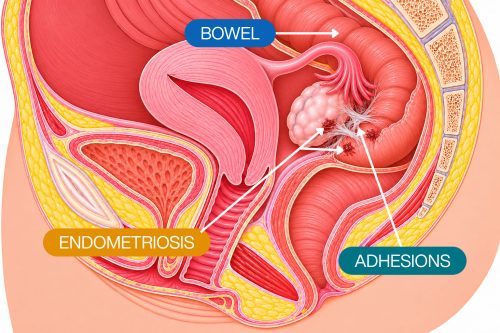
Endometriosis occurs when tissue resembling the endometrium develops outside the uterine cavity. These tissue deposits, called endometriotic lesions, most commonly affect the peritoneo pélvico, ovaries, and surrounding pelvic structures. Endometriosis can also affect organs in other parts of the body. [3][6]
The lesions may cause inflammation, fibrosis (scar tissue), and adherencias that connect structures normally separated from one another.
These changes do not always cause symptoms. Silent endometriosis is not a separate disease or stage; it describes endometriosis that occurs without symptoms.
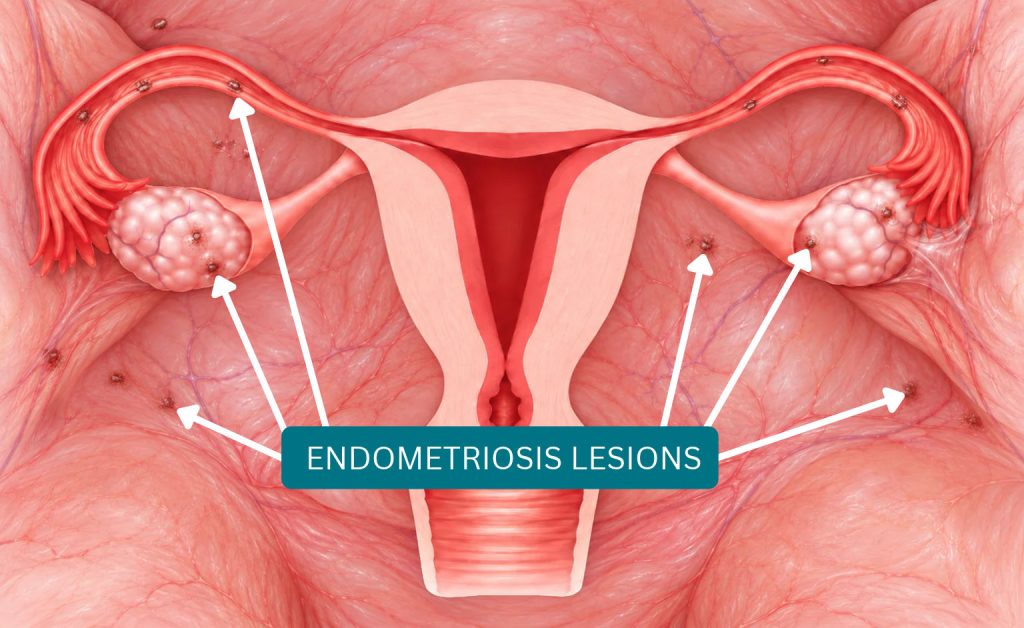
Ilustración médica que muestra lesiones de endometriosis de color marrón rojizo oscuro que afectan el útero, los ovarios y los tejidos pélvicos circundantes.
Why Endometriosis Does Not Always Cause Pain
Endometriosis-related pain is influenced by inflammation, adhesions, nerve involvement, and how the nervous system processes pain signals.
Endometriotic lesions can release inflammatory substances that irritate surrounding tissues. Some lesions also contain nerve fibers or develop close relationships with nerves involved in pain transmission.
The location of lesions, inflammatory activity, nerve involvement, and individual differences in pain processing may influence whether symptoms develop. However, the reasons some women remain asymptomatic are not fully understood. [4]
Importantly, the anatomical extent of endometriosis does not reliably predict pain severity.
A woman with superficial lesions may experience severe pelvic pain, while another with extensive disease may have little discomfort.
Even stage 4 endometriosis, which may involve ovarian endometriomas and dense adhesions, does not necessarily cause severe pain. [6]
How Silent Endometriosis Is Discovered
Because silent endometriosis produces no recognizable symptoms, it is often discovered during medical examinations or procedures performed for another reason.
During pelvic or abdominal surgery, a surgeon may identify endometriotic lesions or adhesions that were not previously suspected.
In other cases, ultrasound or MRI performed for an unrelated concern may reveal an ovarian endometrioma or findings suggestive of deep endometriosis.
Some women also discover they have endometriosis during fertility evaluations, despite having no significant history of pelvic pain.
Although these women may have no pelvic pain, infertility is itself a clinical concern. Endometriosis discovered during infertility evaluations is therefore not necessarily the same as incidentally discovered, asymptomatic disease. [1]
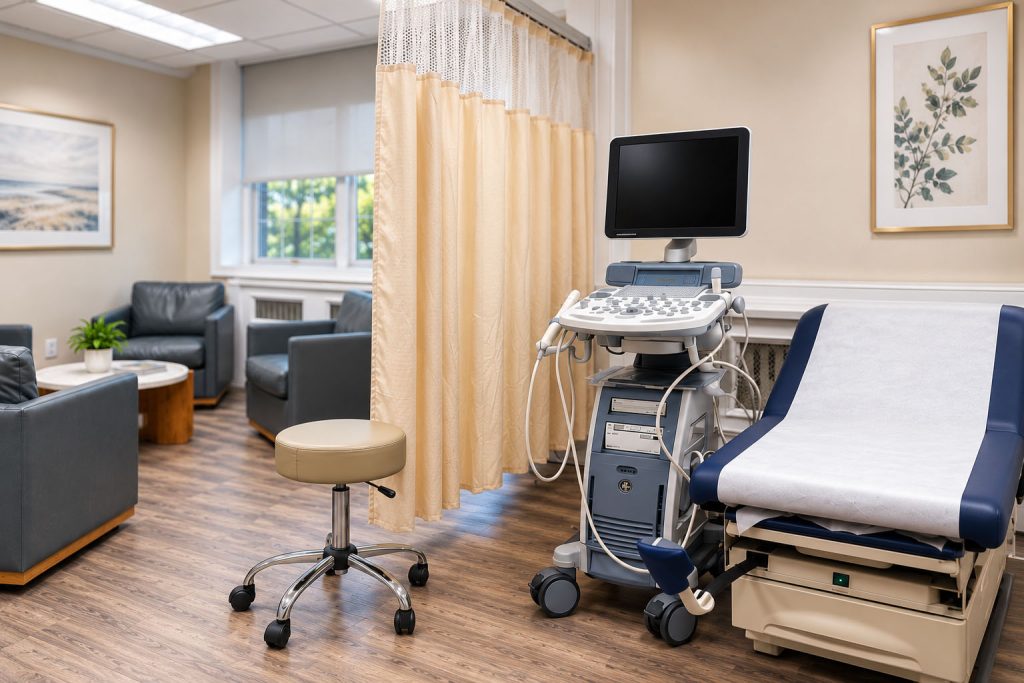
An ultrasound examination room where imaging may help identify ovarian endometriomas and certain forms of deep endometriosis, even without noticeable symptoms.
Silent Endometriosis May Affect Fertility
Normally, the fimbriae, finger-like projections at the end of the fallopian tube, help capture an egg released from the ovary during ovulation.
Endometriosis may interfere with this process when adhesions restrict the movement of the ovaries or fallopian tubes. Inflammation may also affect reproductive function, even without pelvic pain. [2]
However, silent endometriosis does not automatically cause infertility. Many women with endometriosis conceive naturally, and difficulty becoming pregnant may have several causes.
Una ecografía normal no descarta la endometriosis
Ultrasound and MRI can identify ovarian endometriomas and certain forms of deep endometriosis. However, superficial lesions may remain undetected.
The National Institute for Health and Care Excellence (NICE) advises that normal examination or ultrasound findings should not exclude endometriosis.
Laparoscopia can allow direct visualization and biopsy of suspected lesions, but it is not routinely recommended for women without symptoms or other clinical concerns.
Does Silent Endometriosis Require Treatment?
Not every woman with silent endometriosis requires treatment.
The European Society of Human Reproduction and Embryology (ESHRE) recommends against routinely removing incidentally discovered asymptomatic lesions or prescribing medication solely for these findings. [1]
However, deep endometriosis involving a ureter may affect kidney function without significant pain. Ovarian endometriomas may also require evaluation, particularly when fertility is a concern.
Treatment decisions should consider disease location, organ involvement, and reproductive goals rather than pain alone.
Can a Symptom Checker Detect Silent Endometriosis?
A symptom checker cannot detect endometriosis without symptoms. A low score does not rule out the disease, just as a high score cannot confirm it.
NYGSE’s Endometriosis Symptom Checker is an educational tool, not a diagnostic test.
Understanding Endometriosis Beyond Pain
Endometriosis is not defined by the severity of pain. Some women experience significant symptoms, while others have none.
En New York Gynecology Surgery & Endometriosis (NYGSE), evaluation considers symptoms, imaging findings, pelvic anatomy, reproductive goals, and possible organ involvement.
Women without symptoms, fertility concerns, or abnormal findings generally do not require routine screening. However, suspected deep disease, ovarian endometriomas, or unexplained infertility may warrant specialist evaluation.
Referencias
- Becker, C. M., et al. (2022). ESHRE guideline: Endometriosis. Human Reproduction Open, 2022(2), hoac009. https://doi.org/10.1093/hropen/hoac009
- Bulletti, C., Coccia, M. E., Battistoni, S., & Borini, A. (2010). Endometriosis and infertility. Journal of Assisted Reproduction and Genetics, 27(8), 441–447. https://doi.org/10.1007/s10815-010-9436-1
- Fitzgerald, A. C., Parker, A. B., & Namazi, G. (2026). Extrapelvic endometriosis: Clinical manifestations, diagnosis, and management. Current Opinion in Obstetrics and Gynecology, 38(4), 277–285. https://doi.org/10.1097/GCO.0000000000001108
- Morotti, M., Vincent, K., & Becker, C. M. (2017). Mechanisms of pain in endometriosis. European Journal of Obstetrics & Gynecology and Reproductive Biology, 209, 8–13. https://doi.org/10.1016/j.ejogrb.2016.07.497
- National Institute for Health and Care Excellence. (2024). Endometriosis: Diagnosis and management (NICE Guideline NG73). https://www.nice.org.uk/guidance/ng73/chapter/Recommendations
- Zondervan, K. T., Becker, C. M., & Missmer, S. A. (2020). Endometriosis. The New England Journal of Medicine, 382(13), 1244–1256. https://doi.org/10.1056/NEJMra1810764