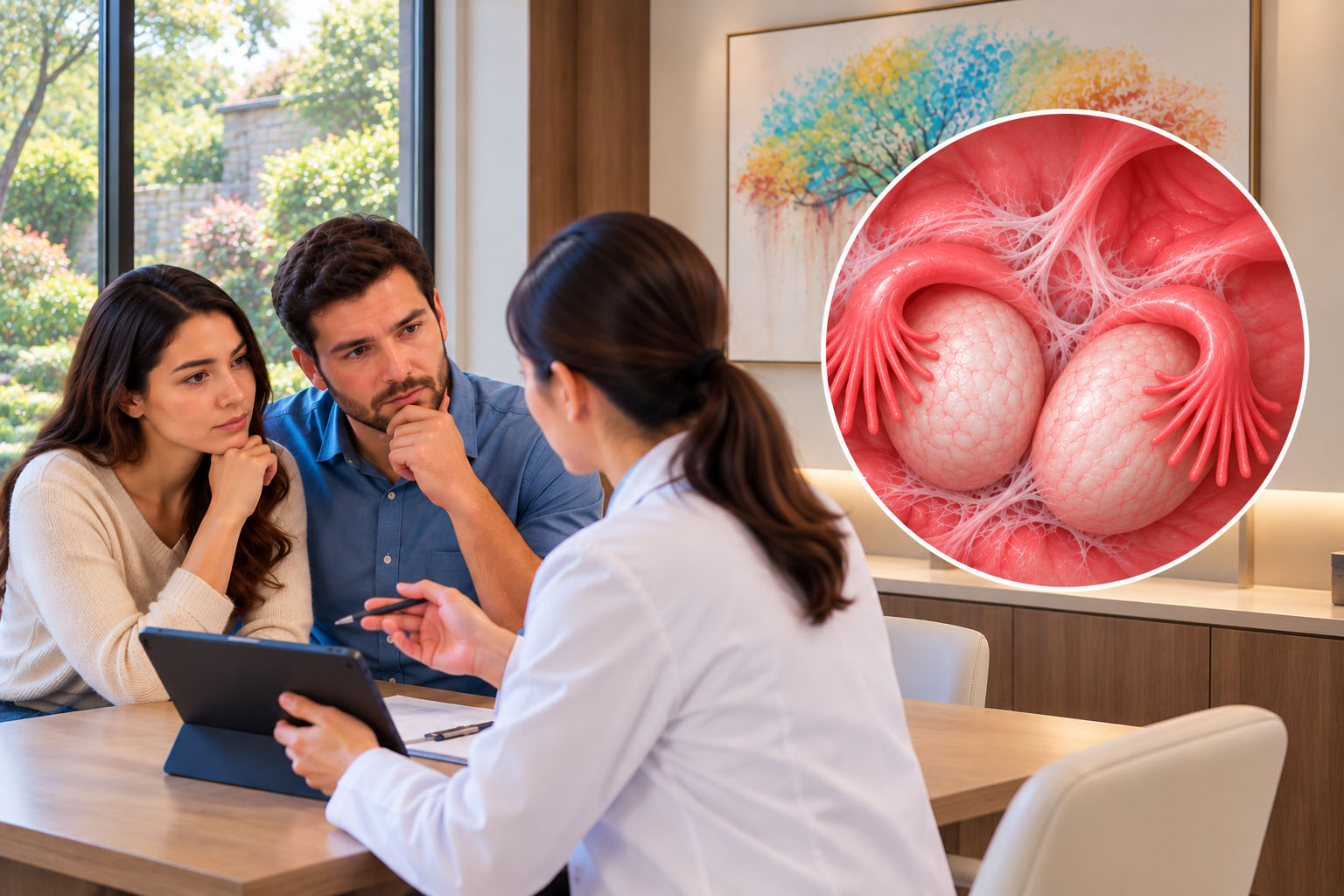
Finding out that you have kissing ovaries can raise an immediate question: Can I still get pregnant?
Kissing ovaries occur when the ovaries are positioned unusually close together, typically behind the uterus. The finding is often associated with endometriosis and pelvic adhesions that have changed the normal position of the ovaries. [2][3]
When pregnancy is the goal, the position of the ovaries is only part of the picture. The condition of the fallopian tubes, ovarian reserve, endometriomas, pelvic adhesions, age, and other fertility factors may all influence the chances of conception. [1][4]
Kissing ovaries may be associated with endometriosis and pelvic adhesions, but pregnancy may still be possible.
Kissing Ovaries Can Affect Reproductive Anatomy
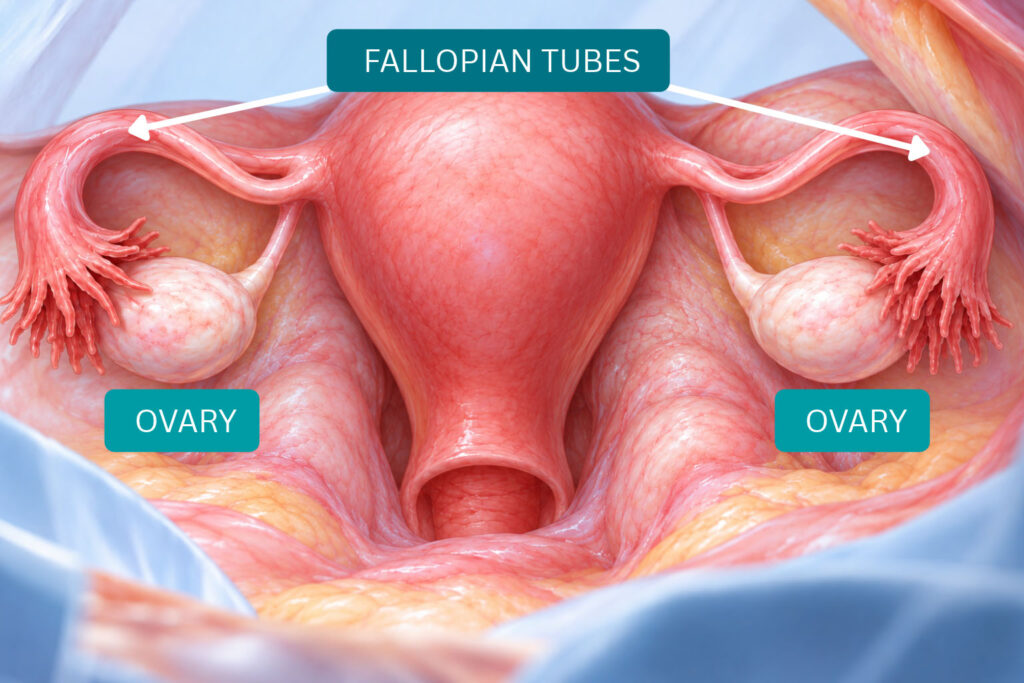
Normally, the ovaries are positioned on opposite sides of the uterus and have some mobility within the pelvis.
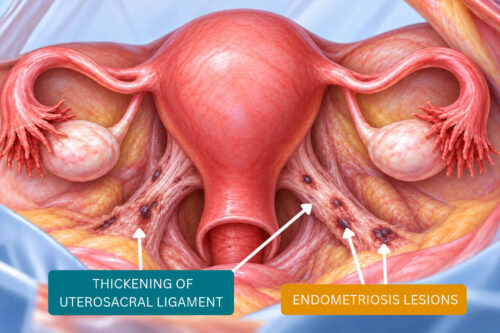
With kissing ovaries, adhesions may pull the ovaries toward the center of the pelvis until they lie next to each other, often behind the uterus. This altered anatomy can be associated with more extensive pelvic endometriosis and adhesive disease. [2][3]
The concern for fertility is therefore not simply that the ovaries are touching. The underlying endometriosis and adhesions may also affect other reproductive structures.
The Fallopian Tubes Are an Important Part of the Picture
The fallopian tubes play an essential role in natural conception because fertilization normally occurs within the tube.
Endometriosis and pelvic adhesions can distort the relationship between the ovaries and fallopian tubes or interfere with tubal function. [3]
In the original study describing the kissing ovaries sign, tubal endometriosis was more common among patients with kissing ovaries. Among patients with infertility, tubal obstruction was also more common when kissing ovaries were present. [2]
This does not mean that everyone with kissing ovaries has blocked fallopian tubes. However, tubal function may be an important part of the fertility evaluation.
Medical illustration showing normal ovaries and fallopian tubes involved in natural conception.
Natural Pregnancy May Still Be Possible
Some patients with kissing ovaries may still have functioning ovaries and open fallopian tubes and may be able to become pregnant naturally.
The likelihood of pregnancy depends on the overall fertility picture, including age, ovarian reserve, tubal function, endometriomas, previous surgery, extent of endometriosis, and sperm factors. [1][4]
For this reason, kissing ovaries should not be viewed as a prediction of whether someone can or cannot become pregnant.
Surgery Is Not Always Necessary Before Pregnancy
The presence of kissing ovaries on an ultrasound or MRI does not automatically mean that surgery is required before trying to become pregnant.
Treatment decisions should be individualized. For some patients, surgery may be considered because of pain, endometriomas, significant endometriosis, distorted pelvic anatomy, or other clinical concerns. For others, proceeding with fertility treatment may be more appropriate. [1][4]
The potential benefits of ovarian surgery also need to be weighed against its possible effect on ovarian reserve, particularly when endometriomas are involved. [1][4]
IVF May Be an Option for Some Patients
For some patients with endometriosis-related infertility, in vitro fertilization (IVF) may be considered. [1][4]
IVF can bypass certain problems involving the fallopian tubes because eggs are retrieved directly from the ovaries and fertilized outside the body. However, ovarian reserve, endometriomas, adhesions, previous surgery, age, and other fertility factors still need to be considered when planning treatment. [1][4]
The appropriate path may involve natural conception, surgery, fertility treatment, or a combination of approaches depending on the individual patient.
Pregnancy With Kissing Ovaries Is Possible
Kissing ovaries can be an important sign that endometriosis or adhesions have changed normal pelvic anatomy, but they do not mean pregnancy is impossible.
For patients hoping to conceive, the more important question is how the ovaries, fallopian tubes, ovarian reserve, and underlying endometriosis are affecting fertility as a whole.
At New York Gynecology Surgery & Endometriosis (NYGSE), we evaluate the complete clinical picture to determine how endometriosis and pelvic adhesions may be affecting reproductive anatomy and what treatment options may be appropriate.
Becker, C. M., Bokor, A., Heikinheimo, O., Horne, A., Jansen, F., Kiesel, L., King, K., Kvaskoff, M., Nap, A., Petersen, K., Saridogan, E., Tomassetti, C., van Hanegem, N., Vulliemoz, N., & Vermeulen, N. (2022). ESHRE guideline: Endometriosis. Human Reproduction Open, 2022(2), hoac009. https://doi.org/10.1093/hropen/hoac009
Ghezzi, F., Raio, L., Cromi, A., Duwe, D. G., Beretta, P., Buttarelli, M., & Mueller, M. D. (2005). “Kissing ovaries”: A sonographic sign of moderate to severe endometriosis. Fertility and Sterility, 83(1), 143–147. https://doi.org/10.1016/j.fertnstert.2004.05.094
Guerriero, S., et al. (2016). Systematic approach to sonographic evaluation of the pelvis in women with suspected endometriosis, including terms, definitions and measurements: A consensus opinion from the International Deep Endometriosis Analysis (IDEA) group. Ultrasound in Obstetrics & Gynecology, 48(3), 318–332. https://doi.org/10.1002/uog.15955
National Institute for Health and Care Excellence. (2024). Endometriosis: Diagnosis and management (NICE Guideline NG73).https://www.nice.org.uk/guidance/ng73