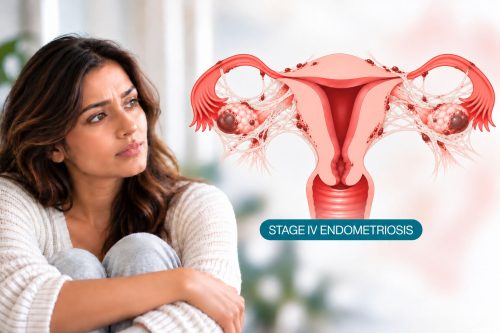


You had an ovarian cyst treated or surgically removed, and for a while, everything seemed fine. But a few months later, another ultrasound reveals a new cyst on the same ovary. Why does it keep coming back? Does this mean the previous treatment failed, or could endometriosis be responsible?
Not all ovarian cysts are the same. Some develop naturally during the menstrual cycle and disappear without treatment. Others, particularly ovarian endometriomas, are associated with endometriosis and may recur even after surgery. [1][4]
Understanding the difference matters because the type of cyst, your symptoms, and your fertility plans can influence what happens next.
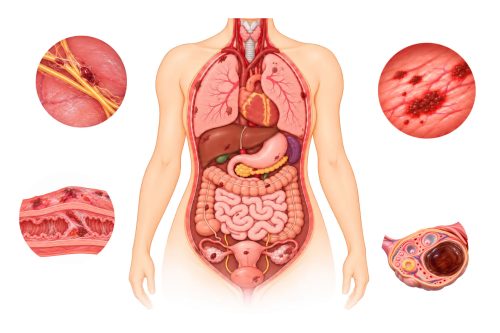
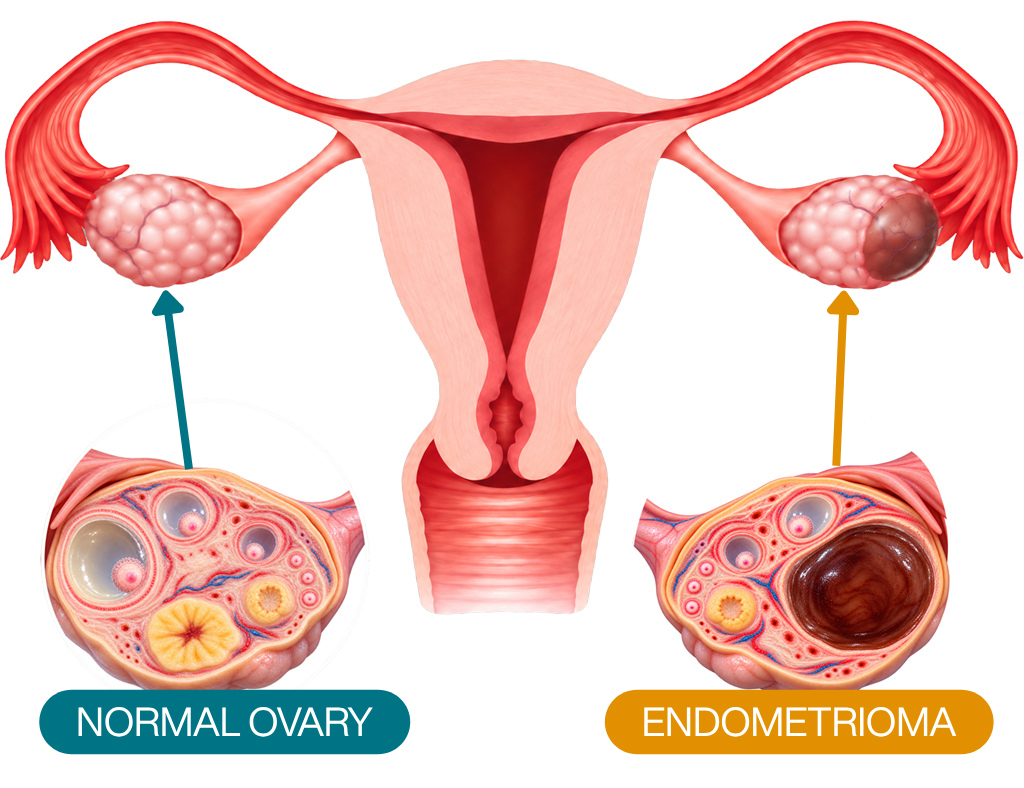
A medical illustration comparing functional ovarian cysts, which usually resolve on their own, and ovarian endometriomas, which are linked to endometriosis and may recur after surgery.
Why Do Ovarian Cysts Keep Coming Back?
Ovarian cysts can keep coming back for different reasons, depending on the type of cyst. Some develop because of the normal hormonal changes that occur during each menstrual cycle, while others are associated with underlying conditions such as endometriosis.
During a normal menstrual cycle, the ovaries develop small, fluid-filled structures called follicles. One usually releases an egg during ovulation. Occasionally, a follicle continues growing or fluid accumulates after ovulation, forming a functional ovarian cyst.
Most functional cysts disappear without treatment. However, because ovulation occurs repeatedly, a new cyst can develop during a later menstrual cycle. Finding another ovarian cyst does not necessarily mean the original cyst has returned. It may be an entirely new cyst.
Endometriosis-related cysts are different. An ovarian endometrioma develops in association with endometriosis, a chronic inflammatory disease that can continue to affect the ovaries. Unlike functional cysts, endometriomas may persist or recur even after surgical treatment.
The important question is not simply why another cyst has appeared, but what type of cyst it is and what is causing it to develop.
Understanding Ovarian Endometriomas
An ovarian endometrioma develops when endometriosis affects the ovary, forming a cyst containing old, blood-derived material. These cysts are sometimes called chocolate cysts because their contents resemble thick, dark brown fluid.
Unlike functional cysts, which often resolve within a few menstrual cycles, ovarian endometriomas may persist for longer periods. However, not all endometriomas continue growing. Some remain stable or decrease in size without treatment, while others may enlarge or cause pelvic discomfort, particularly around menstruation. [2]
Some patients experience painful periods, pain during intercourse, or persistent pelvic discomfort. Others have few recognizable symptoms, and the endometrioma is discovered during an ultrasound performed for another reason.
Endometrioma Recurrence After Surgery
Surgery can remove an existing endometrioma, but it does not necessarily eliminate the underlying endometriosis. Endometriotic tissue may remain elsewhere in the pelvis, and disease activity can continue after the operation.
A new endometrioma may develop in the previously operated ovary or the opposite ovary. Recurrence does not automatically mean the original surgery was unsuccessful. [4]
This distinction matters because removing a cyst addresses the existing lesion, while managing endometriosis may require a longer-term approach.
How Common Is Endometrioma Recurrence?
A 2024 systematic review and meta-analysis by Veth et al. examined ovarian endometrioma recurrence after surgery among patients who did not receive postoperative hormonal treatment. [4]
| Time After Surgery | Recurrence Rate |
|---|---|
| 3 months | 4% |
| 6 months | 14% |
| 12 months | 17% |
| 24 months | 27% |
Source: Veth et al. (2024). Recurrence after surgery for endometrioma:
A systematic review and meta-analyses. Fertility and Sterility, 122(6), 1079–1093.
These findings suggest that recurrence becomes more common with longer follow-up. However, individual risk varies, and these percentages should not be interpreted as a prediction for every patient.
The numbers also explain why follow-up matters. Even when surgery successfully removes an endometrioma, the possibility of recurrence should be considered when developing a long-term treatment plan.
Recurring Endometriomas and Ovarian Health
The ovaries contain a limited supply of follicles that gradually declines with age. This remaining reproductive potential is commonly described as ovarian reserve.
Endometriomas may be associated with changes in ovarian function. Surgery to remove them can also affect ovarian reserve because healthy ovarian tissue may be damaged or removed during cyst excision. [1]
This concern becomes particularly important when a patient has already undergone ovarian surgery or has endometriomas affecting both ovaries.
Repeated surgery should not automatically be the next step whenever another endometrioma appears. The potential benefits must be weighed against the risks to ovarian function, especially for patients planning future pregnancies.
Can Ultrasound Identify a Recurring Endometrioma?
Pelvic ultrasound is commonly used to evaluate ovarian cysts. Endometriomas often have recognizable imaging features, including relatively uniform internal echoes sometimes described as a ground-glass appearance. [3]
However, not every cyst with a similar appearance is an endometrioma. Functional hemorrhagic cysts and other ovarian lesions can sometimes resemble endometriomas on imaging.
Your healthcare provider may recommend follow-up imaging or additional evaluation depending on the cyst’s characteristics, your symptoms, and previous medical history.
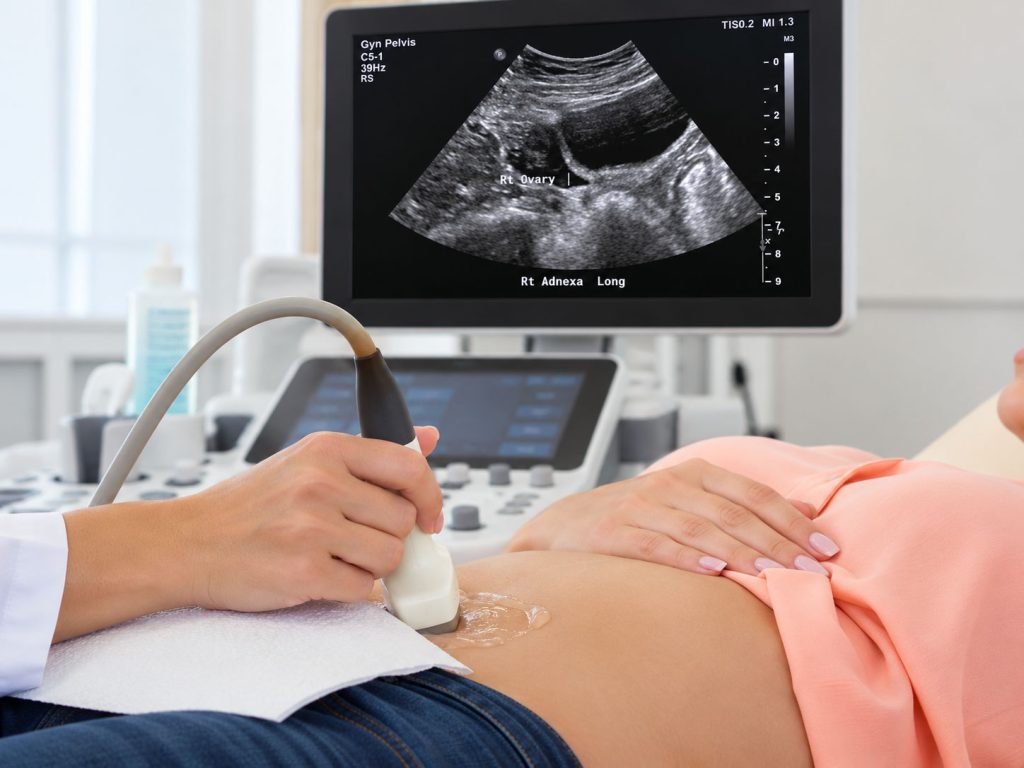
Woman undergoing a pelvic ultrasound examination while a monitor displays an ultrasound image.
Is Another Surgery Always Necessary?
Not necessarily. Treatment depends on several factors, including the cyst’s appearance and size, pain severity, previous surgery, and whether pregnancy is a current goal.
Some patients may benefit from observation with follow-up imaging. Others may be offered hormonal treatment to manage endometriosis-related symptoms and reduce the likelihood of recurrence.
The European Society of Human Reproduction and Embryology recommends offering long-term postoperative hormonal treatment to patients who are not immediately seeking pregnancy, to help reduce endometrioma and symptom recurrence. However, hormonal suppression is not suitable for everyone, particularly those actively trying to conceive. [1]
When surgery is appropriate, preserving healthy ovarian tissue is an important consideration. The goal is not simply to remove another cyst but to balance symptom relief, disease management, and ovarian function.
Looking Beyond the Cyst: Managing Endometriosis
If ovarian cysts repeatedly appear, determining whether they are functional cysts, endometriomas, or another type of ovarian lesion is an important first step. Reviewing previous ultrasound findings and surgical records can help clarify whether a cyst has truly recurred or represents a different condition.
An endometriosis specialist can assess your symptoms, imaging results, previous treatment, and fertility goals. Depending on the findings, further care may involve monitoring, hormonal treatment, fertility counseling, or carefully planned surgery.
At New York Gynecology Surgery & Endometriosis, our specialists provide individualized evaluation for patients with suspected or confirmed endometriosis. Consider scheduling a consultation to better understand why your ovarian cysts may be recurring and discuss the treatment options appropriate for you.
References
- Becker, C. M., Bokor, A., Heikinheimo, O., Horne, A., Jansen, F., Kiesel, L., King, K., Kvaskoff, M., Nap, A., Petersen, K., Saridogan, E., Tomassetti, C., van Hanegem, N., Vulliemoz, N., & Vermeulen, N. (2022). ESHRE guideline: Endometriosis. Human Reproduction Open, 2022(2), hoac009. https://doi.org/10.1093/hropen/hoac009
- Knez, J., Bean, E., Nijjar, S., Mavrelos, D., & Jurkovic, D. (2024). Ultrasound study of natural progression of ovarian endometrioma. Ultrasound in Obstetrics & Gynecology, 64(3), 405–411. https://doi.org/10.1002/uog.27607
- Van Holsbeke, C., Van Calster, B., Guerriero, S., Savelli, L., Paladini, D., Lissoni, A. A., Czekierdowski, A., Fischerova, D., Zhang, J., Mestdagh, G., Testa, A. C., Bourne, T., Valentin, L., & Timmerman, D. (2010). Endometriomas: Their ultrasound characteristics. Ultrasound in Obstetrics & Gynecology, 35(6), 730–740. https://doi.org/10.1002/uog.7668
- Veth, V. B., Keukens, A., Reijs, A., Bongers, M. Y., Mijatovic, V., Coppus, S. F. P. J., & Maas, J. W. M. (2024). Recurrence after surgery for endometrioma: A systematic review and meta-analyses. Fertility and Sterility, 122(6), 1079–1093. https://doi.org/10.1016/j.fertnstert.2024.07.033