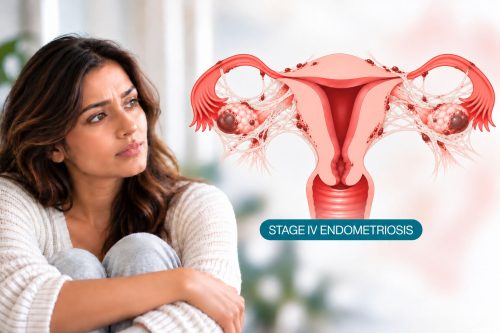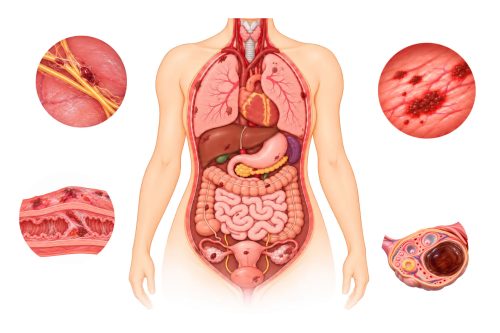


Endometriosis is not cancer. It is a benign, chronic inflammatory disease in which tissue similar to the lining of the uterus grows outside the uterus. However, some of its biological characteristics resemble those observed in cancer. [1][4]
Endometriosis lesions can infiltrate surrounding tissues, develop their own blood supply, and survive outside their normal anatomical environment. In some cases, the disease can affect the bowel, bladder, ureters, and even organs beyond the pelvis. [1][7]
Although these characteristics may sound alarming, endometriosis is not a malignant disease. Understanding the similarities and differences can help explain why a benign condition may still cause significant complications.
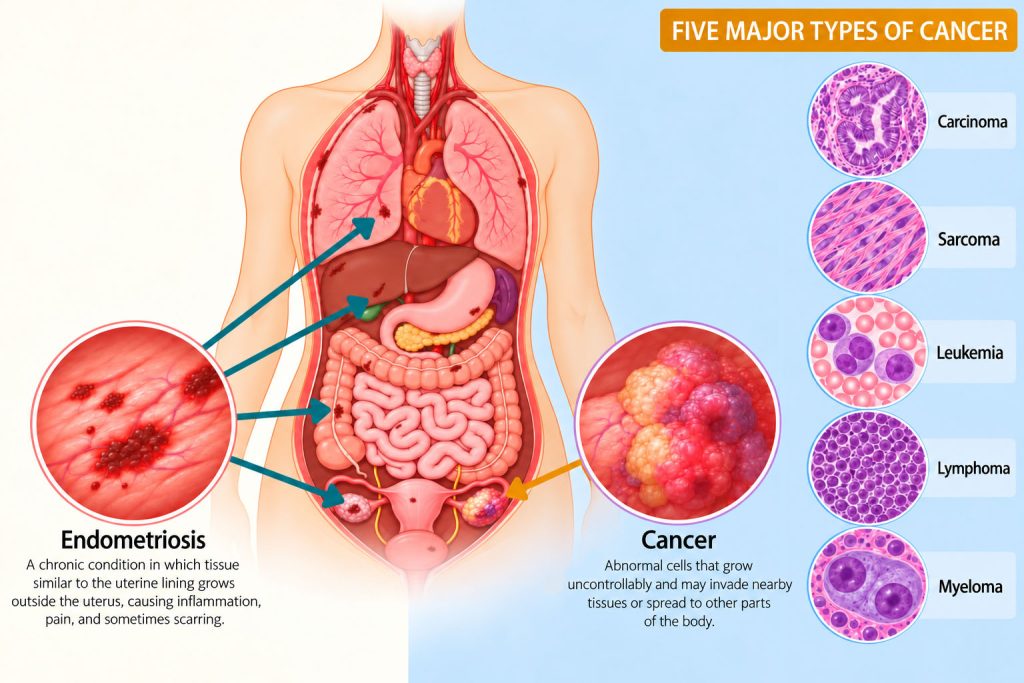
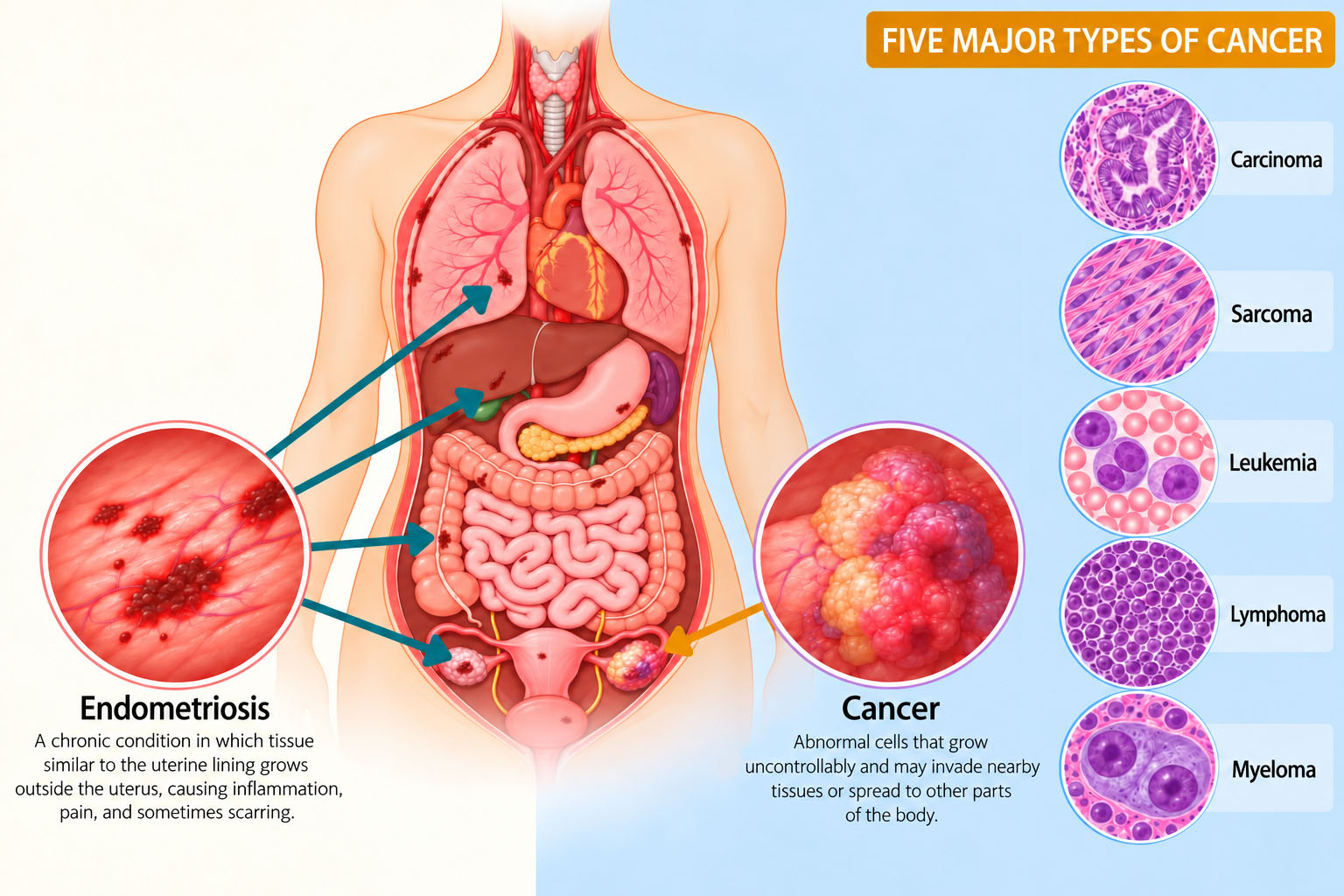
A medical illustration comparing endometriosis and cancer, showing affected organs, abnormal tissue growth, and the five major types of cancer.
Is Endometriosis a Form of Cancer?
No. Endometriosis is classified as a benign disease, meaning its lesions are not cancerous.
Cancer involves malignant cells that can grow uncontrollably, invade surrounding tissues, and sometimes spread to distant organs. Cancer includes several major types, such as carcinoma, sarcoma, leukemia, lymphoma, and myeloma.
Endometriosis, by contrast, does not belong to any of these cancer categories. It involves benign endometrial-like tissue growing outside the uterus, although its lesions can share certain biological characteristics with cancer.
However, benign does not necessarily mean harmless.
Endometriosis can cause chronic inflammation, scarring, adhesions, pelvic pain, and infertility. In more extensive cases, lesions may infiltrate nearby organs and interfere with their normal function. [4]
The important distinction is that endometriosis can cause significant tissue damage without being cancer.
Why Does Endometriosis Behave Like Cancer?
Researchers have identified several biological similarities between endometriosis and cancer, particularly involving tissue invasion, blood vessel formation, cell survival, and inflammation.
1. Endometriosis Can Invade Surrounding Tissues
Endometriosis lesions can infiltrate nearby tissues, particularly in patients with deep endometriosis.
Depending on their location, lesions may affect the bowel, bladder, ureters, uterosacral ligaments, and other pelvic structures. [6]
Over time, inflammation and fibrosis may contribute to adhesions, causing organs that normally move independently to become attached to one another.
Cancer can also invade surrounding tissues. The local infiltration associated with endometriosis is biologically different from malignant invasion. Endometriosis remains a benign disease even when its lesions extend deeply into surrounding tissues.
2. Endometriosis Can Develop Its Own Blood Supply
For endometriosis lesions to survive and grow, they require oxygen and nutrients.
One process that supports their survival is called angiogenesis, the formation of new blood vessels from existing vessels.
Research suggests that endometriosis lesions can stimulate blood vessel formation through signaling molecules such as vascular endothelial growth factor (VEGF). [5]
Angiogenesis also plays an important role in cancer, where growing tumors may stimulate the formation of additional blood vessels. However, angiogenesis is not exclusive to cancer. It also occurs during normal processes such as wound healing and tissue repair.
Angiogenesis is one of several biological processes that may help endometriosis lesions survive outside the uterus.
3. Endometriosis Cells May Resist Normal Cell Death
The body naturally eliminates damaged or unnecessary cells through a process called apoptosis, or programmed cell death.
Some studies suggest that endometriosis lesions exhibit changes in the mechanisms regulating apoptosis, allowing certain cells to survive longer than expected. [1][7]
Cancer cells can also develop mechanisms that help them avoid programmed cell death. However, resistance to apoptosis does not automatically make a cell cancerous.
In endometriosis, these changes may contribute to the persistence of lesions outside the uterus.
4. Endometriosis Can Cause Chronic Inflammation
Endometriosis is associated with persistent inflammatory activity.
Lesions interact with surrounding tissues and immune cells, releasing inflammatory substances that may contribute to pain, fibrosis, and adhesions. [1][7]
Chronic inflammation is also involved in the development and progression of certain cancers. However, inflammation occurs in many benign conditions and does not indicate malignancy.
In endometriosis, inflammation can contribute to symptoms and anatomical changes even without cancerous cell growth.
5. Endometriosis Can Occur Beyond the Pelvis
Endometriosis most commonly affects structures within the pelvis, including the ovaries, pelvic peritoneum, and tissues surrounding the uterus.
However, in rare cases, lesions can occur outside the pelvis.
Examples include the diaphragm, thoracic cavity, abdominal wall, and other distant locations. Researchers continue to investigate how endometriosis develops in these areas. Proposed mechanisms include the movement of endometrial-like cells through lymphatic or blood vessels and the transformation of certain cells into endometrial-like tissue. [1]
Unlike cancer metastasis, endometriosis found outside the pelvis is not classified as metastatic cancer. The mechanisms by which endometriosis develops in distant locations are still being studied.
Endometriosis and Cancer Have Important Biological Differences
Despite sharing certain biological characteristics, endometriosis and cancer are fundamentally different diseases.
| Characteristic | Endometriosis | Cancer |
|---|---|---|
| Classification | Benign (noncancerous) | Malignant (cancerous) |
| Tissue invasion | Can infiltrate surrounding tissues and cause fibrosis | Can invade and destroy surrounding tissues |
| Blood vessel formation | Can support lesion survival | Can support tumor growth |
| Inflammation | Common | May contribute to progression |
| Altered cell survival | Can occur | Common in many cancers |
| Organ involvement | Can affect multiple organs and tissues throughout the body | Can affect multiple organs and may spread through metastasis |
Although endometriosis is a benign condition, it can share certain biological characteristics with cancer, including tissue infiltration, inflammation, and the formation of new blood vessels. These similarities do not mean that endometriosis is cancer.
Endometriosis Can Sometimes Be Mistaken for Cancer
In some circumstances, endometriosis can resemble cancer on medical imaging.
Ovarian endometriomas, also called chocolate cysts, may appear as complex ovarian masses.[6] Certain deep endometriosis lesions can also produce tissue thickening or nodules that resemble other pelvic conditions.
Additionally, some patients with endometriosis have elevated levels of CA-125, a blood marker sometimes used during ovarian cancer evaluation. However, CA-125 can also increase in benign conditions and cannot independently diagnose or exclude cancer. [2]
When imaging findings are unusual or suspicious, additional evaluation may be necessary to distinguish endometriosis from malignancy.
Can Endometriosis Turn Into Cancer?
Although endometriosis is benign, research has identified an association between endometriosis and an increased relative risk of certain ovarian cancers, particularly ovarian clear cell carcinoma and endometrioid carcinoma. [3]
In rare cases, malignant transformation of endometriosis-associated tissue may occur. However, most patients with endometriosis will never develop ovarian cancer. The absolute risk remains low. [3][4]
Having endometriosis does not mean that cancer is inevitable or that every endometriosis lesion has the potential to become malignant.
Individual risk factors, medical history, and suspicious clinical findings should guide further evaluation.
Understanding Why Endometriosis Behaves Like Cancer
Endometriosis and cancer share certain biological processes, including tissue invasion, angiogenesis, altered cell survival, and inflammation.
These similarities do not make endometriosis a form of cancer.
Understanding how endometriosis lesions survive and affect surrounding tissues can help explain why the disease sometimes causes significant symptoms and complications despite its benign classification.
At New York Gynecology Surgery & Endometriosis, our specialists provide individualized evaluation and treatment for patients with suspected or confirmed endometriosis, including complex disease involving surrounding pelvic organs.
Consider scheduling a consultation to better understand your symptoms, diagnostic findings, and available treatment options.
References
- Adilbayeva, A., & Kunz, J. (2024). Pathogenesis of endometriosis and endometriosis-associated cancers. International Journal of Molecular Sciences, 25(14), 7624. https://doi.org/10.3390/ijms25147624
- American College of Obstetricians and Gynecologists. (2020, October). Can I get a CA 125 test to make sure I don’t have ovarian cancer? https://www.acog.org/womens-health/experts-and-stories/ask-acog/can-i-get-a-ca-125-test-to-make-sure-i-dont-have-ovarian-cancer
- Barnard, M. E., Farland, L. V., Yan, B., Wang, J., Trabert, B., Doherty, J. A., Meeks, H. D., Madsen, M., Guinto, E., Collin, L. J., Maurer, K. A., Page, J. M., Kiser, A. C., Varner, M. W., Allen-Brady, K., Pollack, A. Z., Peterson, K. R., Peterson, C. M., & Schliep, K. C. (2024). Endometriosis typology and ovarian cancer risk. JAMA, 332(6), 482–489. https://doi.org/10.1001/jama.2024.9210
- Becker, C. M., Bokor, A., Heikinheimo, O., Horne, A., Jansen, F., Kiesel, L., King, K., Kvaskoff, M., Nap, A., Petersen, K., Saridogan, E., Tomassetti, C., van Hanegem, N., Vulliemoz, N., & Vermeulen, N. (2022). ESHRE guideline: Endometriosis. Human Reproduction Open, 2022(2), hoac009. https://doi.org/10.1093/hropen/hoac009
- Bo, C., & Wang, Y. (2024). Angiogenesis signaling in endometriosis: Molecules, diagnosis and treatment (Review). Molecular Medicine Reports, 29(3), Article 43. https://doi.org/10.3892/mmr.2024.13167
- National Institute for Health and Care Excellence. (2024). Endometriosis: Diagnosis and management (NICE Guideline NG73). https://www.nice.org.uk/guidance/ng73
- Psilopatis, I., Burghaus, S., Au, K., Hofbeck, L., Windischbauer, L., Lotz, L., & Beckmann, M. W. (2024). The hallmarks of endometriosis. Geburtshilfe und Frauenheilkunde, 84(6), 555–563. https://doi.org/10.1055/a-2306-8759