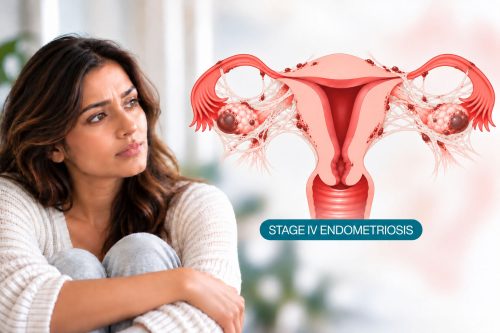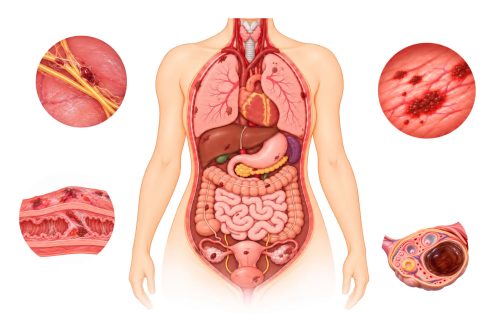


Being told you have Stage I, II, III, or IV endometriosis can sound like a measure of how serious the condition is.
But endometriosis staging is often misunderstood.
Unlike cancer staging, a higher endometriosis stage does not necessarily mean that a patient will have more severe symptoms, and an earlier stage does not mean that the disease cannot cause significant pain.
So what do the four stages actually describe?
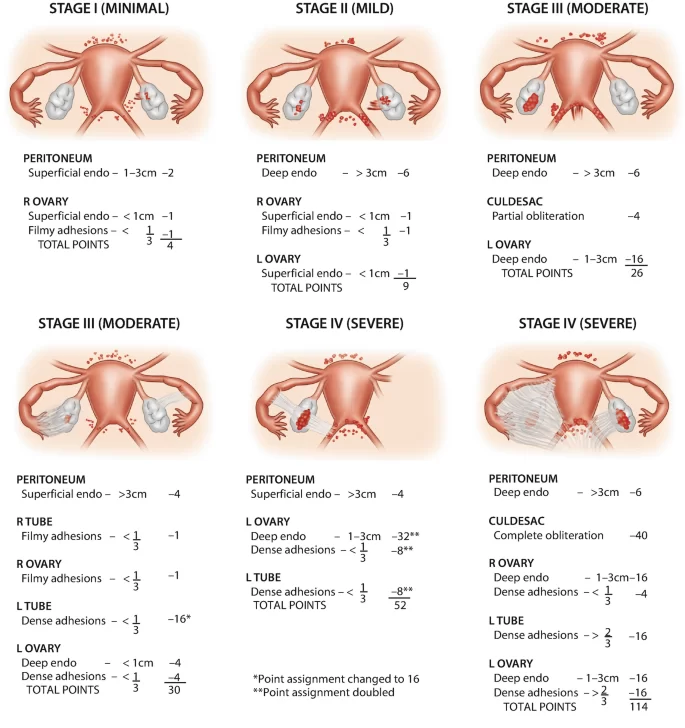
Source: American Society for Reproductive Medicine (1997).
How Is Endometriosis Staged?
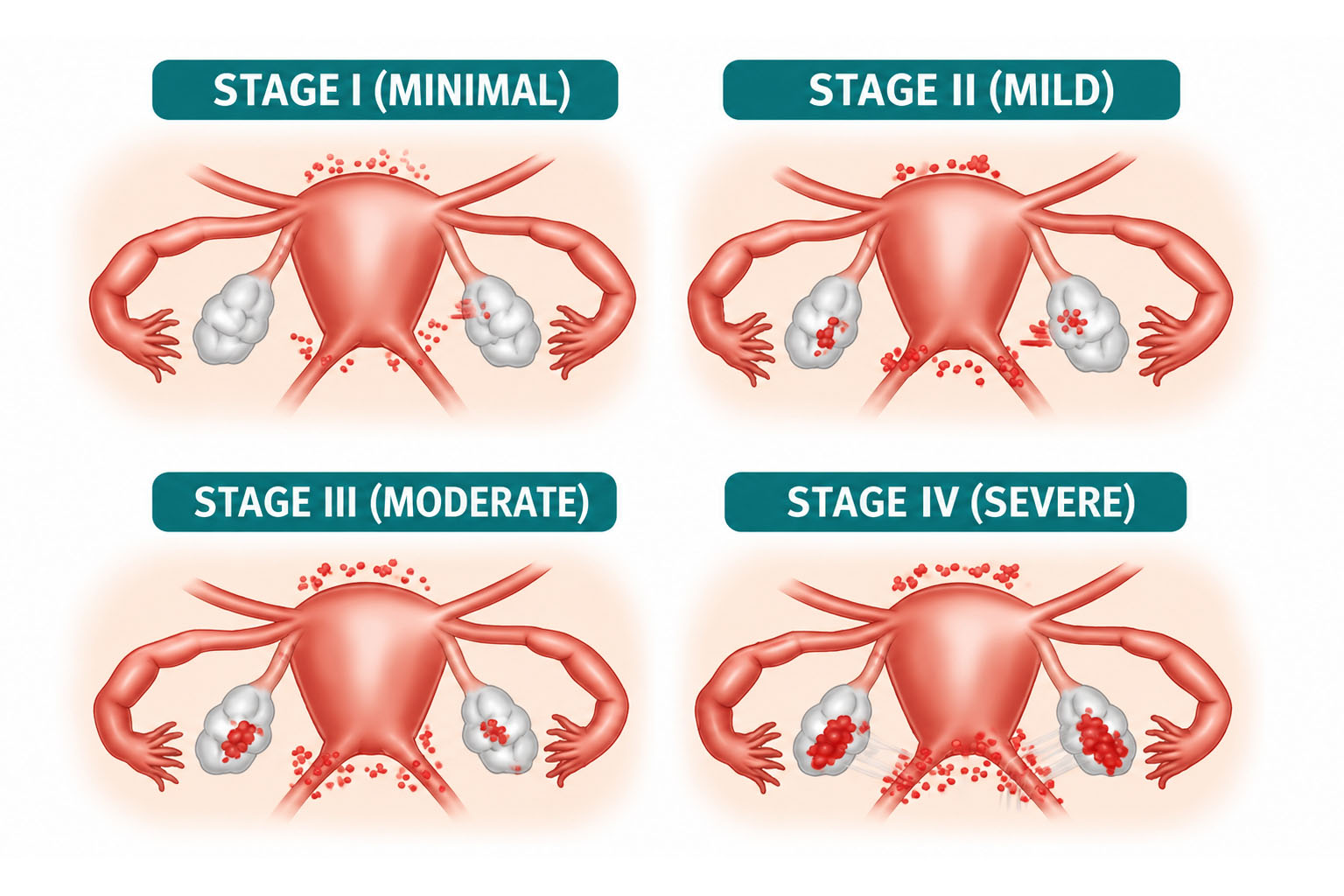
The commonly used American Society for Reproductive Medicine (ASRM) classification divides endometriosis into four stages:
Stage I: Minimal
Stage II: Mild
Stage III: Moderate
Stage IV: Severe
The stage is determined using a point system based on findings such as the location, size, and depth of endometriosis lesions, ovarian involvement, and the presence and extent of adhesions.
In other words, staging primarily describes what is found anatomically, rather than how a patient feels.
Stage I Endometriosis: Minimal
Stage I is classified as minimal endometriosis.
There may be a small number of superficial endometriosis implants, often involving the peritoneum or ovaries, with little significant scar tissue.
But “minimal” refers to the findings used in the staging system. It does not necessarily mean minimal symptoms.
A patient with Stage I disease can still experience significant pelvic pain or painful periods.
Stage II Endometriosis: Mild
Stage II is considered mild endometriosis.
Compared with Stage I, there may be more lesions or deeper areas of endometriosis. Disease may involve the peritoneum and ovaries, with limited adhesions.
Again, the word “mild” describes the anatomical classification, not necessarily the patient’s experience.
Stage III Endometriosis: Moderate
Stage III, or moderate endometriosis, generally reflects more extensive disease.
Findings may include deeper endometriosis, ovarian endometriomas, and adhesions involving the ovaries or fallopian tubes. Adhesions can cause pelvic organs that normally move freely to become attached to surrounding structures.
At this stage, ovarian and tubal involvement may become particularly relevant when fertility is a concern.
Stage IV Endometriosis: Severe
Stage IV represents the highest category in the ASRM staging system.
Patients may have deep endometriosis, larger ovarian endometriomas, and extensive or dense adhesions affecting the ovaries, fallopian tubes, or other pelvic structures.
In some cases, significant adhesions can substantially distort normal pelvic anatomy.
But even the term “severe” needs context.
Stage IV describes the extent of anatomical disease according to the classification system. It does not automatically tell us how severe a patient’s pain will be.
Does a Higher Stage Mean More Pain?
Not necessarily.
This is one of the most important things patients should understand about endometriosis staging.
Someone with Stage I disease can experience debilitating pain, while another patient with Stage IV endometriosis may have surprisingly few symptoms.
Pain can be influenced by factors beyond the amount of visible disease, including lesion location, inflammation, nerve involvement, adhesions, pelvic floor dysfunction, and individual pain processing.
That is why a patient’s symptoms should never be dismissed simply because their endometriosis is classified as an earlier stage.
Does Stage IV Mean Endometriosis Is Cancer?
No.
The terminology can understandably cause anxiety because people are familiar with Stage IV cancer.
Stage IV endometriosis does not mean cancer, and it does not mean endometriosis has become terminal.
The two staging systems describe entirely different things.
In endometriosis, Stage IV means that the disease has accumulated enough points under the surgical classification system to be categorized as severe based on factors such as lesions, ovarian involvement, and adhesions.
Can Imaging Tell You Your Endometriosis Stage?
Ultrasound and MRI can identify certain forms of endometriosis, including ovarian endometriomas and some deep disease. Imaging can therefore provide valuable information about the likely extent and location of endometriosis.
However, the traditional ASRM stage is based on a scoring system involving anatomical findings, historically documented during surgery.
This is why being told that imaging “looks like Stage III or IV” is not necessarily the same as having a formal surgical stage assigned.
That distinction is particularly relevant to patients diagnosed with an ovarian endometrioma.
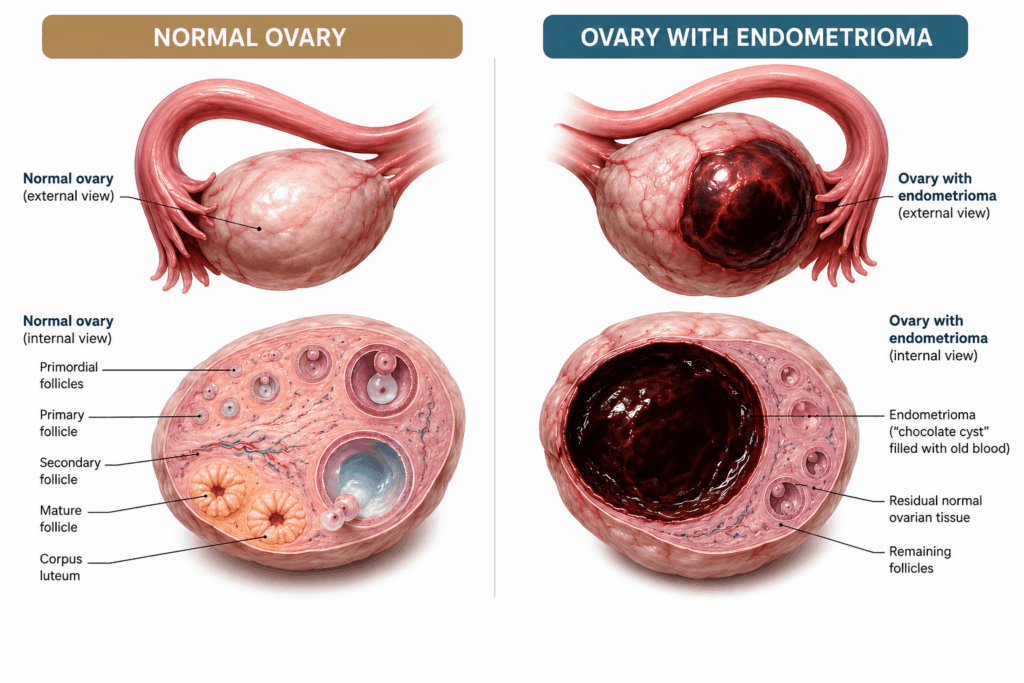
Does an Endometrioma Automatically Mean Stage III or IV?
An ovarian endometrioma can contribute significantly to the ASRM score, particularly when combined with adhesions or disease elsewhere in the pelvis.
However, the size of an endometrioma alone does not determine the stage.
The overall classification considers multiple findings, including whether one or both ovaries are involved, the size and depth of ovarian disease, adhesions, peritoneal disease, and other anatomical findings.
Does Endometriosis Stage Affect Fertility?
Stage can provide some information about the anatomical extent of disease, particularly when the ovaries, fallopian tubes, or pelvic anatomy are affected.
But stage alone cannot predict whether an individual woman will become pregnant.
Age, ovarian reserve, tubal function, ovarian involvement, other fertility factors, previous surgery, and a partner’s fertility can all influence the chances of pregnancy.
For patients concerned about fertility, the stage is therefore only one part of the discussion.
Your Stage Is Only Part of the Endometriosis Picture
Knowing your endometriosis stage can help describe the anatomical extent of disease, but it does not define your experience with endometriosis.
A stage does not tell us exactly how much pain you should have, whether your symptoms are legitimate, whether you will experience infertility, or what treatment is automatically right for you.
At New York Gynecology Surgery & Endometriosis (NYGSE), we look beyond the stage itself. The location of disease, symptoms, imaging, previous treatment, fertility goals, and individual circumstances all matter when determining the appropriate approach to endometriosis care.
References
American Society for Reproductive Medicine. (1997). Revised American Society for Reproductive Medicine classification of endometriosis: 1996. Fertility and Sterility, 67(5), 817–821. https://doi.org/10.1016/S0015-0282(97)81391-X
Becker, C. M., Bokor, A., Heikinheimo, O., Horne, A., Jansen, F., Kiesel, L., King, K., Kvaskoff, M., Nap, A., Petersen, K., Saridogan, E., Tomassetti, C., van Hanegem, N., Vulliemoz, N., & Vermeulen, N. (2022).
ESHRE guideline: Endometriosis. Human Reproduction Open, 2022(2), hoac009. https://doi.org/10.1093/hropen/hoac009
International Working Group of AAGL, ESGE, ESHRE and WES, Tomassetti, C., Johnson, N. P., Petrozza, J., Abrao, M. S., Einarsson, J. I., Horne, A. W., Lee, T. T. M., Missmer, S., Vermeulen, N., Zondervan, K. T., Grimbizis, G., & De Wilde, R. L. (2021). An international terminology for endometriosis, 2021. Human Reproduction Open, 2021(4), hoab029. https://doi.org/10.1093/hropen/hoab029
International Working Group of AAGL, ESGE, ESHRE and WES, Tomassetti, C., Johnson, N. P., Petrozza, J., Abrao, M. S., Einarsson, J. I., Horne, A. W., Lee, T. T. M., Missmer, S., Vermeulen, N., Zondervan, K. T., Grimbizis, G., & De Wilde, R. L. (2021). An international terminology for endometriosis, 2021. Journal of Minimally Invasive Gynecology, 28(11), 1849–1859. https://doi.org/10.1016/j.jmig.2021.08.032
World Health Organization. (2025, October 15). Endometriosis. https://www.who.int/news-room/fact-sheets/detail/endometriosis