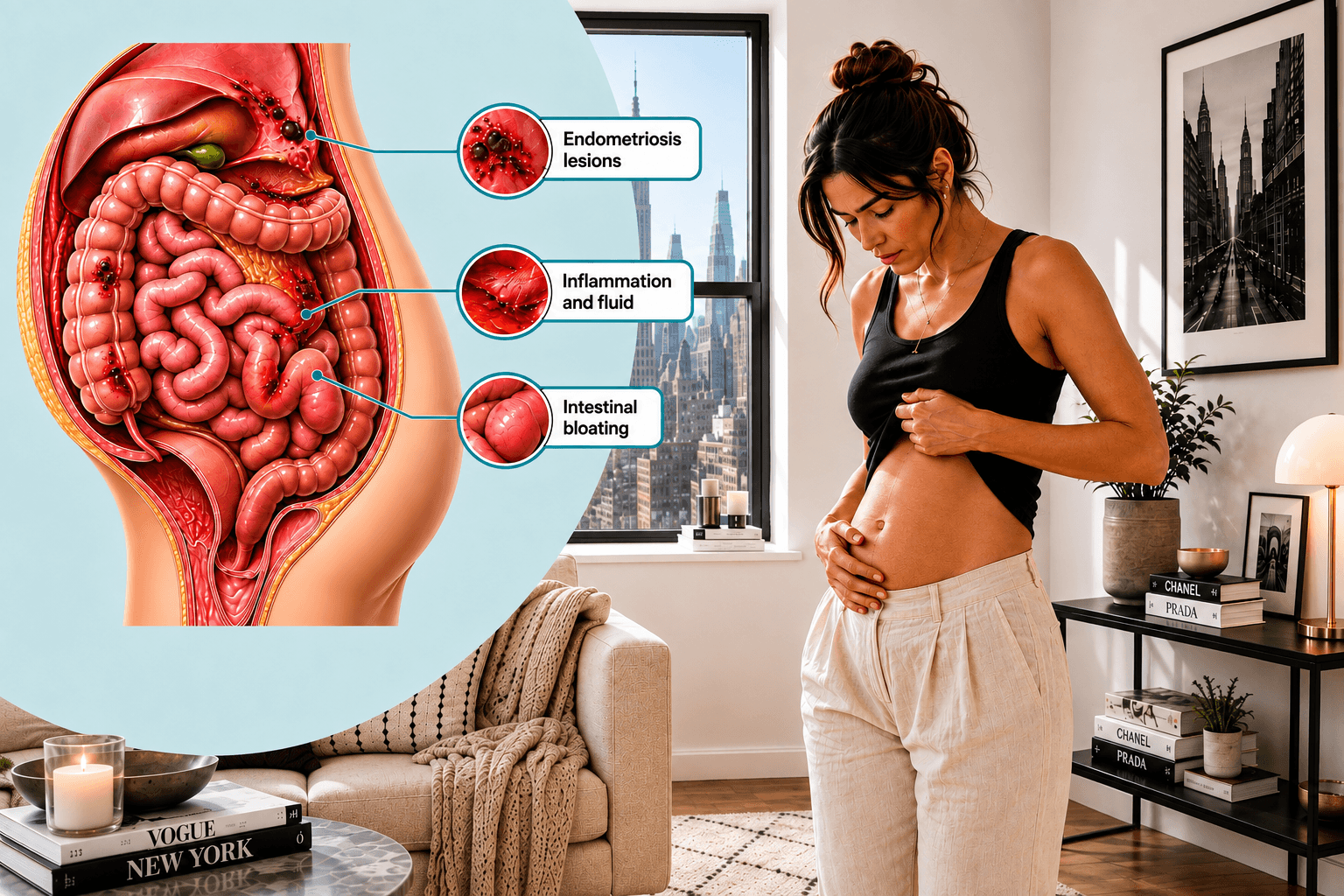
One day your abdomen may look relatively normal. Later that day, or around your period, it may become noticeably swollen, tight, and uncomfortable.
Many women with endometriosis describe this as “endo belly”.
Endo belly is not a formal medical diagnosis. It is a term commonly used to describe significant abdominal bloating or visible distension experienced by some women with endometriosis.
But why does it happen, and when could recurrent bloating be related to endometriosis?
Understanding Endo Belly
Endo belly can feel different from person to person. Some women primarily notice visible abdominal swelling, while others experience pressure, tightness, cramping, gas, nausea, or fullness.
It may occur alongside other endometriosis symptoms, including:
Painful periods
Pelvic pain
Constipation or diarrhea
Painful bowel movements
Pain during sex
Fatigue
Bloating describes the sensation of abdominal fullness or pressure, while distension refers to an actual visible increase in abdominal size. Some women experience both.
Importantly, the amount of bloating does not tell us how extensive endometriosis may be.
Why Endometriosis May Cause Bloating?
There is no single explanation for endo belly.
Endometriosis is associated with inflammation, pelvic pain, and gastrointestinal symptoms. Hormonal changes, constipation, altered bowel function, and increased gastrointestinal sensitivity may also contribute to bloating in some patients.
Other conditions can occur alongside endometriosis. A woman may have endometriosis as well as irritable bowel syndrome (IBS), constipation, or pelvic floor dysfunction.
This is why recurrent bloating should be considered as part of the complete symptom pattern, rather than treated as an isolated symptom.
The Connection Between Endo Belly and Your Period
One of the most useful clues may be when the bloating occurs.
Some women notice that abdominal swelling or gastrointestinal symptoms consistently become worse before or during menstruation. This may occur alongside painful periods, pelvic pain, constipation, diarrhea, or painful bowel movements.
However, endometriosis symptoms do not have to occur only during menstruation. Some women experience bloating throughout the menstrual cycle.
If symptoms are recurring, it may help to notice whether there is a consistent relationship between bloating, bowel symptoms, pelvic pain, and your period.
Does Endo Belly Mean You Have Bowel Endometriosis?
No.
Severe bloating, constipation, diarrhea, or painful bowel movements do not automatically mean that endometriosis involves the bowel.
Bowel endometriosis can cause gastrointestinal symptoms, particularly when the rectum or sigmoid colon is affected. However, similar symptoms can occur with endometriosis elsewhere in the pelvis or with gastrointestinal and pelvic floor conditions.
Even bowel symptoms that become worse around menstruation do not prove that endometriosis has affected the bowel.
Determining whether bowel endometriosis may be present requires appropriate clinical evaluation.
What Else Can Cause Severe Bloating?
Endometriosis is only one possible cause.
Constipation, IBS, food intolerances, medications, gastrointestinal conditions, and pelvic floor dysfunction can also contribute to abdominal bloating or distension.
There is therefore no single treatment for endo belly that works for everyone. Treatment depends on what is contributing to the symptoms.
New, persistent, or progressively worsening abdominal swelling should not automatically be attributed to endometriosis, even if you already have an endometriosis diagnosis.
When Bloating Deserves an Endometriosis Evaluation
Occasional bloating is common. But when bloating repeatedly worsens before or during your period, particularly alongside pelvic pain, painful periods, painful bowel movements, or pain during sex, it may be worth discussing with an endometriosis specialist.
At New York Gynecology Surgery & Endometriosis (NYGSE), we look at the complete pattern of a patient’s symptoms to determine whether endometriosis may be contributing and whether further evaluation is appropriate.
Ballard, K. D., Seaman, H. E., de Vries, C. S., & Wright, J. T. (2008). Can symptomatology help in the diagnosis of endometriosis? Findings from a national case-control study, Part 1. BJOG: An International Journal of Obstetrics & Gynaecology, 115(11), 1382–1391. https://doi.org/10.1111/j.1471-0528.2008.01878.x
Ek, M., Roth, B., Ekström, P., Valentin, L., Bengtsson, M., & Ohlsson, B. (2015). Gastrointestinal symptoms among endometriosis patients: A case-cohort study. BMC Women’s Health, 15, 59. https://doi.org/10.1186/s12905-015-0213-2
Maroun, P., Cooper, M. J. W., Reid, G. D., & Keirse, M. J. N. C. (2009). Relevance of gastrointestinal symptoms in endometriosis. Australian and New Zealand Journal of Obstetrics and Gynaecology, 49(4), 411–414. https://doi.org/10.1111/j.1479-828X.2009.01030.x
Simons, M., Cline, M., Gubbels, A., King, C., Lembo, A., & Lupe, S. (2024). Endometriosis is associated with higher healthcare utilization and upper gastrointestinal symptoms. Clinical Gastroenterology and Hepatology, 22(10), 2143–2146.e1. https://doi.org/10.1016/j.cgh.2024.03.005
Velho, R. V., Werner, F., & Mechsner, S. (2023). Endo belly: What is it and why does it happen? A narrative review. Journal of Clinical Medicine, 12(22), 7176. https://doi.org/10.3390/jcm12227176