If your endometriosis symptoms seem to worsen at certain times of the month, the pattern may be related in part to the hormonal and inflammatory changes that occur throughout the menstrual cycle.
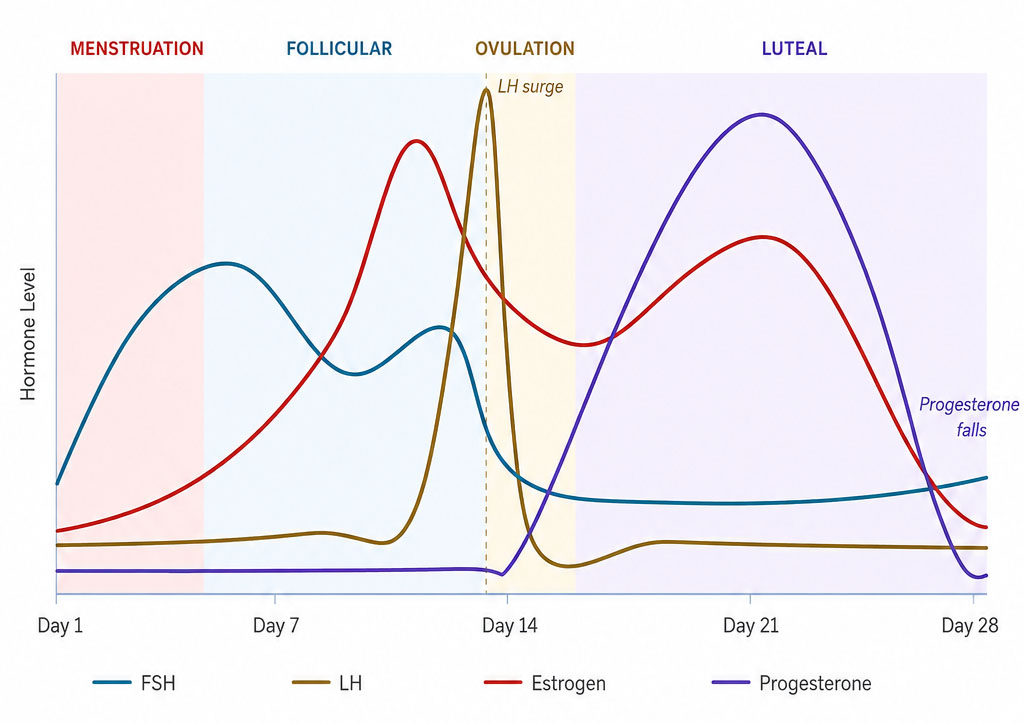
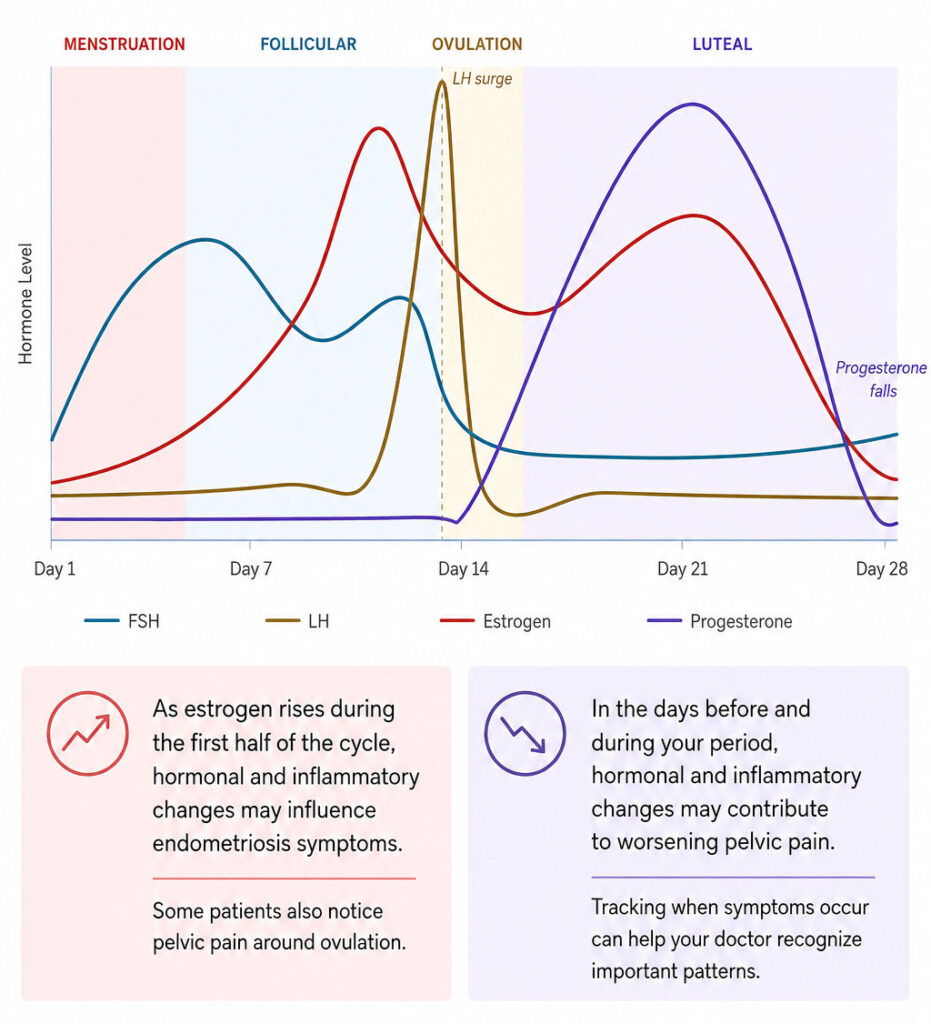
Estrogen, progesterone, follicle-stimulating hormone (FSH), and luteinizing hormone (LH) rise and fall at different points in the cycle. Because endometriosis is a hormone-responsive condition, these changes may influence symptoms, although the timing and severity of pain can vary considerably from person to person.
Some patients notice symptoms primarily around their period. Others experience pain around ovulation, between periods, or throughout much of the month.
How Hormones Change Throughout the Menstrual Cycle
During the first half of the cycle, known as the follicular phase, estrogen levels generally rise as an ovarian follicle develops. A surge in LH then triggers ovulation, when an egg is released from the ovary.
After ovulation, progesterone rises during the luteal phase. If pregnancy does not occur, estrogen and progesterone levels decline, and menstruation begins.
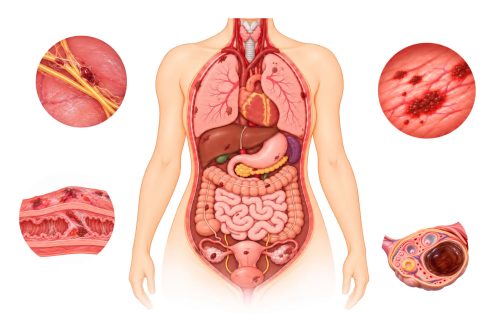
Endometriosis is influenced by estrogen, but hormones are only one part of the disease. Inflammation, the location of endometriosis lesions, adhesions, ovarian endometriomas, pelvic floor dysfunction, adenomyosis, and other conditions may also contribute to pelvic pain.
This is why two patients with endometriosis can experience very different symptoms even at the same point in their menstrual cycles.
Why Some Patients Have Pain Around Ovulation
Ovulation can cause temporary pelvic discomfort even in people without endometriosis. When an ovarian follicle releases an egg, a small amount of fluid or blood may irritate nearby tissues.
For someone who already has pelvic pain, endometriosis, an ovarian endometrioma, or adhesions, discomfort around ovulation may be more noticeable.
However, mid-cycle pain is not specific to endometriosis. Its timing is one piece of information that should be considered alongside the patient’s other symptoms and medical history.
Why Endometriosis Pain Often Worsens Around Your Period
Pain before and during menstruation is one of the most recognized symptoms of endometriosis.
During menstruation, the uterus contracts as it sheds its lining. Prostaglandins, substances involved in these contractions, also contribute to pain and inflammation. In someone with endometriosis, these processes can occur alongside inflammation and pain arising from disease elsewhere in the pelvis.
The result may be pelvic pain that begins before menstruation and becomes more intense during the period.
Painful periods alone do not necessarily mean you have endometriosis. But pain that is severe, worsening, or disruptive to normal activities deserves medical attention, particularly when accompanied by pain during sex, painful bowel movements, urinary symptoms, chronic pelvic pain, or difficulty becoming pregnant.
Endometriosis Does Not Always Follow a Predictable Pattern
Not everyone with endometriosis experiences symptoms at the same time each month.
Some patients have pain mainly during menstruation. Others experience symptoms before their period, around ovulation, or at other times of the month. Some have chronic pelvic pain that is not clearly tied to their menstrual cycle.
Hormonal treatment can also change these patterns by altering ovulation, menstruation, or hormone exposure.
For this reason, the timing of pain can provide useful information, but it cannot confirm or rule out endometriosis on its own.
Track the Pattern, Not Just the Pain
If you are experiencing recurring pelvic symptoms, keeping a symptom diary for several cycles may help.
Record when your period begins and when symptoms occur. Note pelvic pain, pain during sex, painful bowel movements or urination, bloating, and any other symptoms that seem to change with your cycle. It can also be useful to record how much the symptoms interfere with work, exercise, sleep, or other daily activities.
A symptom diary cannot diagnose endometriosis, but it can help your gynecologist see patterns that may otherwise be difficult to recognize during a single appointment.
When Your Symptoms Follow Your Cycle
Some menstrual discomfort is common. But when pelvic pain repeatedly worsens before or during your period, particularly alongside painful periods, painful bowel movements, pain during sex, or other recurring pelvic symptoms, it may be worth discussing with an endometriosis specialist.
At New York Gynecology Surgery & Endometriosis (NYGSE), we look at the complete pattern of a patient’s symptoms, including when they occur and how they affect daily life, to determine whether endometriosis may be contributing and whether further evaluation is appropriate.
Becker, C. M., Bokor, A., Heikinheimo, O., Horne, A., Jansen, F., Kiesel, L., King, K., Kvaskoff, M., Nap, A., Petersen, K., Saridogan, E., Tomassetti, C., van Hanegem, N., Vulliemoz, N., & Vermeulen, N. (2022). ESHRE guideline: Endometriosis. Human Reproduction Open, 2022(2), hoac009. https://doi.org/10.1093/hropen/hoac009
Reed, B. G., & Carr, B. R. (2018). The normal menstrual cycle and the control of ovulation. In K. R. Feingold et al. (Eds.), Endotext. MDText.com, Inc. https://www.ncbi.nlm.nih.gov/books/NBK279054/