If the phrase “kissing ovaries” appears in an ultrasound or MRI report, it can sound unusual and concerning. The term describes ovaries that are positioned unusually close together, typically behind the uterus.
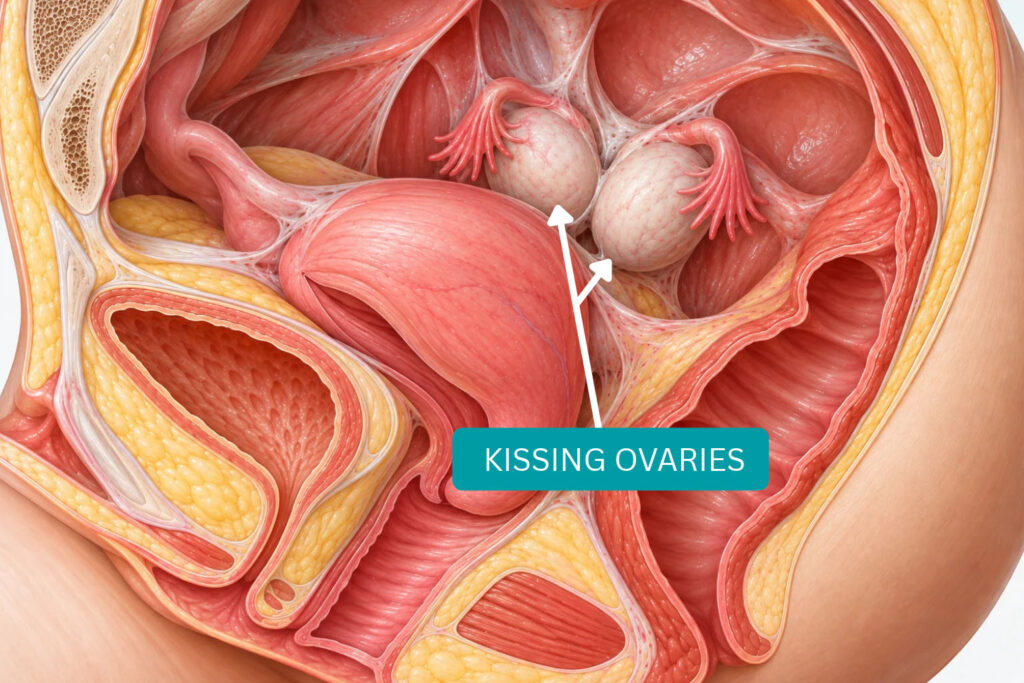
Normally, the ovaries are located on opposite sides of the uterus and have some degree of mobility within the pelvis. When adhesions restrict that movement, the ovaries can be pulled toward the midline until they appear to touch or “kiss”.
Kissing ovaries are particularly associated with endometriosis and pelvic adhesions, although the finding alone does not establish a diagnosis. [2]
Medical illustration of kissing ovaries (posterior-oblique sagittal view): Both ovaries are pulled toward the midline behind the uterus.
What Are Kissing Ovaries?
Kissing ovaries describe a pelvic imaging finding in which the right and left ovaries are positioned next to one another, usually behind the uterus in the posterior pelvis. [2]
This abnormal position can occur when adhesions bind the ovaries to each other or to nearby structures.
Instead of moving relatively freely on opposite sides of the uterus, one or both ovaries may become fixed in an abnormal position.
For a doctor evaluating suspected endometriosis, this change in pelvic anatomy can provide useful information because kissing ovaries have been associated with more extensive pelvic endometriosis and adhesive disease.[2]
Kissing Ovaries Associated With Endometriosis
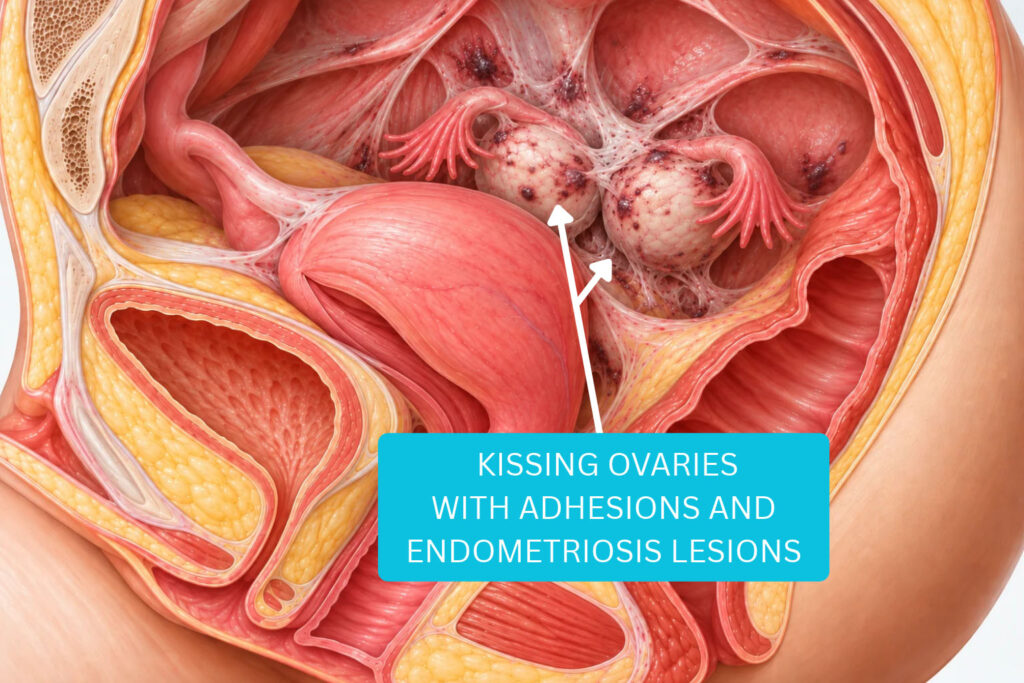
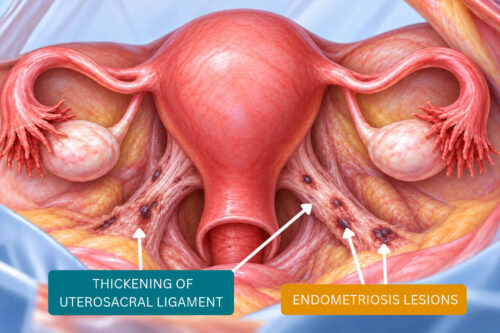
Endometriosis can cause inflammation, fibrosis, and adhesions within the pelvis. Adhesions can restrict normal ovarian mobility and change the position of pelvic structures. [1][3]
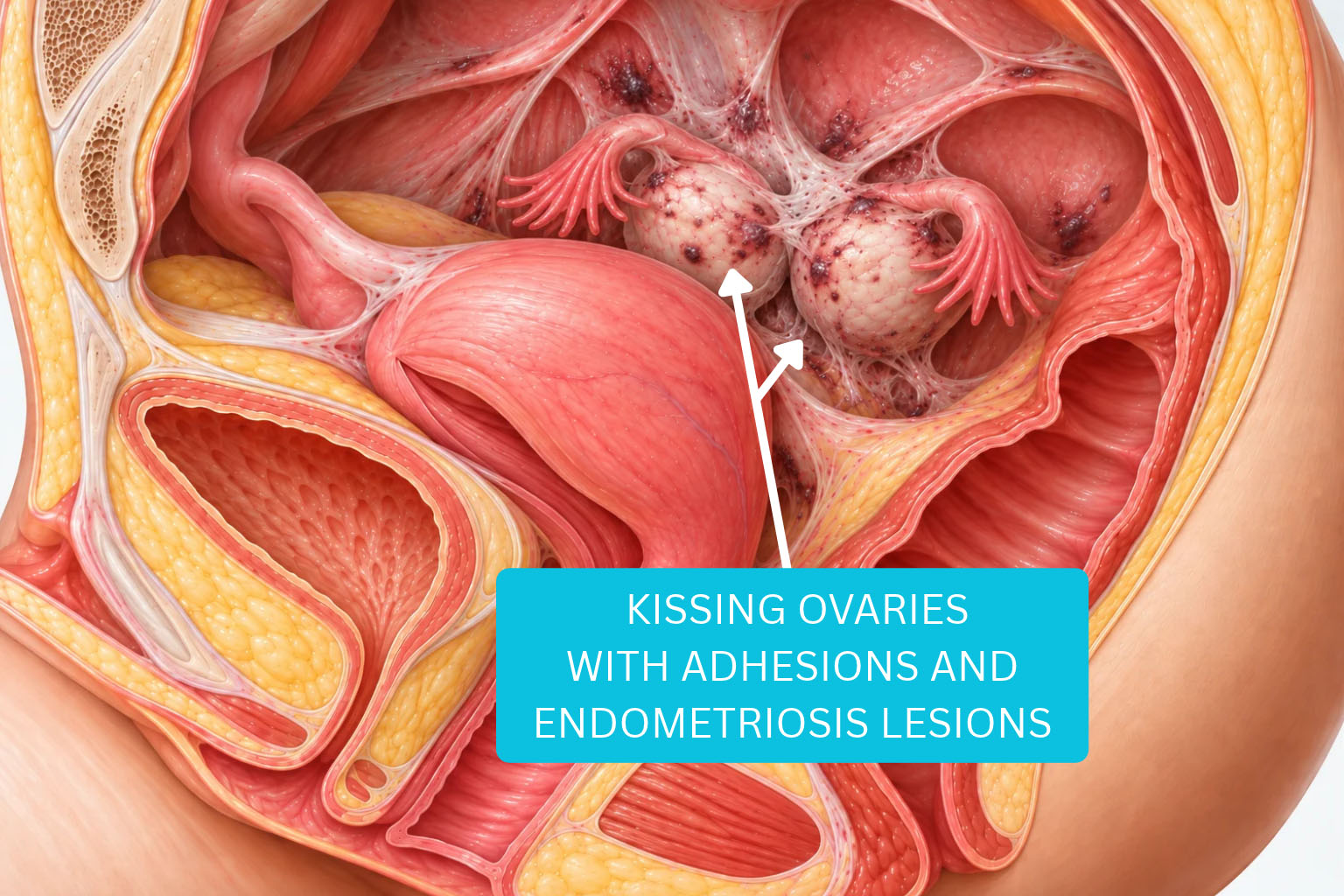
When endometriosis and adhesions involve the ovaries and surrounding tissues, the ovaries may become pulled toward the center of the pelvis and fixed behind the uterus.
This can create the kissing ovaries appearance.
The finding has been associated with more extensive pelvic endometriosis and adhesive disease. However, kissing ovaries should be interpreted together with the patient’s symptoms, medical history, and other imaging findings.
Medical illustration of kissing ovaries (posterior-oblique sagittal view): Both ovaries are pulled toward the midline behind the uterus, where endometriosis and fibrotic adhesions can cause them to become closely apposed
Kissing Ovaries on Ultrasound or MRI
On ultrasound, both ovaries may appear unusually close together behind the uterus rather than in their expected positions on either side.[2]
During a specialized pelvic ultrasound, ovarian mobility may also be assessed. An ovary that does not move freely may suggest adhesions. [3]
Ultrasound may also identify ovarian endometriomas and certain forms of deep endometriosis. MRI can provide additional information about the location and extent of disease. [1][4]
Neither ultrasound nor MRI, however, identifies every form of endometriosis. Normal imaging does not completely exclude the disease. [1][4]
Do Kissing Ovaries Mean You Have Endometriosis?
Not necessarily.
Kissing ovaries are associated with endometriosis, but they are not a diagnosis by themselves. [2] Pelvic adhesions can also develop after pelvic surgery, infection, or other inflammatory conditions.
Symptoms also provide important context. These may include painful periods, chronic pelvic pain, pain during sex, painful bowel movements, or difficulty becoming pregnant.
Kissing Ovaries and Infertility
Kissing ovaries do not automatically mean that a patient will have difficulty becoming pregnant. However, the underlying endometriosis or adhesions responsible for the finding may affect ovarian and fallopian tube anatomy. Some patients may also have ovarian endometriomas or other factors that influence fertility. [1]
For patients trying to become pregnant, fertility assessment should consider the complete clinical picture rather than the position of the ovaries alone.
Do Kissing Ovaries Need Surgery?
Not necessarily.
An imaging finding alone is not a reason for surgery. Treatment depends on symptoms, the suspected extent of disease, fertility goals, previous treatment, imaging findings, and the patient’s individual circumstances. [1][4]
For some patients, medical management or observation may be appropriate. For others with significant pain, infertility concerns, endometriomas, or complex adhesive disease, surgical evaluation may be considered.
When Kissing Ovaries Deserve Further Evaluation
Kissing ovaries can be an important clue that adhesions have altered normal pelvic anatomy.
When the finding occurs alongside pelvic pain, painful periods, painful bowel movements, infertility, endometriomas, or other signs of endometriosis, further evaluation may be appropriate.
At New York Gynecology Surgery & Endometriosis (NYGSE), we consider the complete pattern of symptoms and imaging findings to determine whether endometriosis may be contributing and what further evaluation or treatment may be appropriate.
Becker, C. M., Bokor, A., Heikinheimo, O., Horne, A., Jansen, F., Kiesel, L., King, K., Kvaskoff, M., Nap, A., Petersen, K., Saridogan, E., Tomassetti, C., van Hanegem, N., Vulliemoz, N., & Vermeulen, N. (2022). ESHRE guideline: Endometriosis. Human Reproduction Open, 2022(2), hoac009. https://doi.org/10.1093/hropen/hoac009
Ghezzi, F., Raio, L., Cromi, A., Duwe, D. G., Beretta, P., Buttarelli, M., & Mueller, M. D. (2005). “Kissing ovaries”: A sonographic sign of moderate to severe endometriosis. Fertility and Sterility, 83(1), 143–147. https://doi.org/10.1016/j.fertnstert.2004.05.094
Guerriero, S., et al. (2016). Systematic approach to sonographic evaluation of the pelvis in women with suspected endometriosis, including terms, definitions and measurements: A consensus opinion from the International Deep Endometriosis Analysis (IDEA) group. Ultrasound in Obstetrics & Gynecology, 48(3), 318–332. https://doi.org/10.1002/uog.15955
National Institute for Health and Care Excellence. (2024). Endometriosis: Diagnosis and management (NICE Guideline NG73).https://www.nice.org.uk/guidance/ng73